Fix Your Grip: Why Your Grip Is Sabotaging Your Throw (And How to Fix It)
Most horseshoe players blame their misses on timing, bad luck, or “just being off today.”
Almost nobody blames their grip.
That’s a mistake.
Your grip is the first decision you make on every pitch—and the one decision that quietly affects everything else: your release, your rotation, your arc, and your consistency when the pressure’s on. The problem is, grip mistakes don’t always feel wrong. In fact, some of them feel comfortable… right up until they cap your progress.
If you’ve ever thought:
- “Some days I can’t miss, other days I can’t hit anything”
- “My release feels fine, but the shoe does something weird”
- “I haven’t changed anything, but my accuracy dropped”
There’s a good chance your grip is the culprit.
Let’s fix it—without tearing down your entire throw.
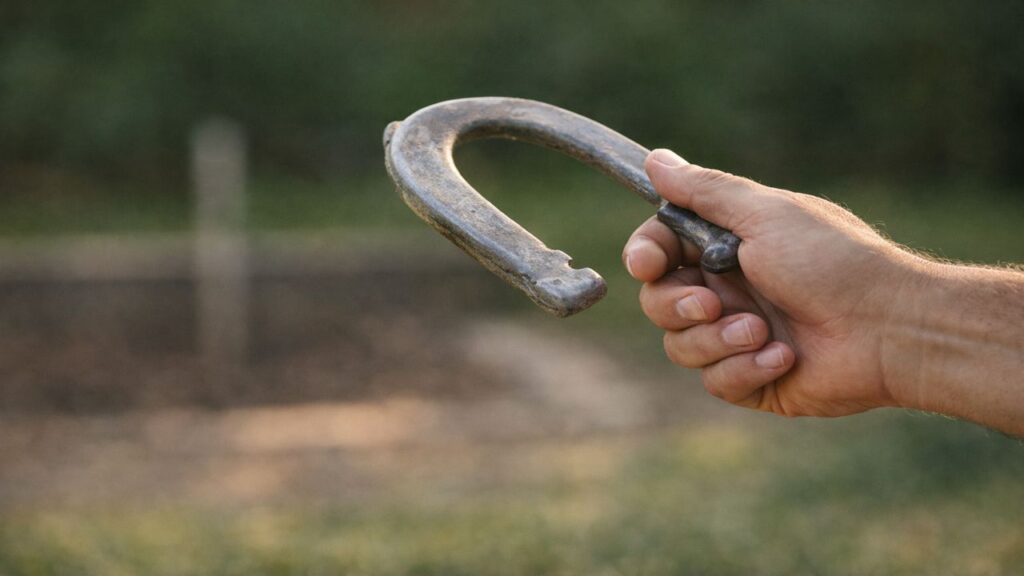
What a Horseshoe Grip Is Actually Supposed to Do
A lot of players think the grip’s job is to hold onto the shoe.
It’s not.
A good grip has three jobs:
- Control the shoe without tension
- Allow a clean, repeatable release
- Let the horseshoe rotate naturally
That’s it.
Your grip is not supposed to steer the shoe, force rotation, or compensate for other mechanical issues. When it does, it creates inconsistency—even if you still hit the occasional ringer.
The best grips are boring. They don’t look dramatic. They don’t change much. And they don’t feel “strong.” They feel repeatable.
Signs Your Grip Is Hurting Your Game (Even If You’re Still Hitting Some Ringers)
Grip problems rarely show up as total failure. They show up as unreliable.
Here are the warning signs most players ignore:
- Your horseshoe rotates cleanly one pitch, then wobbles the next
- You hit ringers early, then fade late in the game
- Your misses don’t have a pattern—they’re everywhere
- Your hand feels tired or tight by the second game
- You constantly “re-set” your grip without realizing it
If any of that sounds familiar, your grip isn’t broken—but it is unstable.
The 5 Most Common Grip Mistakes (And Why They’re So Hard to Spot)
1. The Death Grip
This is the most common problem by far.
Players squeeze the shoe because it feels secure. Under pressure, they squeeze even harder. Unfortunately, tension delays release and kills consistency.
A death grip usually causes:
- Late release
- Flat shoes
- Long misses
If your forearm tightens before you pitch, you’re gripping too hard.
2. Thumb Overuse
Your thumb should support, not control.
When the thumb presses too aggressively, it introduces side roll and directional misses. Many players who miss left or right consistently are unknowingly steering the shoe with their thumb.
If your thumb feels “active,” it probably is—and that’s not good.
3. Finger Creep
Finger creep is when your grip slowly changes as the game goes on.
Pressure increases, fatigue sets in, and suddenly your fingers slide a quarter inch without you noticing. That tiny shift is enough to change rotation and release timing.
This is why players say, “I didn’t change anything,” even though something clearly changed.
4. Choking Up Too Far
Gripping too high on the shoe reduces leverage and encourages flat, weak pitches.
It often feels controlled, but it limits arc and makes it harder to maintain consistent rotation—especially at regulation distance.
5. Constant Grip Tweaking
Some players adjust their grip after every miss.
That’s not fixing the problem—that’s chasing it.
Grip adjustments should be deliberate and tested, not reactive. If you’re constantly changing finger placement mid-game, your grip never stabilizes long enough to work.
Finding Your Natural Grip (Without Copying Anyone Else)
Here’s the truth most players don’t want to hear:
Someone else’s grip probably won’t work for you.
Hand size, finger length, flexibility, and comfort all matter. The goal isn’t to copy a grip—it’s to find a neutral starting point you can repeat.
Simple baseline grip test:
- Hold the horseshoe loosely in your pitching hand
- Let your fingers settle naturally along the side
- Avoid squeezing—just support the weight
- That relaxed position is your baseline
From there, you don’t redesign your grip—you refine it.
The 2-Minute Grip Consistency Test
This test exposes grip problems fast.
- Pitch 10 shoes without looking at your hand
- After each pitch, freeze your grip and look at finger placement
- Compare where your fingers actually are vs where you think they are
If finger placement shifts, even slightly, your grip isn’t locked in yet.
That doesn’t mean it’s bad—it means it needs training.
Grip Drills That Actually Work
No gimmicks. No nonsense.
Drill 1: Dry Grip Reps (No Pit Needed)
- Hold the horseshoe in your pitching hand
- Set your grip
- Relax your hand
- Reset it again
Do this 20–30 times a day. You’re training muscle memory without fatigue.
Drill 2: One-Shoe Grip Drill
Pitch only one horseshoe at a time.
This forces you to reset your grip every pitch and removes mindless repetition. You’ll feel inconsistencies immediately.
Drill 3: Closed-Eye Grip Check
Set your grip with your eyes closed, then open them.
If your fingers land each time differently, your grip isn’t as natural as you think.
Drill 4: Grip Reset Between Pitches
Before every pitch:
- Relax your hand
- Re-establish your grip
- Pitch
This habit pays off under pressure.
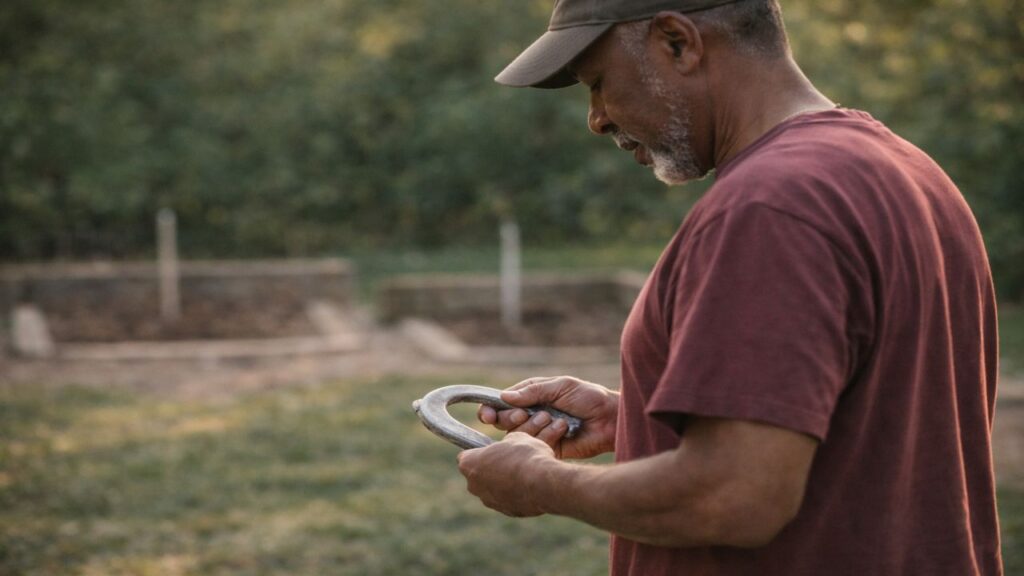
Adjusting Your Grip Without Wrecking Your Throw
Big grip changes fail. Every time.
Use the 10% rule:
- Change pressure slightly, not finger placement
- Test over multiple sessions
- Never judge after one game
If you change too much at once, you won’t know what worked—or why.
Grip, Weather, and Real-World Conditions
- Cold weather: Players over-grip without realizing it
- Heat & humidity: Slick shoes encourage squeezing
- Sweaty hands: Dry your hands—don’t clamp down
Tension is the enemy, not the environment.
Grip Fatigue and Aging Hands
Here’s some good news for older players:
You don’t need strength to grip a horseshoe well.
In fact, many senior players improve accuracy by loosening their grip and trusting their mechanics. Relaxation often replaces force, and consistency improves.
Aging hands don’t end good pitching. Over-gripping does.
Equipment That Affects Grip Feel (Choose One, Rotate Later)
For this article, focus on balanced, textured horseshoes that don’t force you to squeeze for control.
A solid example is the St. Pierre American Professional Series—known for consistent weight distribution and surface feel that promotes relaxed control.
The key isn’t the brand. It’s how confident you feel holding the shoe without tension.
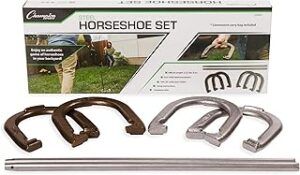
Horseshoe Game Set
How Grip Problems Show Up in Miss Patterns
- Left/right misses: Thumb pressure or uneven finger balance
- Short shoes: Choking up or death grip
- Flat dead drops: Over-control at release
- Leaners instead of ringers: Inconsistent rotation
These patterns matter—and they’ll come back in a big way in Fix Your Miss later in the series.
When Not to Fix Your Grip
Don’t change your grip:
- Mid-match
- After one bad pitch
- Because someone else is pitching well
- When frustration is the real issue
Grip fixes belong in practice, not panic.
Frequently Asked Questions
How tight should I grip a horseshoe?
Tight enough to control it, loose enough to let it leave cleanly.
Should my grip change with different horseshoes?
Only pressure—not finger placement.
Why does my grip feel different late in games?
Fatigue and tension, not loss of skill.
Can grip issues cause side roll?
Absolutely. Thumb and finger imbalance are common causes.
How long does it take to fix a grip problem?
Weeks, not days—if done correctly.
Grip Is the Beginning—Not the Fix
Your grip won’t magically make you a great horseshoe player.
But if it’s wrong—or inconsistent—it will quietly limit everything else you try to improve.
Fixing your grip doesn’t mean squeezing harder or copying someone else. It means relaxing, repeating, and trusting a grip that works with your throw instead of fighting it.
This is where consistency starts.
This shop is my clubhouse for fellow players. You’ll find mugs, shirts, and pit gear to keep games fair, trash talk fun, and ringers flying — whether you’re building your first court or running a league.