Backyard games are more than just entertainment. They shape how families gather, how neighbors connect, and how traditions are built over time. Some games are trendy for a season. Others quietly become permanent fixtures — pulled out year after year because they continue to deliver.
If you’re choosing a lawn game for your yard, the real question isn’t which one is popular right now. It’s which one holds attention long term? Which one grows with your family? Which one provides both fun and depth?
Horseshoes have been around for generations, yet it still competes with modern favorites like cornhole, bocce ball, croquet, and ladder toss. So how does it really compare?
Let’s break it down honestly.
Horseshoes vs Cornhole
Cornhole is everywhere. It’s portable, simple to understand, and accessible for almost anyone within minutes. That ease of entry makes it appealing for casual gatherings and large events.
However, simplicity also limits long-term growth. The mechanics of cornhole are relatively straightforward. Once players establish a consistent toss, improvement often levels off. Strategy exists — blocking or sliding bags — but the physical refinement remains limited.
Horseshoes demand more precision and repetition.
The weight of steel requires a controlled grip and consistent release. The throwing distance is longer. Arc matters. Rotation matters. Players can track ringer percentage and pursue gradual improvement over months and years.
Cornhole works extremely well for quick social play.
Horseshoes offers deeper skill development that keeps competitive players engaged far longer.
Horseshoes vs Bocce Ball
Bocce ball excels in relaxed environments. It’s low-impact and heavily strategic, making it especially popular among older adults.
But bocce focuses more on placement than repetition.
Once a ball is rolled, the physical motion is complete. The rest of the frame revolves around positioning and scoring. While that strategic element is valuable, it doesn’t create the same level of mechanical refinement over time.
Horseshoes blends mechanics and strategy.
Each throw requires repeatable form. At the same time, players must decide whether to chase a ringer or throw defensively. That combination keeps both body and mind engaged.
Bocce encourages social pacing.
Horseshoes encourage measurable progression.

Horseshoes vs Croquet
Croquet brings tradition and charm. It feels classic and structured. However, it also requires more equipment and maintenance than many realize. Wickets must be aligned, the surface should be relatively level, and equipment can wear down over time.
Horseshoes are simpler once installed.
Two stakes, properly spaced pits, and a reliable set of shoes are all that’s needed. The setup becomes part of the yard rather than something that must be assembled each time.
Croquet tends to move slowly and methodically. That pace works for some groups, but competitive personalities may eventually crave more direct head-to-head rhythm.
Horseshoes provides that rhythm — throw, retrieve, reset — without feeling rushed.
Horseshoes vs Ladder Toss
Ladder toss is portable and colorful, making it ideal for parties and quick outdoor fun. Setup takes minutes, and anyone can participate.
However, it functions primarily as a novelty game. The mechanical skill ceiling is limited, and long-term development is minimal.
Horseshoes offer significantly greater depth.
Players refine grip, stance, arc, and release over time. Ringer percentage creates measurable goals. Defensive placement introduces strategic nuance.
Ladder toss entertains for a day.
Horseshoes sustains engagement for years.
Physical Activity Comparison
When comparing lawn classics, it’s worth examining physical benefits.
Cornhole and ladder toss require short throws and limited movement. Bocce involves steady walking but minimal upper-body engagement. Croquet offers light walking and swinging.
Horseshoes engage multiple muscle groups while remaining low-impact.
Players walk the court distance between frames. They bend to retrieve shoes. They engage shoulders, forearms, core, and stabilizing muscles during each controlled pitch. Balance and weight transfer play critical roles in proper form.
For retirees, especially, that combination of manageable exertion and coordination training is valuable.
It keeps the body active without overwhelming it.

Competitive Ceiling and Long-Term Value
Most backyard games reach a plateau fairly quickly. Once players master the basics, improvement slows.
Horseshoes continue to reward refinement.
A beginner might start at a 15% ringer rate. With consistent practice, that can rise to 30%. More dedicated players pursue 40% and beyond. League competitors aim even higher.
The ability to measure progress through ringers percentage creates lasting motivation.
Few lawn games offer that kind of structured advancement.
Equipment Durability
Durability matters in backyard investments.
Cornhole boards can warp over time. Bags wear out. Croquet mallets splinter. Ladder toss ropes stretch. Bocce balls chip.
A quality forged steel horseshoe set, however, can last decades. The Franklin Sports Professional Horseshoe Set provides regulation-weight steel shoes and solid stakes designed for repeated backyard play. Durable equipment reduces replacement costs and increases long-term usage.
Once a horseshoe pit is installed, maintenance is minimal compared to other lawn games.
It becomes part of the landscape.
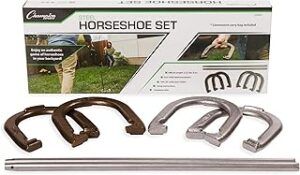
Horseshoe Game Sets
Space Requirements
Horseshoes do require space. A regulation court spans 40 feet between stakes. Not every yard accommodates that distance.
Portable games like cornhole and ladder toss adapt more easily to smaller areas.
However, when space allows for proper installation, a permanent horseshoe pit often increases engagement. The dedicated space invites consistent play.
Commitment encourages usage.
Frequently Asked Questions
Which backyard game is best for seniors?
Horseshoes and bocce are both strong options. Horseshoes offers greater measurable skill progression while remaining low-impact and adaptable.
Is horseshoes harder to learn than cornhole?
It requires more mechanical refinement, but beginners can start immediately. Mastery develops over time, which adds long-term interest.
Do horseshoes require a large yard?
A regulation court requires 40 feet between stakes. Some players adjust the distance slightly for casual play while maintaining safety.
Which lawn game has the highest competitive depth?
Horseshoes generally provide the highest long-term skill ceiling due to ringer percentage tracking and mechanical refinement.
Are horseshoes expensive to set up?
After the initial purchase of a durable forged steel set and stakes, ongoing costs are minimal compared to many other backyard games.
The Backyard Game That Stays Relevant
Backyard classics come and go in waves. Some trends heavily for a few years before fading. Others quietly endure because they deliver something deeper than novelty.
Horseshoes continues to thrive because it balances simplicity and depth. It provides measurable improvement without overwhelming complexity. It works for kids, adults, and retirees alike. It rewards patience and consistency.
If you’re choosing a lawn game that grows with your family rather than being replaced next season, horseshoes remains one of the strongest long-term investments you can make in your backyard.
Not because it’s trendy.
Because it endures.