Why Horseshoes Is the Perfect Retirement Hobby
Retirement is often described as the reward for decades of hard work. The alarm clock disappears. The schedule opens up. The daily pressures ease. For many people, that freedom feels incredible at first.
But after the initial adjustment, something unexpected can happen.
Without structure, days start to blur together. Physical activity may decrease. Social interaction can quietly shrink. The competitive spark that once fueled motivation fades. What sounded like unlimited relaxation can begin to feel like a lack of direction.
That’s why choosing the right retirement hobby matters more than most people realize.
The ideal retirement activity should keep you moving without straining your body, keep your mind engaged without overwhelming you, and keep you connected without forcing social pressure. It should be affordable, sustainable, and adaptable as the years go by.
Horseshoes checks every one of those boxes.
On the surface, it may look like a simple backyard game. But underneath that simplicity is a hobby uniquely suited to the retirement years — physically, mentally, and socially.
Let’s take a closer look at why.
Sustainable Physical Activity Without Joint Punishment
One of the biggest health priorities in retirement is staying physically active in a way that can be maintained long term. High-impact sports become less appealing as joints stiffen and recovery takes longer. Running on pavement, intense gym sessions, or pickup basketball games can create more soreness than satisfaction.
Horseshoes offer movement without impact.
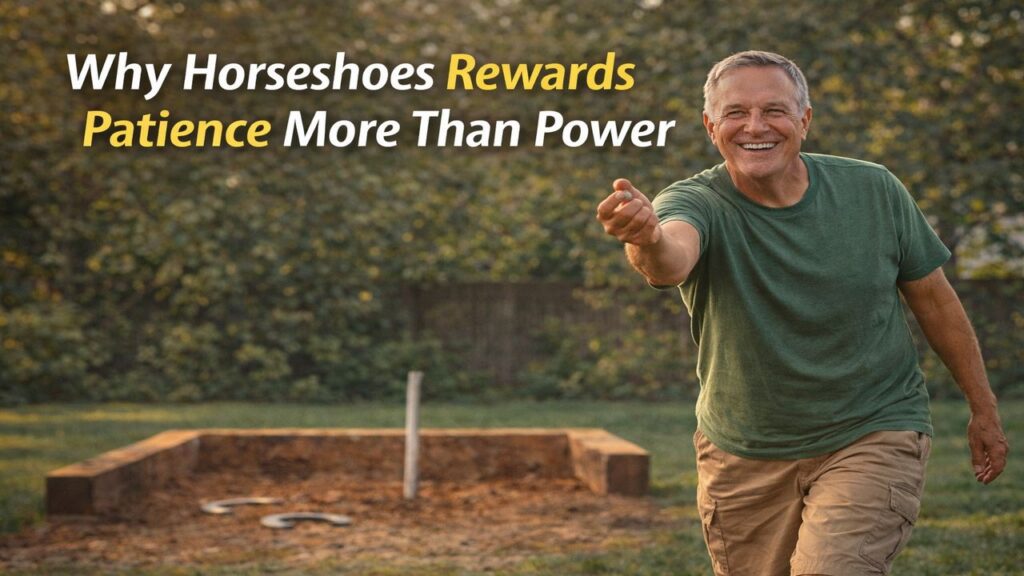
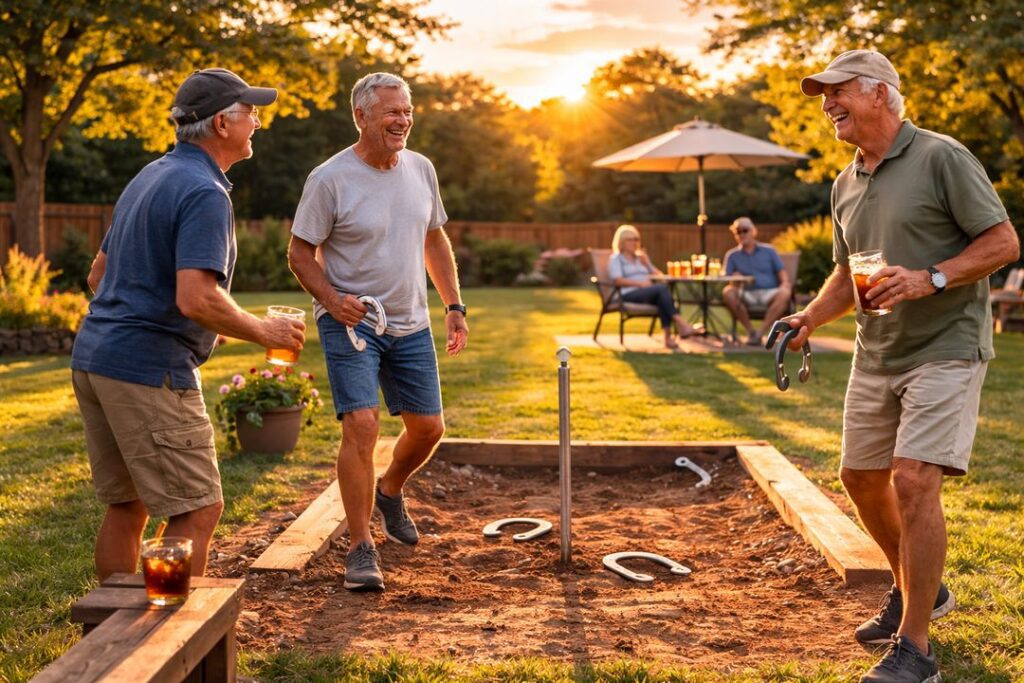
Each game involves walking between pits, bending to retrieve shoes, and engaging the shoulders and forearms in a controlled throwing motion. The movement is deliberate rather than explosive. You’re not sprinting or jumping. You’re transferring weight smoothly and repeating a balanced motion.
That controlled repetition strengthens:
- Shoulder stability
- Forearm and grip strength
- Core engagement
- Balance and coordination
Balance becomes increasingly important with age. Falls are a major health concern for retirees, and maintaining stabilizing muscle strength plays a key role in prevention. The steady stance and weight shift required in pitching help maintain that stability.
Even the simple routine of walking back and forth during a match promotes circulation and light cardiovascular engagement. It’s moderate activity — not exhausting, not punishing — but consistent enough to matter.
Best of all, intensity is adjustable. You control the pace. You control session length. You control frequency.
That kind of flexibility makes horseshoes sustainable year after year.
A Mental Challenge That Keeps the Brain Sharp
Physical movement is only part of healthy aging. Mental engagement is just as important.
Many retirees find that once structured work life ends, the daily problem-solving and decision-making that kept their minds sharp decreases. Passive routines — television, scrolling, idle conversation — don’t provide the same stimulation.
Horseshoes require thinking.
Every frame demands decisions. Do you go for a ringer or place a blocker? Do you cancel out your opponent’s shoe or defend your advantage? How is the pit reacting today? Is the clay softer than usual? Is there a breeze affecting the arc?
You’re constantly evaluating conditions and adjusting accordingly.
The blend of repetition and strategy activates both physical and cognitive systems. You’re calculating percentages in your head. You’re recognizing patterns in your opponent’s throws. You’re managing tempo and emotional control.
This kind of mental engagement is subtle but powerful. It’s not overwhelming. It doesn’t feel like work. But it challenges you enough to stay sharp.
And because no two games unfold the same way, the learning never stops.
Structure Without Pressure
One unexpected challenge of retirement is the loss of rhythm. Workdays once provided a natural structure. There were responsibilities, goals, deadlines, and performance measures. Without them, it’s easy for weeks to drift by.
Horseshoes reintroduces structure — but without stress.
A weekly league night gives you something to prepare for. A Saturday morning practice session provides a goal. Tracking your ringer percentage creates measurable progress.
The difference is that this structure is chosen, not imposed.
You’re not reporting to a boss. You’re not managing deadlines. You’re pursuing improvement for yourself.
That sense of forward movement can be incredibly motivating. Instead of asking, “How do I fill today?” you’re thinking, “How can I improve this week?”
Purpose doesn’t have to be grand. Sometimes it’s as simple as refining your release or shaving five percentage points off your average.
Healthy Competition Keeps Motivation Alive
Retirement doesn’t eliminate competitive instinct. For many people, that instinct fueled decades of career growth, problem-solving, and goal achievement. Once it disappears, something feels missing.
Horseshoes restores that edge in a healthy, manageable way.
Competition in this sport isn’t about brute strength or raw athleticism. It’s about control, consistency, and composure. That makes it uniquely fair across age ranges.
Tracking your ringer percentage creates tangible progress. Watching it climb from 20% to 30% over several months provides visible proof of improvement. Competing against friends keeps sessions lively without becoming hostile.
The competitive element keeps you engaged. It gives you something to strive for. It turns practice into a pursuit rather than repetition.
And because the game rewards calm precision over speed, experience becomes an advantage rather than a liability.
Social Connection That Feels Natural
Social isolation can quietly become one of retirement’s biggest risks. Without daily workplace interaction, opportunities for regular conversation decrease.
Horseshoes creates natural social structure.
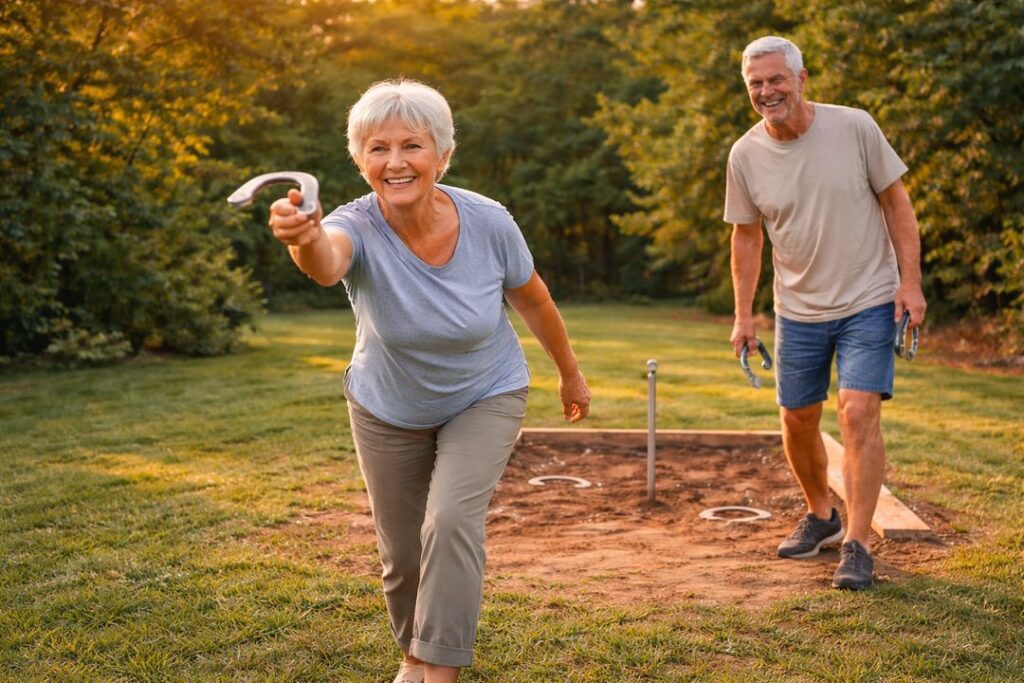
The game encourages conversation between throws. There’s laughter, light teasing, discussion of strategy, and shared stories. It’s social without being forced. You’re gathered for a purpose — and that purpose makes interaction easier.
League nights often become weekly highlights. Backyard matches bring neighbors together. Friendly rivalries build camaraderie.
The game is inclusive enough for varying skill levels, which makes it accessible for spouses, friends, and even grandchildren. That multigenerational aspect adds depth that many hobbies lack.
Few activities create such an easy blend of competition and connection.
Affordable and Long-Lasting
Many retirement hobbies require continuous spending — memberships, equipment upgrades, travel expenses. Horseshoes remains refreshingly simple.
A quality forged steel set, properly balanced and regulation weight, can last for years with minimal maintenance. The St. Pierre American Professional Series Horseshoe Set is a strong example. Forged for durability and designed with balanced geometry, it provides predictable rotation and long-term reliability for backyard and league play alike.
Once you have a solid set and properly placed stakes, your ongoing costs are minimal. There are no monthly dues required unless you choose to join a league. There’s no pressure to upgrade constantly.
It’s a one-time investment in years of play.
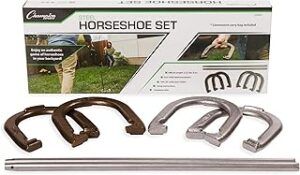
Horseshoe Game Sets
Adaptable as the Years Go On
One of the most powerful aspects of horseshoes is how it scales with you.
If your shoulder needs rest, you shorten sessions. If stamina dips, you play fewer frames. If you’re feeling strong, you extend practice. The game adapts to your condition.
Unlike sports that demand peak performance or rapid reaction time, horseshoes rewards calm repetition and mechanical discipline. Those qualities often improve with age.
Many retirees find that while raw strength may decrease slightly, strategic understanding deepens. Reading opponents becomes sharper. Emotional control becomes steadier.
In horseshoes, experience is an asset.
That makes it one of the rare hobbies you truly don’t age out of.
A Bridge Between Generations
Retirement often shifts focus toward family. Finding activities that connect generations can be challenging.
Horseshoes make that easy.
Grandchildren can learn the basics quickly. Adult children can compete seriously. Backyard tournaments during family gatherings become traditions. Stories form around close matches and surprising upsets.
It becomes more than exercise or competition — it becomes shared history.
Very few hobbies remain accessible across decades of age difference. Horseshoes do.
Real Health Benefits Add Up
Let’s step back and look at the combined effect:
- Moderate physical activity
- Balance and coordination training
- Shoulder and grip strengthening
- Strategic thinking
- Social engagement
- Outdoor exposure
- Stress reduction
Individually, each benefit matters. Combined, they create a powerful formula for healthy retirement living.
The beauty is that it doesn’t feel like a health program. It feels like a game.
And games are sustainable.
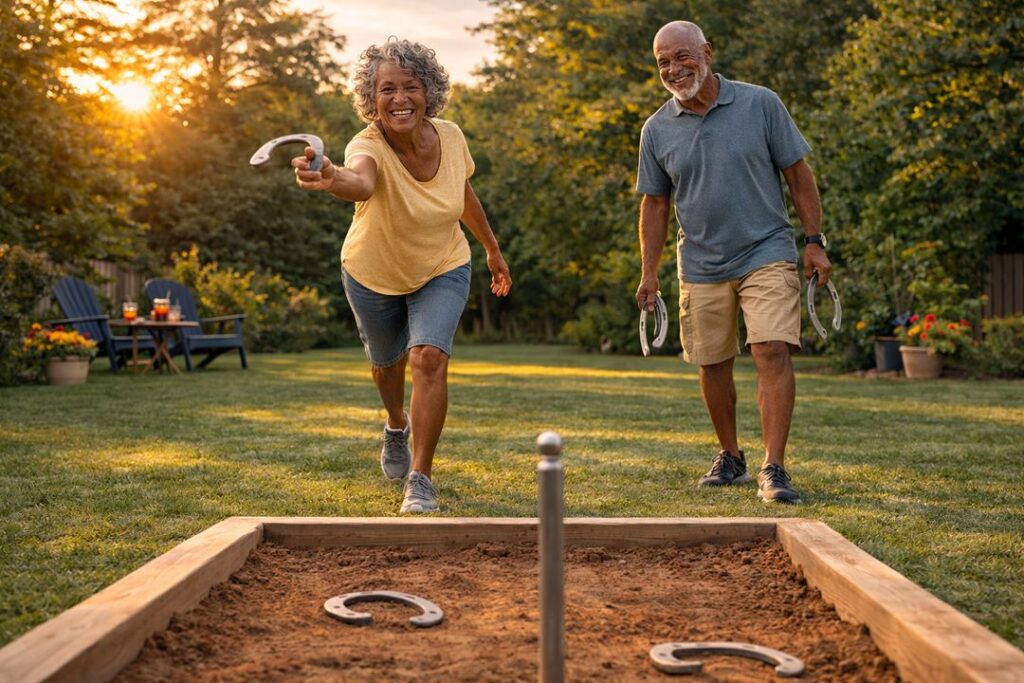
Frequently Asked Questions About Horseshoes in Retirement
Is horseshoeing a good hobby for retirees?
Yes. It combines low-impact physical activity with mental engagement and social interaction. It’s adaptable to various fitness levels and does not require intense athletic performance.
Are horseshoes safe for seniors?
When played with proper spacing and controlled form, horseshoes is generally very safe. Players can control pace and session length, making it manageable for most retirees.
How much space is required?
A regulation court requires 40 feet between stakes, but casual play can be adjusted slightly shorter if needed, provided safety and clear throwing lanes are maintained.
What equipment should retirees start with?
A regulation-weight forged steel set provides durability and predictable performance. Sets like the St. Pierre American Professional Series are well-suited for long-term backyard or league use.
Can someone start playing in their 60s or 70s?
Absolutely. Many players begin in retirement and become highly skilled within a few years. The sport rewards consistency and control more than raw power.
Do horseshoes really provide health benefits?
Yes. Regular play supports coordination, balance, light cardiovascular activity, cognitive engagement, and social connection — all important components of healthy aging.
Retirement Should Be Active, Not Idle
Retirement isn’t meant to shrink your world. It’s meant to give you the freedom to shape it intentionally.
The best hobbies don’t just fill time — they create energy. They get you outside. They keep your mind alert. They give you a reason to gather with others. They offer measurable progress without unnecessary stress.
Horseshoes does all of that with remarkable simplicity.
It provides motion without punishment. Competition without pressure. Community without obligation. Improvement without overwhelm.
It gives you something to look forward to — a match, a practice session, a rematch next week.
That anticipation keeps retirement moving forward instead of standing still.
And sometimes, the strongest foundation for the next chapter of life is as simple as a steady footing, controlled motion, and a well-placed throw toward a stake set firmly in the ground.