Does the Brand of Horseshoe Actually Affect Your Score?
If you’ve spent any time around horseshoe players—whether in a backyard game or a competitive league—you’ve probably heard the debate: “It’s not the shoes, it’s the player.” But is that really true?
The reality is, not all horseshoes are created equal. Different brands vary in weight balance, shape, grip feel, and even how they rotate through the air. For casual players, those differences might go unnoticed. But when you start paying attention to consistency, accuracy, and ringers, equipment suddenly becomes a much bigger factor. So we put the question to the test: Does the brand of horseshoe actually affect your score?
The answer isn’t as simple as yes or no—but it is eye-opening.
1. Why This Question Matters More Than You Think
Most backyard players don’t think twice about what set they’re using. If it’s metal and shaped like a horseshoe, it’s good enough.
But once you start chasing consistency, small differences matter.
We’re talking about:
- How the shoe leaves your hand
- How it rotates mid-air
- How it lands in the pit
- How often does it “grab” the stake
That’s where brand differences start to show up.
And once you notice it… You can’t unsee it.
2. What Actually Changes Between Horseshoe Brands
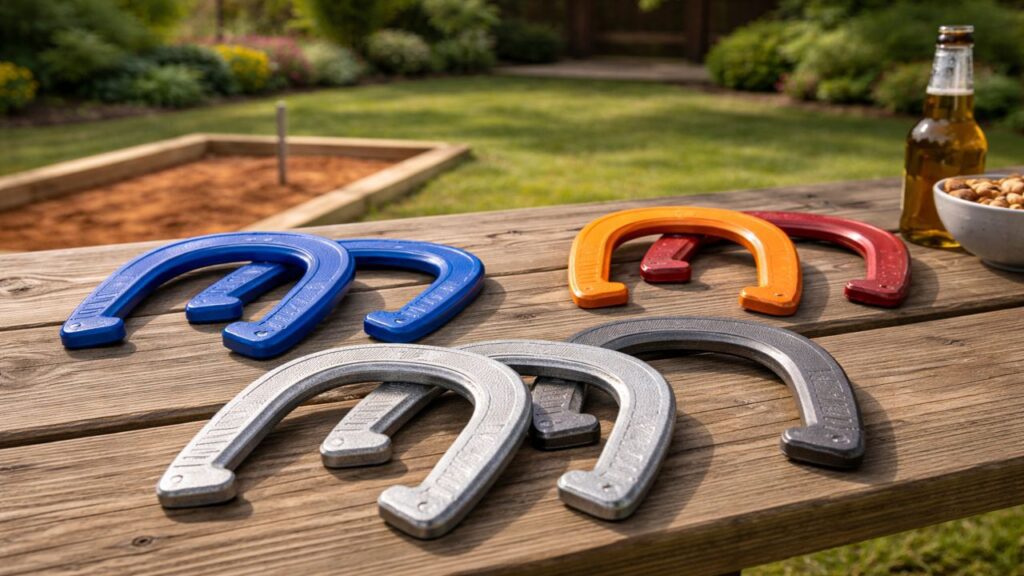
Let’s break this down in plain terms. Not marketing. Not hype. Just what you feel when you throw.
Weight Distribution
Some horseshoes feel evenly balanced. Others feel slightly heavier on one side.
That affects:
- Rotation speed
- Stability in flight
- Control at release
A well-balanced shoe tends to produce a more predictable throw.
Shape and Opening
Not all shoes have the same “open end” width or curvature.
Wider openings can:
- Increase ringer potential
- Be more forgiving on near-misses
Narrower shapes can feel more precise—but less forgiving.
Surface Texture
Some shoes are smooth. Others have a rougher, grippier finish.
This directly impacts:
- How secure the shoe feels in your hand
- How consistent your release is
If your grip changes even slightly… your accuracy will too.
Thickness and Feel
Some brands feel chunkier. Others feel slimmer and faster.
That changes how the shoe:
- Rolls off your fingers
- Rotates in the air
- Lands in the pit
It’s subtle—but real.
3. The Real Test: Same Player, Different Shoes
To keep things fair, we ran a simple test.
Same player.
Same pit.
Same distance.
Same weather.
Only one thing changed—the horseshoe brand.
Each set was used for 30 throws, tracking:
- Ringers
- Leaners
- Close shots
- Misses
What Happened?
The results weren’t identical.
Not even close.
Some sets produced smoother, more consistent throws almost immediately. Others felt awkward—even after several rounds.
And here’s the key takeaway:
The player didn’t suddenly get better or worse—the equipment changed the feel.
4. Where the Biggest Differences Showed Up
This is where things got interesting.
Release Consistency
Certain shoes felt natural coming out of the hand. Others required constant micro-adjustments.
That alone affected accuracy more than expected.
Rotation Control
Some brands flipped clean every time.
Others?
Slight wobble.
Inconsistent turn.
That leads to missed opportunities—even on good throws.
Landing Behavior
This one surprised a lot of people.
Some shoes “died” nicely in the pit.
Others bounced or rolled more than expected.
And when you’re chasing ringers… that matters.
5. Does a Better Brand Guarantee a Better Score?
Let’s clear this up.
No brand is going to magically turn a beginner into a ringer machine.
But…
The right horseshoe can absolutely make consistency easier.
Think of it like this:
- A poor match fights your mechanics
- A good match supports your natural throw
That’s a big difference over time.
6. The Biggest Mistake Players Make
Most players switch horseshoes too often—or never at all.
Both are problems.
If you switch constantly, your body never adapts.
If you never experiment, you might be stuck with a set that’s working against you.
The smart move?
Test different sets intentionally.
Pay attention to feel.
Stick with what works.
7. Finding the Right Horseshoe for YOU
There’s no universal “best” horseshoe.
Only the one that fits your throw.
Some players prefer a heavier feel.
Others want something lighter and quicker.
Some like a wider opening.
Others prefer tighter control.
The goal isn’t to copy someone else’s setup.
It’s to find what makes your throw more repeatable.
8. A Solid Set to Start With
If you’re serious about improving accuracy, it helps to use a reliable, well-balanced set during practice.
The St. Pierre American Professional Series Horseshoes are widely used because they offer a consistent feel, solid weight balance, and a shape that works well for both beginners and experienced players.
They’re not magic.
But they’re dependable.
And that’s exactly what you want when you’re working on your throw.
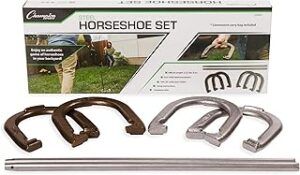
Horseshoe Game Sets
FAQ
1. Do professional horseshoe players use different brands?
Yes. Many players choose specific brands based on personal preference, grip feel, and balance.
2. Can beginners benefit from better horseshoes?
Absolutely. A consistent, well-balanced set makes it easier to develop proper mechanics early on.
3. How do I know if my horseshoes are hurting my game?
If your throws feel inconsistent despite good form, your equipment may not match your natural release style.
4. Should I switch horseshoe brands often?
No. Test different options, then stick with one set long enough to build consistency.
5. What matters more—skill or equipment?
Skill always comes first. But the right equipment helps you apply that skill more consistently.
It’s Not Just the Player
The saying “it’s not the shoes, it’s the player” sounds good—but it’s only part of the truth. Skill will always be the foundation of good horseshoe pitching, but the equipment you use can either support that skill or quietly work against it. When you find a horseshoe that fits your grip, your release, and your natural throwing style, everything starts to feel smoother—and your results usually follow. If you’ve never tested different brands before, it might be time to experiment a little. You don’t need a dozen sets… just one that finally feels right when it leaves your hand.
Hi there, and thanks for stopping by! My name is Larry, and I’m the voice behind PlayingHorseshoes.com. I love the game and have been playing since I was a kid. I started this blog because I am passionate about the sport, and with all the technology, I hope the sport doesn’t die. I plan to do my part to keep it going for me and my brother’s sake. Thanks for stopping by. Feel free to subscribe and comment. Thank You!