The One-Week Horseshoe Accuracy Experiment
Improving your horseshoe pitching accuracy doesn’t always require months of league play or endless backyard practice sessions. Sometimes the biggest improvements come from focused, structured training that targets the fundamentals of grip, arc, release, and consistency.
To find out how much progress a player could realistically make in a short period of time, we ran a simple but revealing test: a one-week horseshoe accuracy experiment. The goal was straightforward — practice every day for seven days using specific drills designed to improve accuracy and control, then measure whether those drills actually helped produce more consistent throws.
Could a single week really make a difference?
The results were more interesting than expected.
1. Setting Up the Experiment
Before throwing the first shoe, we created a few simple rules to keep the experiment realistic and focused.
Each practice session lasted about 30 to 40 minutes, long enough to work on mechanics but short enough to avoid fatigue. The idea wasn’t to throw hundreds of shoes until the arm got tired. Instead, the emphasis was on quality throws and deliberate practice.
Each day included roughly 60 to 80 pitches, broken into drills that targeted specific parts of the throwing motion.
Grip.
Arc.
Release timing.
Distance control.
By isolating each part of the throw, it becomes easier to identify small mistakes that normally go unnoticed during casual play.
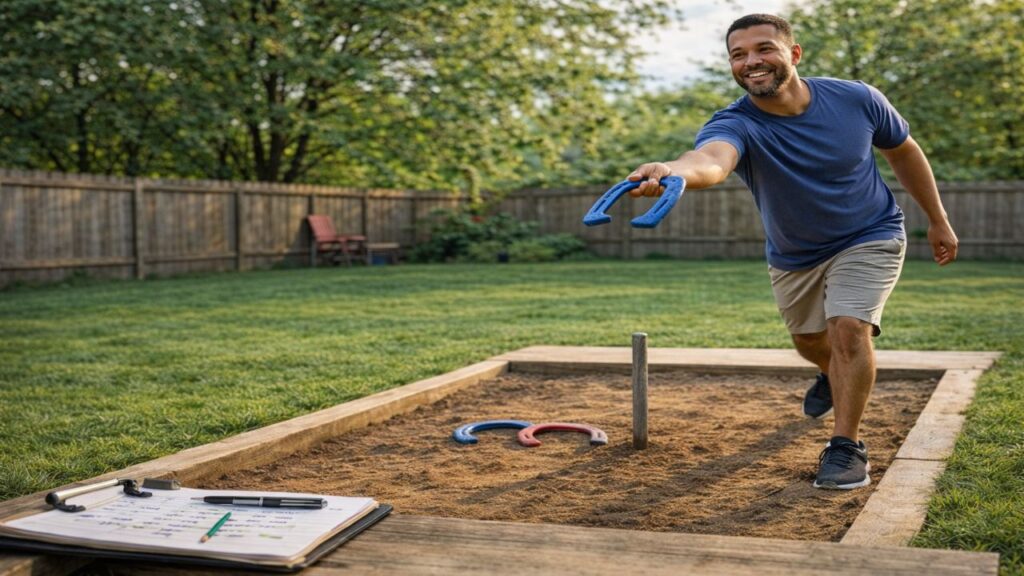
2. Day One: Establishing Your Real Accuracy
The first step was to establish a realistic baseline.
Many players assume they know how accurate they are, but without tracking results, it’s easy to misjudge performance. So the first practice session focused entirely on measurement.
The test was simple: throw 20 horseshoes and record the results.
We tracked:
- Ringers
- Leaners
- Close throws
- Misses
For most backyard players who pitch occasionally, a typical starting point is somewhere around 2 to 4 ringers out of 20 throws.
That number becomes the benchmark for improvement.
And sometimes the baseline result is surprising.
3. Day Two: Fixing the Grip
Consistency starts with how the horseshoe sits in your hand.
Many players unknowingly adjust their grip slightly from throw to throw. The difference may seem tiny, but even small changes can alter the rotation and release timing of the shoe.
On Day Two, the entire practice session focused on grip consistency.
Before each throw, we paused for a moment and checked the grip position. The fingers stayed along the side of the shoe with the same pressure every time.
No rushing.
No adjustments mid-throw.
Just repeat the same grip again and again until it feels automatic.
It sounds simple.
But simple habits often produce the biggest improvements.
4. Day Three: Controlling the Arc
The next step focused on one of the most common causes of inaccurate throws — a poor throwing arc.
When players throw too flat, the shoe often skips through the pit or lands short. When the arc becomes too high, accuracy disappears.
The solution was to aim slightly above the stake instead of directly at it.
This creates a smooth arc that allows the shoe to drop naturally into the pit area.
After about twenty throws using this method, the difference becomes noticeable.
Shoes begin landing more softly.
Closer.
More controlled.
And occasionally — right around the stake.
5. Day Four: Changing the Distance
Midway through the experiment, we introduced a small twist.
Instead of throwing from the standard distance, we moved five feet farther back for several rounds of practice.
This forces the body to produce a smoother motion and a higher arc. Players quickly realize they can’t muscle the shoe from that distance — the throw has to be clean and controlled.
After thirty throws at the longer distance, returning to the regulation pitching position suddenly feels easier.
The stake appears closer.
The arc feels smoother.
Confidence increases.
Sometimes changing the distance for a short time can recalibrate your entire throwing rhythm.
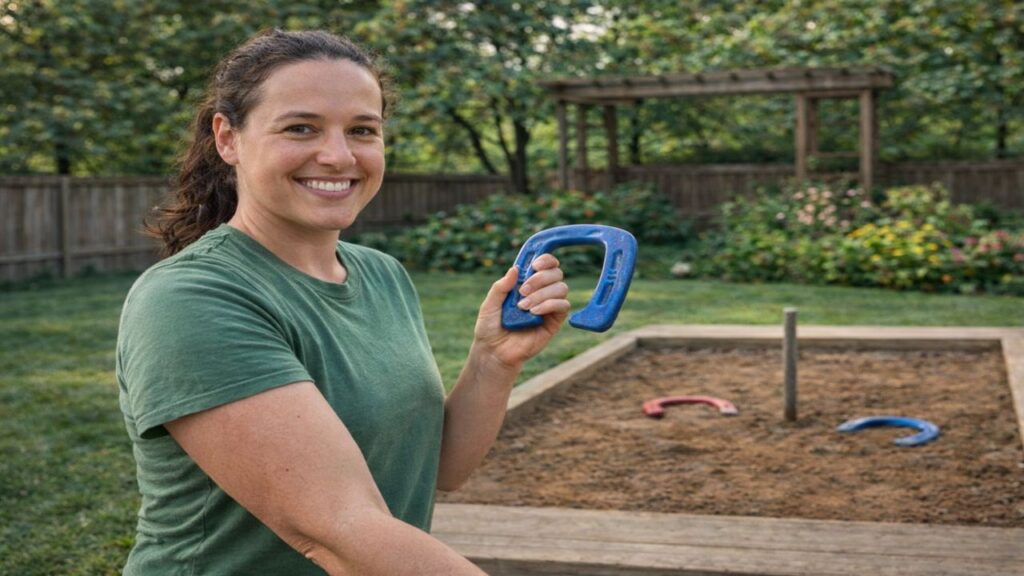
6. Day Five: The Reset Routine
Accuracy often breaks down when players rush their throws.
You miss one shoe, grab the second, and immediately fire it toward the stake, hoping to correct the mistake.
That’s where the reset routine comes in.
Before each throw, we added a short pause:
Step back.
Relax the shoulders.
Set the stance again.
Focus on the stake.
Every throw becomes intentional instead of rushed.
This simple routine slowed the pace of practice, but the quality of the throws improved noticeably.
Consistency loves patience.
7. Day Six: Expanding the Target Zone
By the sixth day, the focus shifted away from ringers.
Instead of aiming directly at the stake, the goal was simply to land each shoe within a one-foot circle around it.
This drill removes pressure and allows the body to focus on accuracy rather than perfection.
And something interesting usually happens.
When players stop chasing ringers, they often throw more of them naturally.
Because the mechanics become smoother.
8. Day Seven: The Final Accuracy Test
After six days of focused practice, it was time to repeat the original accuracy test.
Again, we threw 20 horseshoes and recorded the results.
For many players, the improvement shows up clearly.
A typical example might look like this:
Day One
20 throws
3 ringers
5 close throws
Day Seven
20 throws
6 ringers
9 close throws
That’s not tournament-level pitching yet, but it represents a clear improvement in just seven days.
Small gains add up quickly.
What the One-Week Experiment Proved
The biggest lesson from this experiment wasn’t just the increase in ringers.
It was the power of structured practice.
Random practice produces random results.
But when players focus on specific mechanics — grip consistency, arc control, reset routines, and distance adjustments — improvement happens faster than most people expect.
Better throws come from repeatable habits.
Not just throwing more shoes.
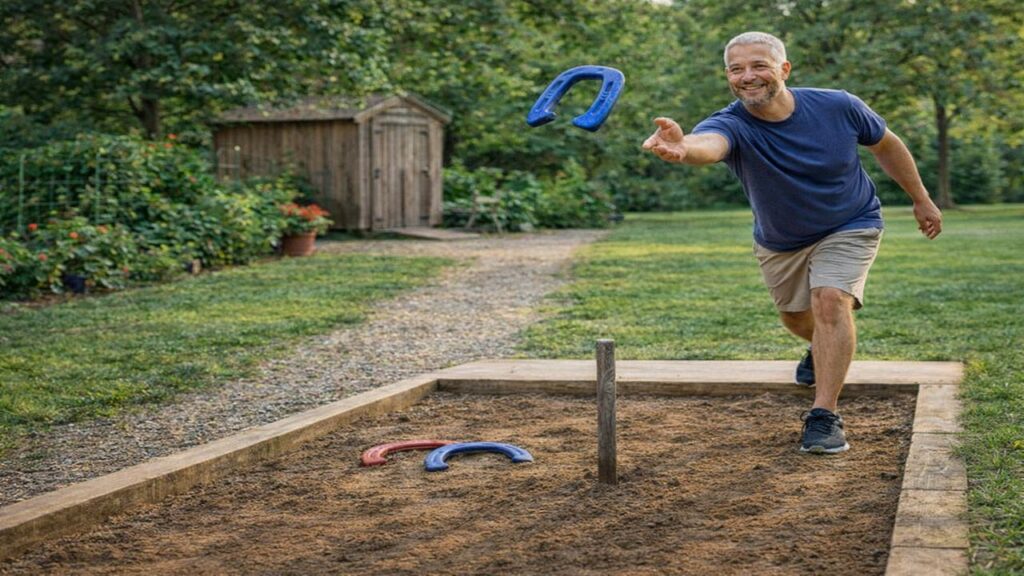
Using the Right Horseshoes for Practice
Another important factor in accuracy training is equipment consistency.
Using a reliable horseshoe set allows players to focus on mechanics instead of adjusting to different weights or shapes. Many backyard players prefer practicing with the Champion Sports Official Horseshoe Set, which provides balanced weight and durable construction for regular training sessions.
When you’re running accuracy drills or structured experiments like this one, dependable equipment helps eliminate unnecessary variables.
Consistency in practice leads to consistency in results.
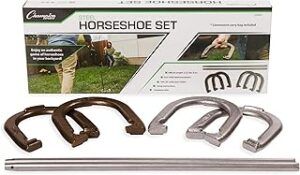
Horseshoe Game Sets
FAQ
1. Can you really improve horseshoe accuracy in one week?
Yes. Focused drills that target mechanics often produce noticeable improvements in consistency within several days.
2. How long should horseshoe practice sessions last?
Most productive sessions last 30–45 minutes. Longer sessions often lead to fatigue and sloppy mechanics.
3. How many horseshoes should you throw in practice?
A good target is 60–100 throws per session when working on accuracy drills.
4. Should beginners track their results?
Absolutely. Tracking ringers and close throws helps players identify patterns and measure improvement over time.
5. What’s the most important factor in horseshoe accuracy?
Consistency in grip, stance, and release timing. When those three elements stay the same, accuracy improves naturally.
A Week Can Change Your Throw
Many players assume improving their horseshoe pitching accuracy takes months of constant practice. While mastery certainly takes time, this one-week experiment shows that focused drills and structured practice can produce meaningful improvements much faster than most people expect.
A one-week experiment won’t turn anyone into a tournament champion overnight.
But it can prove something important.
Improvement doesn’t always require endless hours of practice — sometimes it just takes a little structure and a willingness to test new ideas.
If you enjoyed this experiment, try running your own version next week. Change a few drills, track your results, and see what works best for your throwing style.
You might be surprised how quickly those shoes start landing closer to the stake.
Hi there, and thanks for stopping by! My name is Larry, and I’m the voice behind PlayingHorseshoes.com I love the game and have been playing since I was a kid. I started this blog because I am passionate about the sport, and with all the technology, I hope the sport doesn’t die. I plan to do my part to keep it going for me and my brother’s sake. Thanks for stopping by. Thank You!