Why Horseshoes Gets Better the Longer You Play (And Most Games Don’t)
Most games peak early.
They’re exciting at first because everything is new. The learning curve feels steep, progress comes fast, and small wins feel big. But after a while, something changes. Improvement slows. Outcomes feel repetitive or random. The game stops rewarding experience and starts favoring speed, reflexes, or luck.
That’s usually when people drift away.
Horseshoes don’t follow that pattern.
For many players, the game actually improves the longer they play. It becomes more satisfying, fairer, and more meaningful with time. Instead of plateauing, skill deepens. Instead of relying on luck, execution tightens.
This isn’t nostalgia talking. It’s built into how the game works.
1. Horseshoes are designed around mastery, Not Novelty
Games that peak early tend to rely on novelty. The fun comes from surprise, chaos, or quick reactions. Once players adapt, there’s nowhere else to go.
Horseshoes are built differently.
From the beginning, the game makes it clear that improvement will come through repetition, not tricks. The target doesn’t move. The distance doesn’t change. There are no power-ups, shortcuts, or surprise mechanics waiting to be discovered.
What changes is the player.
Over time, pitchers refine:
- Their tempo
- Their release
- Their height and rotation
- Their ability to self-correct
That depth keeps revealing itself slowly. Players don’t “figure out” horseshoes in a weekend. They grow into it.

2. Experience Improves Outcomes Instead of Being Neutralized
In many games, experience eventually stops mattering. Once everyone reaches a certain competence level, results flatten out, and luck takes over.
Horseshoes do the opposite.
Experience compounds.
An experienced player:
- Reads misses more accurately
- Makes smaller, smarter adjustments
- Maintains rhythm under pressure
- Avoids emotional overcorrection
Those advantages don’t disappear with time — they strengthen. That’s why seasoned players can step into a casual game or a competitive match and still perform consistently.
The game respects experience instead of erasing it.
3. The Throw Ages Well
One of the biggest reasons horseshoes improve with time is the throwing motion itself.
The underhand pitch is:
- Joint-friendly
- Low impact
- Based on rhythm rather than speed
Unlike reaction-heavy sports, it doesn’t punish aging reflexes. Instead, it rewards control and awareness. As players gain years of repetition, their motion becomes smoother and more efficient.
What they lose in raw athleticism, they gain in consistency.
That balance keeps the game playable — and enjoyable — for decades.
4. Misses Become Information, Not Frustration
Early on, misses can feel disappointing. Later, they become instructive.
Long-term players learn that misses are rarely random. They’re signals:
- Too much arm speed
- Release point drift
- Tempo breaking down
With experience, players stop reacting emotionally to misses. They analyze them calmly and adjust without panic.
That mindset shift is huge.
Instead of feeling stuck, experienced players feel in control, even when things aren’t going perfectly. That sense of control is one of the main reasons the game becomes more enjoyable with time.
5. Pressure Becomes Manageable Instead of Overwhelming
In games that rely on speed or reaction, pressure amplifies mistakes. Players rush. Mechanics collapse. Outcomes feel chaotic.
Horseshoes resist that effect.
Because the game allows players to:
- Set their feet
- Take their time
- Follow a routine
Pressure doesn’t force a change in approach. Experienced players lean into their routine instead of abandoning it.
Over time, that creates confidence. Close games don’t feel frantic. They feel familiar.
That’s a rare quality — and one that keeps players coming back.
6. Practice Stays Relevant No Matter How Long You Play
Another reason horseshoes age well is how practice translates directly into performance.
There’s no separation between “practice mode” and “real play.”
The conditions stay the same:
- Same distance
- Same target
- Same motion
What you practice today still applies years from now. There’s no system overhaul or shifting meta to relearn. That continuity makes long-term improvement feel meaningful instead of temporary.
Players don’t outgrow practice. They refine it.
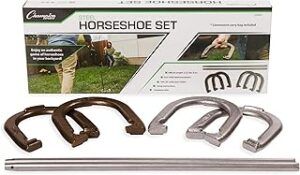
Horseshoe Game Set
7. Equipment Rewards Skill More as You Improve
As players gain experience, they become more sensitive to feedback. Small changes in release, tempo, and height matter more — and that’s when equipment stops being neutral and starts either helping or hurting consistency.
Lightweight or poorly balanced horseshoes can blur that feedback. A regulation-style set keeps the game honest.
A solid example for players focused on long-term improvement is Champion Sports Official Competition Horseshoes.
These are well-suited for players who want their skill — not luck — to decide outcomes:
- Regulation weight that encourages a smooth, repeatable arc
- Consistent balance that reinforces clean rotation
- Predictable reactions on near-misses, making adjustments easier
- Durable construction that holds its feel over years of play
As players improve, these shoes don’t become obsolete — they become more informative. Clean pitches feel cleaner. Mistakes are easier to diagnose. That kind of feedback is exactly what keeps horseshoes satisfying over the long haul.
Good equipment doesn’t make the game easier. It makes progress clearer.
8. The Game Encourages Long-Term Mindset
Horseshoes quietly train patience.
Progress doesn’t come in bursts. It comes in small, repeatable gains. Over time, players learn to appreciate:
- Cleaner misses
- Better rhythm
- Improved consistency
Those wins might not show up dramatically on the scoreboard every game, but they accumulate.
That long-term mindset changes how players approach competition. Winning matters, but improvement matters more. That balance is rare — and deeply satisfying.
9. Social Play Improves Instead of Wearing Thin
Many games become less enjoyable socially over time. Skill gaps widen. Frustration grows. Casual players feel pushed out.
Horseshoes handle social play better.
Because the game:
- Scales naturally
- Allows for handicapping
- Encourages conversation and pacing
Experienced players can play with beginners without ruining the experience. Teaching becomes part of the fun. Shared improvement strengthens the community instead of dividing it.
That social durability is another reason players stick with the game long-term.
10. The Scoreboard Keeps Its Credibility
Perhaps the most underrated reason horseshoes get better with time is that the scoring system remains honest.
As players improve, scores feel deserved. Wins feel earned. Losses feel instructive rather than unfair.
There’s nothing more frustrating than losing despite playing well. Horseshoes minimize that feeling. Over time, players trust the game to reflect reality.
That trust deepens enjoyment instead of eroding it.
Frequently Asked Questions
Why do horseshoes feel more rewarding the longer you play?
The game rewards experience, repetition, and control rather than speed or luck.
Do older players really have an advantage?
In many cases, yes. Experience, tempo, and consistency often outperform raw strength.
Does improvement ever plateau?
Improvement slows, but it doesn’t stop. Refinement replaces rapid gains.
Are horseshoes easier on the body long-term?
Yes. The underhand motion and controlled pace make it sustainable for decades.
Why do longtime players stay loyal to the game?
Because it continues to reward effort and attention long after novelty fades.
Why This Matters More Than Ever
In a world full of games that burn bright and fade fast, horseshoes stand out by doing the opposite. It doesn’t chase excitement through chaos. It builds satisfaction through mastery.
The longer you play, the more the game gives back — not because it changes, but because you do.
That’s why horseshoes don’t just survive over time. It improves.
And horseshoes aren’t just for the backyard anymore. It’s been adapted to fit modern occasions, from beach parties to casual indoor competitions with makeshift sets. This adaptability keeps the game fresh and exciting in new settings, ensuring it never gets stale.
There’s something undeniably satisfying about finding joy in simplicity, and horseshoes offers that in spades. Its real charm is revealed over time, as the game weaves itself into your life, transforming from a simple backyard game to a longstanding tradition.