Why Horseshoes Rewards Patience More Than Power
Many players come to horseshoes with instincts shaped by other sports. They assume that strength, aggression, or extra effort will translate into better results. After all, that’s how most games work. You swing harder, throw faster, or push more, and performance improves.
Horseshoes quietly resist that logic.
Over time, players discover that the game doesn’t reward force nearly as much as it rewards restraint. In fact, the harder someone tries to overpower the pitch, the more inconsistent their results tend to become. Meanwhile, the calm, patient players — the ones who look almost effortless — keep scoring.
This difference isn’t accidental. It’s built into the game’s structure.
1. Power Adds Variables Instead of Removing Them
Power feels decisive, but in horseshoes it introduces complexity rather than control.
When a shoe is thrown with excessive force, small mechanical inconsistencies are magnified. Minor grip differences, subtle release timing errors, and slight wrist movements all become more impactful as speed increases. The shoe travels faster, rotates more aggressively, and reacts less predictably when it hits the pit.
Patient throws reduce those variables.
A controlled swing produces a stable arc and manageable rotation, giving the shoe more time to behave consistently in flight. That slower, smoother motion allows players to see and feel what went right or wrong. Over time, consistency grows not because the player is stronger, but because the motion is simpler.
In horseshoes, removing excess effort often produces better results than adding more.
2. The Game’s Natural Tempo Can’t Be Rushed
Horseshoes have a built-in rhythm that doesn’t respond well to impatience.
The target doesn’t move.
The distance doesn’t change.
No opponent is forcing a reaction.
Because nothing demands speed, attempts to rush the motion usually come from internal pressure rather than necessity. When players speed up, arm motion outpaces timing. Releases drift earlier or later than intended. Follow-through shortens, and consistency suffers.
Patient players allow the pitch to unfold at its natural pace.
They let the arm swing freely, trust gravity and momentum, and release without forcing rotation. That rhythm becomes repeatable because it isn’t rushed. Over time, the body memorizes the motion, and the pitch becomes reliable rather than reactive.
Horseshoes rewards players who match its tempo instead of fighting it.
3. Patience Improves Judgment Between Throws
One of the most overlooked benefits of patience in horseshoes is decision-making.
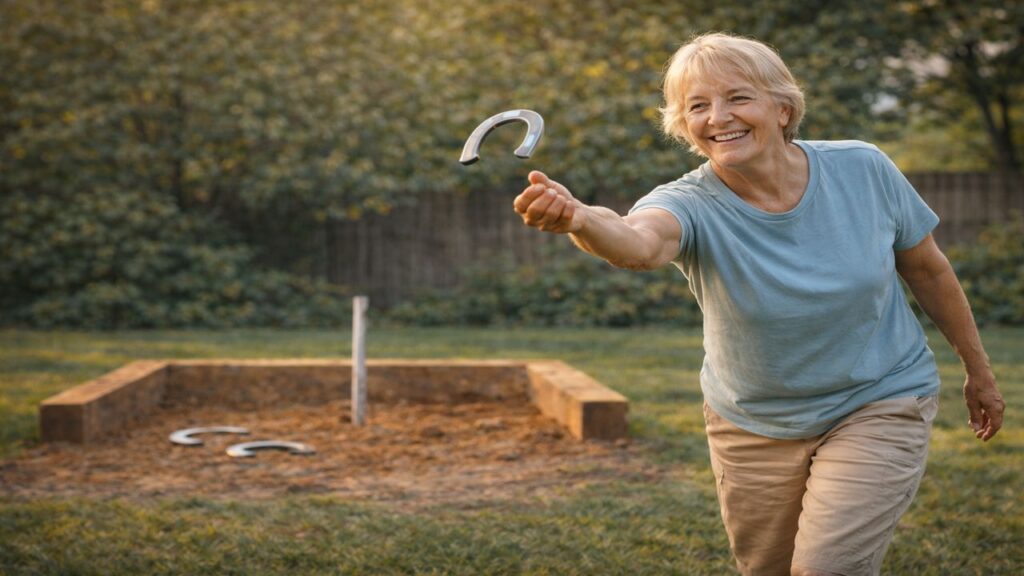
Power-oriented players often respond emotionally. A miss leads to an aggressive correction. A near ringer encourages a harder follow-up. Each pitch becomes a reaction to the last one rather than part of a longer process.
Patient players slow the space between throws.
They take a moment to observe where the shoe landed, how it rotated, and how it approached the stake. Instead of making dramatic adjustments, they make small, intentional ones. That measured approach prevents overcorrection and keeps mechanics stable.
In horseshoes, success often comes from knowing when not to change much.
4. Controlled Throws Create Clearer Feedback
Feedback is only useful when it can be interpreted.
When a shoe is thrown too hard, the result often looks chaotic. It’s difficult to tell whether the miss was caused by line, speed, release height, or rotation because everything happens too quickly. The noise overwhelms the signal.
Controlled throws slow the feedback loop.
Players can see whether the shoe drifted left or right, landed long or short, or approached the stake flat or steep. That clarity allows players to identify patterns instead of guessing. Over time, they learn to associate specific misses with specific mechanical issues.
Patience doesn’t just calm the game — it makes learning possible.
5. Early Power Can Hide Problems That Surface Later
One reason power is so tempting early on is that it sometimes works.
Strong throws can muscle shoes near the stake even when mechanics are inconsistent. That short-term success creates a false sense of progress. Players feel like they’re improving when in reality they’re compensating.
As competition increases or conditions change, those hidden flaws emerge.
Players who relied on power suddenly struggle to control distance and rotation. Because they never developed a patient, repeatable motion, fixing those issues becomes difficult. They’re forced to unlearn habits instead of refining them.
Patient players progress more slowly at first, but their foundation holds up over time.
6. The Underhand Motion Is Designed for Control
Horseshoes use an underhand throw because it naturally encourages smoothness and balance.
Underhand motion works best when the body stays relaxed. Excess tension interferes with timing and release. Trying to overpower the throw contradicts the mechanics the game is built around.
Patient players work with the motion instead of against it.
They allow gravity and momentum to do most of the work. The result is a pitch that feels effortless rather than forced. Over time, that effortlessness becomes reliable — especially when fatigue or pressure enters the picture.
The game quietly favors players who trust the motion.
7. Patience Holds Up Under Pressure
Pressure exposes habits.
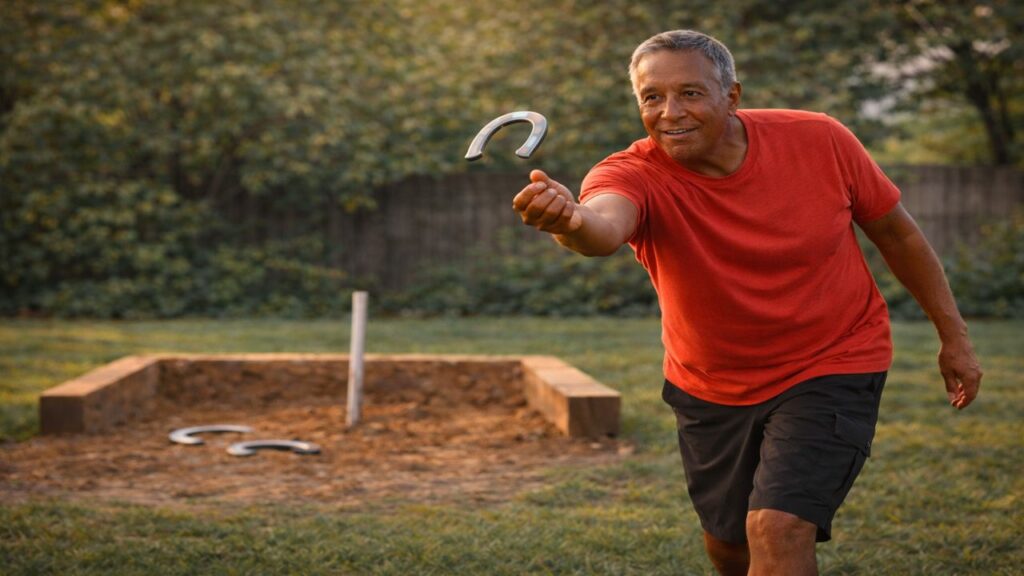
When games get close, power-focused players often tighten up. Muscles engage earlier, arm speed increases, and releases become inconsistent. The desire to “make something happen” overrides mechanics.
Patient players lean into routine.
They slow down when pressure rises. They repeat the same setup, the same swing, and the same release regardless of the score. Because their approach doesn’t change, their results remain steady.
Horseshoes don’t reward urgency. It rewards composure.
8. Equipment Reinforces the Value of Control
As players improve, equipment begins to matter more — especially when it comes to patience versus power.
Lightweight or poorly balanced horseshoes can encourage overexertion. Players feel the need to throw harder to achieve consistent results. Regulation-weight shoes change that relationship.
A solid example for players focused on controlled pitching is Franklin Sports Professional Horseshoes.
These types of shoes respond best to smooth, balanced throws. Clean releases feel stable in flight, while forced throws feel uncomfortable and unpredictable. That feedback reinforces patience without the player having to consciously think about it.
Good equipment doesn’t demand restraint — it teaches it.
Horseshoe Game Sets
9. Patience Improves With Age While Strength Declines
Strength fluctuates over time. Patience often improves.
As players gain experience, they learn how little effort the game actually requires. They reduce wasted motion, eliminate unnecessary tension, and rely on feel instead of force. That efficiency allows older players to remain competitive even as raw strength fades.
Horseshoes don’t punish aging. It rewards adaptation.
Players who embrace patience find that their game evolves rather than declines.
10. Long-Term Consistency Depends on Restraint
Players who stay with horseshoes for years share a common approach. They stop trying to dominate the game and start cooperating with it.
Improvement becomes quieter and more subtle. Misses get smaller. Adjustments get finer. The scoreboard reflects steadiness rather than volatility.
That kind of consistency isn’t flashy, but it’s deeply satisfying. It’s also sustainable.
Horseshoes don’t reward the hardest throw. It rewards the smartest one.
Frequently Asked Questions
Does throwing harder ever help in horseshoes?
Occasionally, but it usually increases inconsistency. Controlled throws produce better long-term results.
Why do smooth throwers look so relaxed?
Because they aren’t forcing the motion. Their efficiency comes from restraint.
Should beginners focus on patience early?
Yes. Learning control early prevents bad habits that are difficult to break later.
Is patience more important than strength?
In horseshoes, absolutely. Control and rhythm outperform power consistently.
Why do patient players handle pressure better?
Because their routine doesn’t change. Pressure doesn’t disrupt their mechanics.
What This Changes About How You Play
Horseshoes aren’t a contest of force. It’s a test of discipline.
The more patient you become, the clearer the game becomes. You stop fighting the motion and start trusting it. You stop reacting emotionally and start adjusting deliberately.
Slow down.
Let the swing settle.
Allow consistency to build.
That’s how horseshoes reward patience — and why power alone never lasts.