What If NASA Hosted a Horseshoe Tournament on the Moon?
A Cosmic Twist on America’s Classic Backyard Game
The Announcement That Shocked the Backyard League
The year is 2035. After decades of scientific milestones, space tourism, and a few too many reality TV spin-offs, NASA finally did it — they announced the first-ever Horseshoe Tournament on the Moon.
Not a simulation. Not a parody.
A real lunar showdown, sanctioned by the World Backyard Sports Federation (a totally legitimate organization we just made up).
The announcement hit social media like a meteor:
“Mission LUNAR RINGER — Bringing backyard tradition to the final frontier.”
For once, even skeptics agreed — it was the best NASA idea since Tang.
Setting the Scene: One Small Pit for Man, One Giant Ringer for Mankind
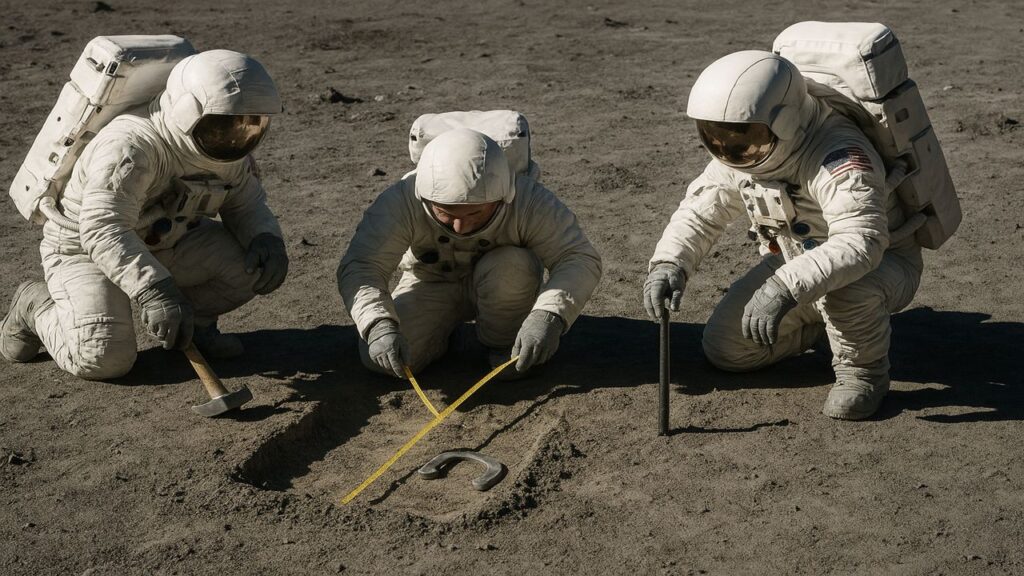
Before liftoff, engineers faced a question never asked before: How do you build a horseshoe pit on the Moon?
Forget hauling sandbags from Earth. Lunar soil, or regolith, is fine, powdery dust that sticks to everything — kind of like that layer of backyard grit that always ends up on your beer can.
So NASA’s engineers went to work designing a modular pit system — laser-leveled, anchored in titanium stakes, and surrounded by low-gravity barriers to keep horseshoes from floating off into the Sea of Tranquility.
They even had to rewrite the rulebook.
- The standard 40-foot distance? On the Moon, that’s excessive — you’d need binoculars to score it.
- Regulation horseshoes? Way too light.
So they developed Lunar Series Horseshoes: same shape, just denser metal to resist over-spin.
At last, the game was ready for liftoff.
The First Toss: A Ringer Heard Around the World
Day one on the Moon.
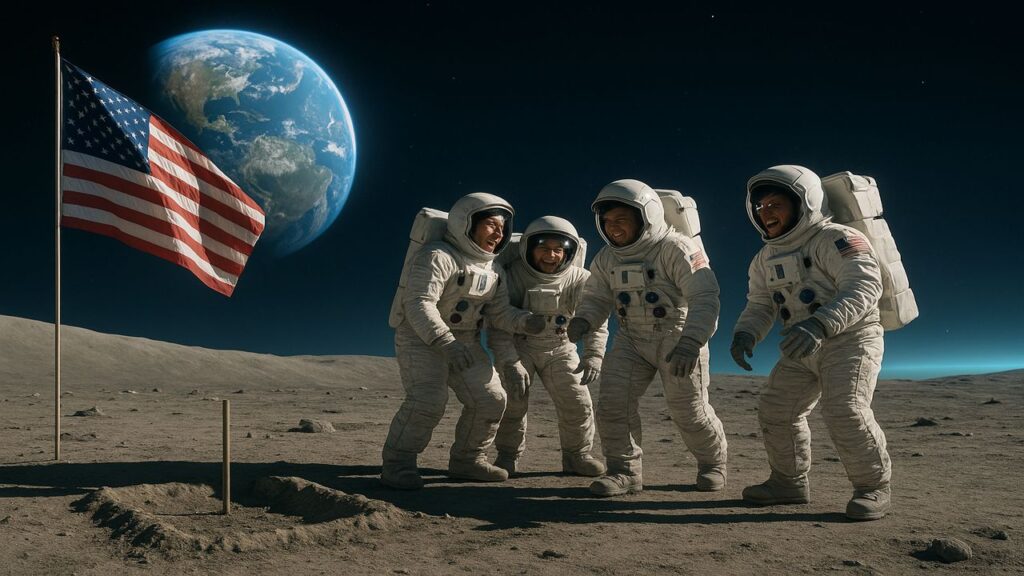
Four astronauts in custom suits step up to the line, each with a brand-new “NASA-approved” set of horseshoes gleaming under the harsh sunlight.
The lunar flag flaps stiffly in the vacuum — though that’s mostly due to a support rod, not the breeze (there isn’t one).
Earth hangs over the horizon, glowing blue and white.
And then, the first toss.
In one-sixth gravity, the shoe spins beautifully… slowly… too slowly.
It hangs in the air like poetry in motion, drifting lazily toward the stake.
Every camera in Mission Control holds its breath.
Ten… nine… eight seconds later — clink!
Ringer.
The crowd on Earth goes wild. Twitter explodes. ESPN’s graphics department has a meltdown.
Horseshoe history has just been made 238,900 miles away.
The Physics of a Lunar Toss
For all you physics fans, here’s the breakdown.
A standard horseshoe on Earth weighs about 2.5 pounds and travels roughly 30 mph with a smooth half-rotation before landing near the stake.
On the Moon, gravity is 1/6 of Earth’s, so the same throw:
- Travels farther — up to six times the distance
- Spins slower — around 0.7 rotations per second
- Lands softer — which means fewer bounce-outs
- But… every mistake is exaggerated. One misjudged arc, and your shoe drifts 40 feet past the pit.
Astronaut “players” found it mesmerizing. Some compared it to slow-motion bowling in space.
One test subject reportedly said,
“It’s like watching a dream float — you toss, you wait, and you hope it comes back down before the next orbit.”
Equipment Challenges: Space Suits and Stake Bounces
Playing in a full EVA suit is no picnic. The gloves are thick, the visors are tinted, and bending over to measure a close call? Forget it.
NASA’s official rule revision read:
“In cases of uncertainty, the nearest player will eyeball it and say, ‘Yeah, that’s close enough.’”
(Backyard players everywhere nodded in approval.)
As for the stakes — those proved tricky. Hammering metal into lunar dust caused “micro moonquakes.” Engineers had to dampen the vibrations so the stake wouldn’t shimmy mid-match.
The solution?
A carbon-titanium anchor drilled 18 inches deep, with vibration sensors that doubled as score counters. Every time a horseshoe made contact, Mission Control logged it automatically.
Science, meet country engineering.
The Competitors: Astronauts, Scientists, and Backyard Heroes
NASA didn’t just send astronauts — they wanted authentic flair. So they opened up a few slots to Earth’s most decorated backyard players.
- Buzz “Two-Ringers” Aldrin Jr. — grandson of the legend, known for his underhand spin style.
- Peggy “The Pitmaster” Sanchez — retired physics teacher, self-proclaimed horseshoe whisperer.
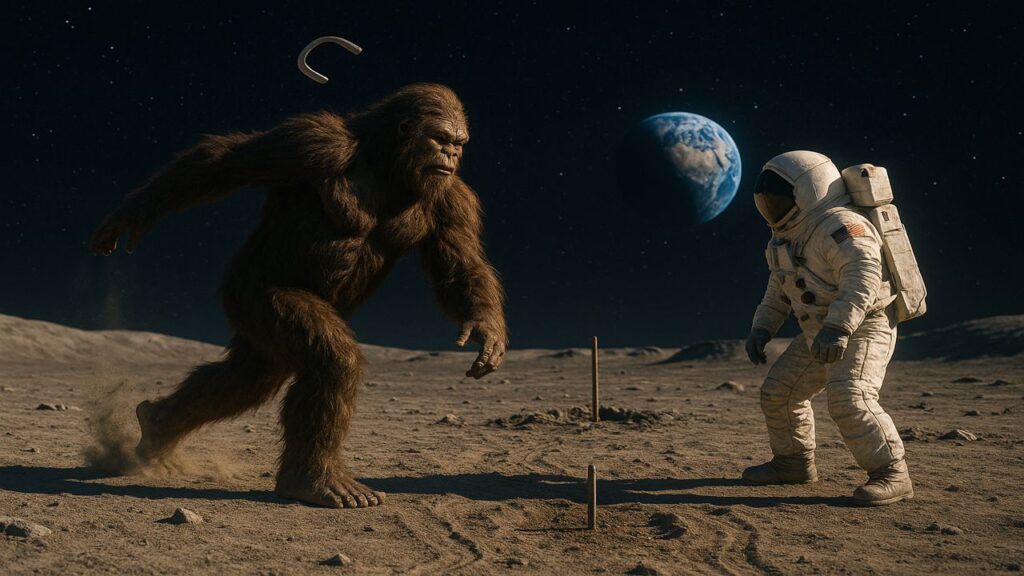
- Bigfoot — yes, you read that right. Rumor has it that, after his last backyard victory on Earth, he was invited as the “Earth Wildcard Entry.” (NASA declined to comment.)
The astronauts handled the gear. The backyard pros handled the bragging.
And together, they made lunar history.
The Unexpected Problems
It didn’t take long for things to get weird.
- Horseshoes Floated Off Mid-Toss
One toss went so high it entered a “temporary lunar orbit.” It was later found embedded in a crater three miles away. - Dust Storms
Every landing kicked up micro-dust clouds that hung suspended for minutes. Visibility dropped. So did tempers. - The “Leaner Debate”
With no atmosphere, shoes didn’t fall the same way. One hovered upright for 47 seconds before tipping. NASA had to invent a new scoring rule: the lunar leaner. - Bigfoot’s Throw
Reports say it “broke physics.” Some call it a ringer. Others call it a small moonquake. Nobody knows for sure — but seismic sensors picked up a “distinct thud” on the far side of the Moon.
The Championship Round: Earth vs. Moon
The finals were broadcast globally — well, delayed by 1.3 seconds because, you know, space.
Peggy Sanchez faced Commander Lee “Iron Arm” Harper.
Score tied. Stakes buried deep. One throw left.
She takes a breath. The horseshoe leaves her glove, tumbling end over end in perfect lunar slow motion.
Viewers on Earth watch, mesmerized, as it arcs gracefully toward the stake.
Contact.
Dust plumes. Silence.
Then the replay confirms it: Double Ringer.
A roar sweeps across the planet — from backyard pits to sports bars to astronaut families in Houston.
Peggy becomes the first-ever Lunar Horseshoe Champion.
Product Spotlight: The Franklin Sports Advanced Horseshoe Set
Back on Earth, you can’t exactly replicate lunar gravity — but you can throw like a pro.
The Franklin Sports Advanced Horseshoe Set gives you top-tier balance, grip, and durability for real backyard play. Its forged steel construction and weighted design keep every toss consistent — whether you’re pitching at sea level or just daydreaming about the Moon.
Strong, sturdy, and beautifully old-school — it’s everything you’d want in a set that’s “NASA-tested and backyard approved.”
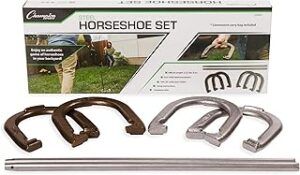
Horseshoe Game Set
How to Host Your Own “Lunar Ringer” Party
Want to bring some of that interplanetary spirit home? Here’s how to do it:
- Theme the Court
Use silver spray paint, glow-in-the-dark stakes, and string lights for that lunar glow. - Suit Up
No space suits required — just matching silver shirts or helmets from the dollar store for laughs. - Low-Gravity Challenge
Mark off a short “moon pit” distance and throw underhand with your off-hand for reduced “gravity effect.” - Play by Lunar Rules
- Double points for airborne ringers.
- Deduct points for lost shoes (if they land in the bushes, count them as orbiting debris).
- Reward the Winner
Give out a “Golden Horseshoe Trophy” — or a tin-foil cup labeled Lunar Legend.
It’s the perfect backyard event — a mix of humor, history, and light competition.
Why It Works: The Spirit of the Game
Sure, it’s ridiculous — but that’s the beauty of horseshoes. It’s a game that belongs everywhere.
- In your granddad’s yard.
- At the campground.
- In outer space.
Because no matter where you set the stake, the goal’s the same: one good throw that makes everyone stop and cheer.
The lunar version just reminds us what makes this game timeless — it’s universal, human, and a little bit magical.
FAQ
Q: Would horseshoes actually work on the Moon?
Yes — though they’d fly slower, farther, and need a heavier design to handle low gravity. You’d also need custom stakes to anchor in lunar soil.
Q: Wouldn’t the dust ruin the game?
Probably. Lunar dust is clingy, sharp, and electrostatic. But that’s part of the fun — imagine cleaning your shoes after a game in zero humidity!
Q: Could players bounce the shoe off the surface?
Technically, yes — but without atmosphere, there’s no wind resistance, so bounce angles would be unpredictable.
Q: Could Bigfoot survive on the Moon?
Rumor has it he brought his own oxygen tank. Let’s just say he adapted quickly.
Thoughts
So, what if NASA really did host a horseshoe tournament on the Moon?
It would probably be the slowest, strangest, and most mesmerizing sporting event in human history.
But it would also prove something deeper: that no matter how far we travel, we’ll always carry our backyard traditions with us.
Horseshoes isn’t just a game — it’s a symbol of connection, laughter, and human ingenuity.
From Dixie backyards to lunar landscapes, it’s still about one thing: getting a little dirt on your hands and a smile on your face.
So tonight, when you toss a shoe toward the stake, glance up at the Moon — and imagine someone up there, waiting for their turn.
Because who knows?
The next great horseshoe match might just be out of this world.
This shop is my clubhouse for fellow players. You’ll find mugs, shirts, and pit gear to keep games fair, trash talk fun, and ringers flying — whether you’re building your first court or running a league.