The Surprising Way Horseshoes Improves Hand-Eye Coordination
When people talk about hand-eye coordination, they usually picture fast sports. Tennis rallies. Basketball passes. Video games that reward lightning reflexes and split-second decisions.
Horseshoes don’t look like it belongs in that conversation.
It’s slower. Quieter. More deliberate. Sometimes so calm that people assume it’s doing nothing special at all.
That assumption couldn’t be more wrong.
Horseshoes improves hand-eye coordination in a way most sports don’t — not through speed, but through precision, timing, and repetition without chaos. The improvement is subtle at first, almost invisible, but once it shows up, it sticks.
That’s the surprising part.
What Hand-Eye Coordination Really Is (And What It Isn’t)
Most people think coordination means reacting fast. That’s only part of the story.
True hand-eye coordination is the ability to:
- Visually lock onto a target
- Translate that visual information into controlled movement
- Release an object at the correct moment
- Repeat that process consistently
Speed-based sports often mask poor coordination. You can be late, off-balance, or sloppy and still recover because the next play comes immediately.
Horseshoes don’t allow that.
Every throw is isolated. There’s no defender to blame, no teammate to bail you out, no fast reset to hide mistakes. The shoe either goes where you intended or it doesn’t.
That clarity is exactly why coordination improves so effectively.
1. The Throw Trains the Brain Before the Hand
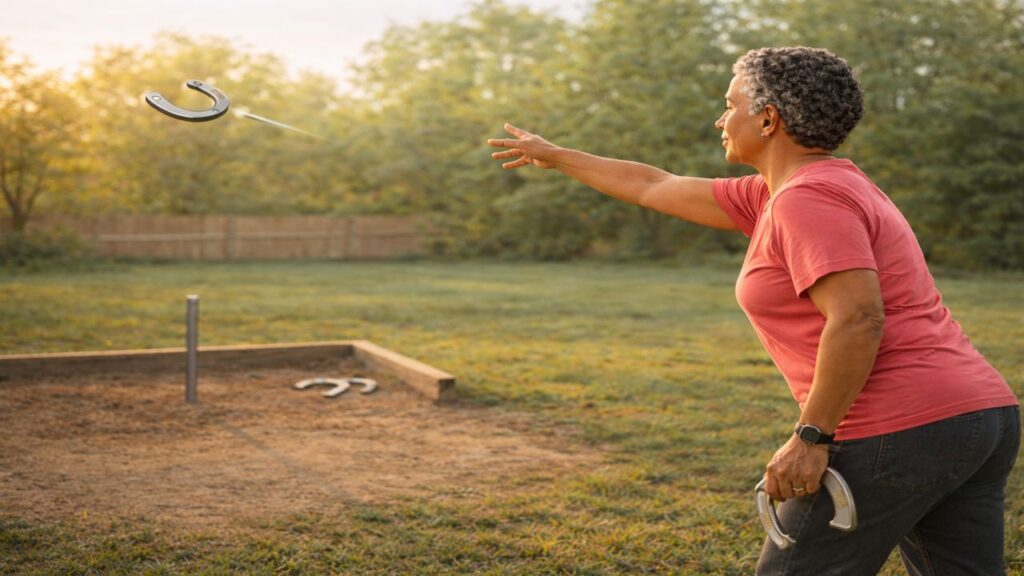
A horseshoe pitch starts long before the arm moves.
Your brain is already coordinating:
- Eye alignment on the stake
- Distance judgment
- Grip pressure
- Arm path and tempo
By the time the shoe leaves your hand, a full sequence of decisions has already happened — slowly enough that your brain can process them.
Miss left? That’s visual alignment.
Too long? Release timing.
Short and flat? Arc control.
The feedback is immediate and specific. Over time, your brain learns to make better predictions before the hand even moves.
That’s coordination at the neurological level, not just physical repetition.
2. Why Slower Games Build Better Coordination
This is where horseshoes separates itself from most sports.
Speed forces reaction.
Slowness allows correction.
After every pitch, you have time to:
- Feel the release
- Replay the motion mentally
- Make one small adjustment
You’re not rushed into the next throw. That pause is critical. It gives your nervous system time to connect cause and effect.
Players often start noticing internal cues:
- “That one felt rushed.”
- “I opened my hand too early.”
- “That release felt clean.”
Those sensations become reference points. Over time, your body automatically repeats the good ones and avoids the bad ones.
That’s how coordination becomes reliable instead of accidental.
Visual Tracking Without Distractions
Another reason horseshoes work so well is the visual environment.
Your eyes stay on:
- One fixed target
- At a consistent distance
- With minimal background movement
The shoe follows a predictable arc. There’s no sudden change in direction, no competing visual stimulus.
That clean setup trains:
- Depth perception
- Timing awareness
- Eye-to-hand synchronization
In fast sports, your eyes jump constantly between moving objects. That’s useful, but it doesn’t isolate coordination the same way.
Horseshoes strips the process down to its essentials.
3. Consistency Is the Hidden Accelerator
Coordination improves fastest when variables stay stable.
That includes:
- Distance
- Target
- Motion
- Equipment
Using a consistent horseshoe set helps your hands and eyes learn together instead of constantly adjusting. A solid option for casual and league-style play is the Champion Sports Official Weight Horseshoe Set. The shoes have predictable balance and weight, which lets players focus on mechanics rather than compensating for uneven feel.
Good equipment doesn’t improve coordination by itself — but inconsistent equipment can slow it down.
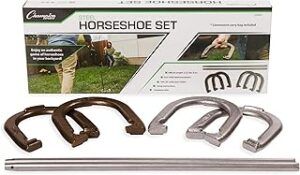
Horseshoe Game Set
Why Horseshoes Work Across All Ages
One of the strongest proofs of horseshoe’s coordination benefits is how well it works for different age groups.
You’ll see it immediately when kids, adults, and seniors throw at the same pit.
- Kids develop coordination because the motion is simple and repeatable
- Adults refine coordination through controlled repetition
- Older players maintain coordination without high-impact stress
Most sports favor speed, strength, or endurance. Horseshoes favor timing and control.
That’s why improvement never really stops — it just changes shape.
What Improves First (Even If Players Don’t Notice)
New players usually focus on ringers. That’s natural, but ringers aren’t the real indicator of coordination.
What improves first is:
- Release consistency
- Arc stability
- Follow-through control
Players often say things like:
- “I’m missing closer.”
- “My throws feel smoother.”
- “I don’t yank it as much.”
That’s coordination locking in quietly.
Ringers come later.
4. Why Horseshoes Transfers to Other Activities
One of the most overlooked benefits is how horseshoe coordination carries over.
Players often notice:
- Better accuracy in other sports
- Improved balance during movement
- More controlled hand motions in daily tasks
That’s because horseshoes train intentional motion. You’re not reacting to chaos — you’re executing a plan.
That skill transfers cleanly.
Coordination Without Mental Burnout
Fast-paced activities sharpen reflexes, but they also exhaust the brain.
Horseshoes do the opposite.
The steady rhythm allows sustained focus without overload. You can throw for a long time without feeling mentally fried.
That makes horseshoes ideal for:
- Skill rebuilding
- Low-stress practice days
- Mental reset routines
You walk away sharper, not drained.
5. Common Coordination Problems Horseshoes Naturally Fix
Without formal instruction, horseshoes often correct:
- Over-gripping
- Jerky arm motion
- Inconsistent release timing
- Poor follow-through
The feedback loop is honest and immediate. The pit doesn’t lie.
Your body adapts on its own.
Why Horseshoes Feel “Easier” Over Time
Players often describe a moment when throwing starts to feel effortless.
That’s not strength.
That’s coordination.
When your eyes, brain, and hand stop arguing, the motion smooths out. You’re no longer forcing the throw — you’re guiding it.
That feeling is addictive, and it’s one of the reasons players keep coming back.
Questions Players Commonly Ask
Are horseshoes really good for hand-eye coordination?
Yes. It isolates timing, release, and visual alignment better than most sports.
Is it better than faster sports?
Not better — different. Horseshoes build precision instead of reaction speed.
How often should I play to see improvement?
Short, regular sessions work better than long, occasional ones.
Do beginners benefit right away?
Yes. Coordination improves before players even realize it.
Is this suitable for seniors?
Absolutely. Low impact and controlled movement make it ideal.
Why Horseshoes Deserve More Credit
The beauty of horseshoes lies in their accessibility. Anyone can pick up a horseshoe and play, which makes it an ideal game for people of all ages to enhance their coordination. The techniques practiced here build a solid foundation for physical activities or even aid in recovering motor skills for those going through rehabilitation.
Encouraging friends and family to give horseshoes a shot can open up new avenues for personal growth. It’s a chance to gather, engage, and learn in a laid-back setting that cherishes patience and precision over speed and flash. Horseshoes rewires how we consider hand-eye coordination—showing that true mastery can be pursued in fresh and fun ways.
So, if you or someone you know is looking to boost their coordination in a way that’s both effective and surprisingly enjoyable, think about setting up a horseshoe pit. You might just discover the secret skills waiting to be uncovered with each deliberate throw. Embrace the simplicity and see the transformation firsthand.
Horseshoes doesn’t advertise itself as a coordination builder.
It doesn’t need to.
By slowing the game down, simplifying the environment, and rewarding controlled movement, it creates ideal conditions for hand-eye coordination to develop naturally — and last.
If you’ve ever noticed your throws feeling smoother, more controlled, and more repeatable, that’s not luck.
That’s the game doing exactly what it’s designed to do.
Horseshoe Gifts and More!
This shop is my clubhouse for fellow players. You’ll find mugs, shirts, and pit gear to keep games fair, trash talk fun, and ringers flying — whether you’re building your first court or running a league.