Trash-Talk Tactics: The Art of Psychological Warfare in Horseshoes
Because sometimes the real battle isn’t in the pit — it’s in your opponent’s head.
Playing Horseshoes has two parts:
- Throwing steel, and
- Destroying your opponent’s confidence with small, carefully crafted verbal attacks.
Every backyard group has “that person” who knows exactly what to say at exactly the right moment. And whether they admit it or not, trash talk is part of the game’s DNA. It’s not mean. It’s not cruel. It’s just… strategic.
In fact, some experts (mostly self-appointed, holding solo cups) claim trash talk plays a bigger role in winning than form or technique.
Let’s break down the psychology of horseshoe warfare, one well-placed jab at a time.

1. The Classic One-Liners
These are the universal tools of the pit — the lines that have been echoing through backyards for decades.
They’re simple.
They’re effective.
And they burrow into your opponent’s brain like sand in a sweaty horseshoe glove.
Examples:
- “You sure you’re aiming at that stake?”
- “Bold choice. Let’s see how it works out.”
- “Oh look, you’re consistent — consistently off.”
These lines introduce the two forces horseshoe players fear most:
Self-doubt and hesitation.
You can see the internal monologue begin:
“Wait… am I off? Should I adjust? Do I look nervous?”
Boom. You’ve already won the first mental round.
2. The Compliment That Isn’t a Compliment
This is the sly, slippery psychological trap.
Delivered with a smile, but sharpened like a freshly cleaned stake.
Examples:
- “That was almost good!”
- “You’ve got great form… when you actually hit the pit.”
- “Wow, you’re really improving. Slowly, but still.”
These “nice” comments sow confusion.
Did they just praise you?
Or insult you?
Or both?
Players who overthink (hello, Virgo and Libra) crumble under the weight of this gentle psychological assault.
3. The Mechanical Breakdown Move
This one is deadly — especially against technique-obsessed players.
All you do is casually point something out about their form.
Anything.
No matter how small.
Examples:
- “Hmm… your wrist rotation is different today.”
- “Is the wind messing with your release angle?”
- “Your stance looks… interesting. New technique?”
Even if they were throwing perfectly, once you trigger the “form spiral,” their brain becomes a malfunctioning instruction manual.
Suddenly, they’re thinking about wrist rotation, elbow height, hip alignment, breathing patterns, and the alignment of Jupiter.
Meanwhile, you’re walking up and dropping ringers.
4. The Jedi Mind Trick
This one requires finesse — and the ability to lie with confidence.
You don’t insult them.
You don’t even mention technique.
You simply plant a thought… subtle but corrosive.
Examples:
- “Careful — this pit leans left.”
- “You’ve been overthrowing a lot lately.”
- “This is your weak side, right?”
These aren’t even necessarily true.
But they activate the fear center of the brain just in time to ruin the throw.
You’ve basically become the Obi-Wan Kenobi of backyard sabotage.
5. The Grandparent Special
This is a stealth-level psychological weapon typically mastered by players over 60.
It involves:
- No talking
- No insults
- Just quiet, devastating disappointment
Examples:
- The slow head shake after you miss
- The long, deep sigh
- The “I raised you better than this” expression
- The hands-behind-the-back stroll toward the pit
No one wants to disappoint Grandpa.
And no one plays well when they think they’ve let him down.
6. Body Language Warfare
Words are optional.
Your face, posture, and gestures do all the heavy lifting.
Common moves:
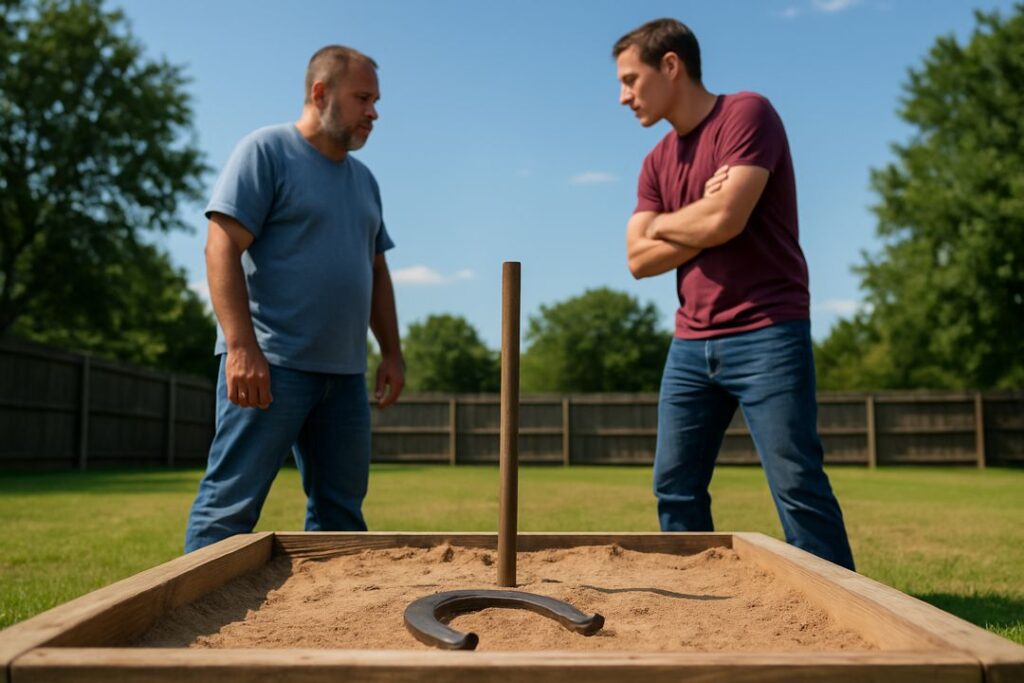
- Crossing your arms as they line up
- Raising an eyebrow when they release
- Staring directly at their horseshoe in the air
- Doing a slow, exaggerated “wow” face before it hits
A perfectly timed shoulder shrug can ruin a player’s confidence for an entire season.
7. The Partner Sabotage Strategy
Trash talk doesn’t just go toward opponents.
Sometimes the “friendly fire” hits your own teammate — intentionally or not.
Examples:
- “We really needed that one…”
- “You sure you want to go first this round?”
- “No pressure, but you miss this, and we lose.”
Nothing ruins a solid throw like a teammate implying you’re the weakest link.
8. The Ringer Prediction Trap
Predicting someone’s miss is a Jedi-level tactic.
Predicting it confidently is downright cruel — and devastating.
Examples:
- “Feels like you’re gonna overthrow this one.”
- “That looks like a left drift coming.”
- “This is going short. I can tell.”
Their brain becomes your puppet.
If they don’t overthrow, they underthrow.
Either way, you win.
9. Fake Encouragement — The Silent Assassin Tool
This is the tactic of someone who claims they “don’t trash-talk.”
Lies.
They just trash-talk politely.
Examples:
- “You’re getting better — just keep trying.”
- “Wow, so close! Again!”
- “Relax, don’t overthink… oh, you did.”
Delivered in a warm, soothing, smug tone.
Perfect for rattling sensitive players without the guilt.
10. The Advanced Trash-Talk Tiers
Every backyard pitcher climbs through these as they evolve:
Tier 1: Friendly Banter
Jokes, laughs, smiles.
Nobody’s mad. Yet.
Tier 2: Skill Sabotage
Comments about form, stance, and aim.
Doubt creeps in like a slow leak.
Tier 3: Psychological Manipulation
Fake encouragement, predicted misses, subtle deception.
This is where the real battle begins.
Tier 4: Emotional Warfare
Lines like:
- “You okay? You seem off today.”
- “You usually do better. What’s wrong?”
Designed to make you question your entire existence.
Tier 5: Relationship-Level Stakes
This is where spouses come in with full artillery:
- “You’re sleeping on the couch if you don’t land this.”
- “Don’t embarrass me in front of my family.”
- “Kids are watching, don’t mess up.”
Horseshoe games have ended marriages.
Probably.

11. Who Are the Best Trash Talkers? A Horseshoe Zodiac Breakdown
Because after writing The Horseshoe Zodiac, we can’t not compare.
Aries
Aggressive, bold, loud.
Full-contact trash talk.
Gemini
Chaotic, unpredictable, hilarious.
Weaponizes distraction.
Leo
Dramatic psychological performance art.
Every comment is a monologue.
Virgo
Technical, devastating, surgical.
Targets your form like a laser.
Scorpio
Silent, intense, terrifying.
They say nothing — and it works.
Sagittarius
Fun, wild, obnoxiously confident.
Talks during their own throw.
Capricorn
Serious competitor.
Trash talk is dry, efficient, cutting.
Everyone else?
They try — but these signs dominate the backyard battlefield.
12. When Trash Talk Goes Too Far
There is a line.
You’ll know it when:
- Someone packs up early
- A horseshoe gets thrown harder than necessary
- The grill master stops smiling
- The whole backyard goes quiet except for one guy saying,
“It was just a joke…”
Playing Horseshoes is supposed to be fun.
The moment someone gets genuinely mad?
You’ve gone from “legendary banter” to “you’re not invited next weekend.”
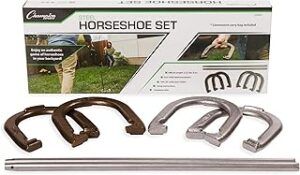
Product Spotlight: Champion Sports Horseshoe Set
Durable steel, clean grip, balanced weight — perfect for veteran pitchers, beginners, and anyone who needs a reliable set while roasting their buddies.
Solid build. Great feel. Won’t chip under pressure (even if your friends do).
Horseshoe Game Set
The Pit Never Lies
Trash talk is the spice of backyard horseshoes.
Used right, it adds flavor, tension, and unforgettable moments.
Used wrong, it’s a one-way ticket to being that guy.
But at the end of the day, the pit doesn’t care.
It reveals the truth in every throw, leaner, bounce, and ringer.
So sharpen your one-liners, practice your eyebrow raises, and master the silent head shake.
Because in the game of horseshoes, the ultimate victory isn’t just on the scoreboard…
It’s in the mind of your opponent.
So remember, while you’re chucking steel and trading jabs, you’re also becoming a little bit sharper, a tad more savvy, and a lot more fun at backyards picnics. Who knew a game of horseshoes could be such good training for life?
This shop is my clubhouse for fellow players. You’ll find mugs, shirts, and pit gear to keep games fair, trash talk fun, and ringers flying — whether you’re building your first court or running a league.