Master the Mental Game: Focus, Confidence, and Strategy in Horseshoe Pitching
Ask any serious horseshoe pitcher what separates good players from great ones, and the answer isn’t just accuracy or mechanics. It’s the mental game.
You can practice for hours and nail perfect throws in your backyard, but if your confidence cracks in the final inning or your focus wavers with a crowd watching, you’ll miss the shots that matter. On the flip side, players with “average” mechanics often win because they’ve mastered their headspace — they stay calm, make smart decisions, and execute under pressure.
This guide digs deep into the psychology of horseshoe pitching. We’ll cover how to sharpen your focus, build unshakable confidence, and use strategy to outthink opponents. With drills, routines, and examples you can apply right away, you’ll learn how to play smarter — not just harder.
Why the Mental Game Is Half the Battle
Horseshoe pitching may look simple: step, throw, hope for a ringer. But the space between pitches is where the real battle happens. You’ve got seconds to clear your mind, manage nerves, and repeat mechanics under pressure.
3 reasons mental strength matters:
- Consistency beats luck. Even casual players land a ringer now and then. But confidence and focus separate “one-hit wonders” from those who hit 40% or more consistently.
- Pressure magnifies mistakes. A tense hand or rushed release can undo months of practice. Calm pitchers hit their stride when others fold.
- Strategy shifts games. Horseshoes isn’t just about who throws best — it’s who thinks best. Knowing when to go for a ringer or block can change outcomes.
👉 Bottom line: If you don’t train your mind as much as your throw, you’ll plateau.
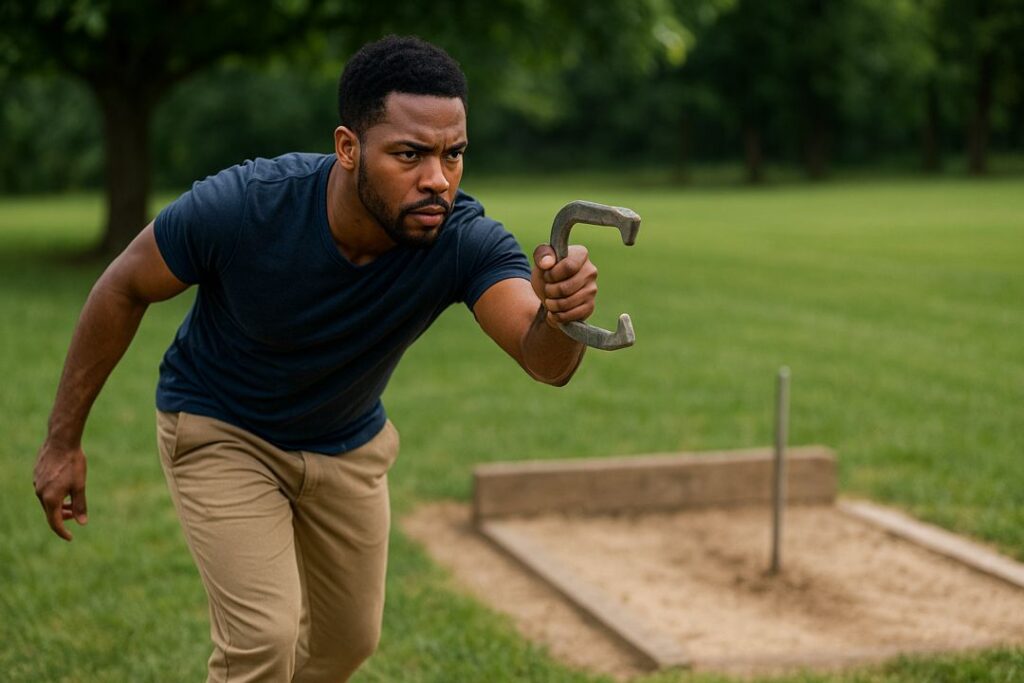
Building Laser-Like Focus
Focus is your ability to block distractions and deliver the same throw, pitch after pitch. You can train it just like you train your release.
1. The Breathing Anchor
Before each pitch:
- Inhale deeply.
- Exhale slowly.
- Step and throw on the exhale.
This sets a rhythm and keeps nerves from creeping in.
2. Visualization Drill
Close your eyes, picture the horseshoe clanging on the stake, then pitch. Mental rehearsal wires your brain for success.
3. Reset Routine
After a bad throw, don’t spiral.
- Shake out your arm.
- Take two slow breaths.
- Step back up fresh.
👉 Pro players often have tiny reset rituals: tapping the shoe, fixing their hat, wiping their hands. These aren’t quirks — they’re psychological resets.
Confidence: Your Silent Edge
Confidence doesn’t mean cocky. It means trusting your throw when it counts. Without it, your body tenses, your release changes, and your game tanks.
How to Build Confidence
- Track your progress. Write down ringer percentages after each session. Nothing boosts confidence like proof you’re improving.
- Practice under pressure. Simulate match points during practice — “I need this ringer to win.” The more you rehearse pressure, the calmer you’ll be in real games.
- Use positive self-talk. Instead of “don’t miss,” say “smooth release.” Your brain acts on positive cues better than negative warnings.
- Start small. During slumps, step closer to the stake and throw until you string hits together. Build confidence at short range, then back up.
👉 Example: In one local league, a veteran pitcher with mediocre mechanics consistently placed top three. Why? He never looked rattled. Even when he missed, he shrugged it off. His calm unnerved others — and that was his edge.

Strategy: Outsmarting Opponents
Horseshoes is a thinking game as much as a throwing one. A well-timed block or safe play can be worth more than a risky ringer attempt.
Singles Play Strategy
- Protect the stake. If you’re ahead, aim to land close, even without ringers. Force your opponent to risk bad throws.
- Tempo control. Don’t let them rush you. Step back, breathe, pitch at your pace.
- Mind games. Stay steady in expression. If you look rattled, they gain confidence.
Doubles Play Strategy
- Partner support. If your partner misses, don’t carry that stress into your throw. Reset, breathe, and pitch like it’s 0–0.
- Communication. Agree on strategy: one aggressive, one safe. This balances risk.
Playing From Behind
- Small wins. Don’t force ringers on every pitch. Aim for solid points and chip away at the lead.
- Momentum swings. Focus on the next throw, not the scoreboard. One double ringer can flip the game.
👉 Real Example: In the 2019 NHPA World Tournament, several underdogs won matches not by throwing more ringers, but by forcing opponents into bad positions through smart blocks.
The Mental Training Toolbox
Here are drills and routines to develop your inner game:
Distraction Drill
Have friends talk, play music, or walk behind you while pitching. Train to block noise and movement.
Focus Grid
Print a sheet of random numbers 1–100. Each day, circle them in order as fast as you can. It trains concentration.
Mindful Minute
Sit quietly for one minute, focusing only on your breath. When your mind wanders, reset. This teaches focus control.
Pressure Rep Drill
Give yourself one chance per pitch. Miss? Write it down. This recreates game-day pressure where every throw matters.
Gear That Helps the Mental Game
Sometimes the right tools make practice smoother — fewer distractions, better focus:
- St. Pierre American Professional Series Horseshoes – Balanced, pro-quality shoes that inspire confidence.
- Tripod Phone Mount – Record throws, spot mechanics, and build self-trust.
Horseshoe Game Set
Case Studies: When the Mind Wins
- The Calm Veteran: In a local league, “Rick” never panicked. Even when down 10 points, he smiled, reset, and pitched steadily. His composure rattled hot-headed opponents.
- The Trash Talker’s Victim: “Tom” was a great thrower — until rivals talked him off his game. Instead of resetting, he rushed throws and lost matches he should’ve won.
- The Rookie With Rituals: A newcomer, “Lisa,” built a simple pre-throw routine: deep breath, adjust grip, exhale, pitch. Within weeks, her ringer percentage jumped because she repeated the same process every throw.
These stories prove skill gets you into the game — but mindset keeps you there.
FAQ: The Mental Game in Horseshoes
Q: How do I stop choking under pressure?
A: Practice pressure drills. Give yourself “must-hit” throws in practice so match pressure feels familiar.
Q: Should I copy pro players’ routines?
A: Use them for inspiration, but build a personal ritual that feels natural. Consistency is more important than mimicry.
Q: What if my opponent trash-talks?
A: Take it as a compliment — they’re worried about you. Reset, breathe, and stick to your rhythm.
Q: Can mental drills really add points?
A: Absolutely. Even a 5% increase in ringer percentage can mean several extra wins over a season.
Q: My partner struggles in doubles. How do I stay sharp?
A: Control what you can. Reset before each pitch and encourage them, but don’t carry their misses.
Final Thoughts
Horseshoe pitching isn’t just a backyard pastime — it’s a mental duel as much as a physical one. The players who rise above are the ones who learn to:
- Focus like a laser when distractions loom.
- Build confidence that carries through misses and slumps.
- Use strategy to outthink opponents, not just outthrow them.
Start small: pick one focus drill, one confidence booster, and one strategy tweak. Layer them into your weekly practice, track your progress, and watch your ringer percentage climb.
Because in the end, the biggest opponent isn’t the person across the pit — it’s the voice in your head. Train that voice, and you’ll master not just the game of horseshoes, but yourself.
👉 Your move: Which mental drill are you going to try first? Comment below and let’s swap strategies.
Hi there, and thanks for stopping by! My name is Larry, and I’m the voice behind PlayingHorseshoes.com. I love the game and have been playing since I was a kid. I started this blog because I am passionate about the sport, and with all the technology, I hope the sport doesn’t die. I plan to do my part to keep it going for my brother and my sake. Thank you for stopping by. Feel free to subscribe and comment. Thank You!