Why Some Players Get Better Faster: The 7 Stages of Horseshoe Skill Growth
If you’ve been around horseshoes long enough, you’ve seen it happen. Two beginners show up on the same day, both eager, both clueless, both tossing shoes like they’re skipping rocks at the lake. Fast-forward a few weeks later, and suddenly one of them is smoothing out their stance, lining up ringers, and acting like they’ve been pitching since the 80s… while the other is still praying the shoe doesn’t land sideways.
Why does that happen?
Why do some players get good fast — almost suspiciously fast — while others grind for years with only a tiny bump in accuracy?
It’s not luck. It’s not genetics. And it’s definitely not that mysterious “horseshoe mojo” we joke about between pits. The truth is that every horseshoe pitcher goes through a predictable progression — seven stages, in fact — and the ones who improve quicker simply move through those stages more deliberately.
This is the roadmap. Whether you’re brand-new, years in, or coaching someone else, understanding these stages turns the whole game into something you can actually master, not just hope for.
Let’s break them down.
Stage 1: The Curiosity Stage — “Let me see if I can even get it near the stake.”
Every player starts here, even if they don’t admit it. This is where you’re learning how the shoe feels — the weight, the balance, the awkwardness — and testing whether you can even control it. Most folks throw with whatever grip “feels right” without any thought behind it.
Common experiences at this stage:
- Shoes wobble like a loose hubcap
- Zero consistency in landing spots
- Feet move wherever they want
- Eyes bounce between the shoe, the stake, and the pit
- Every good throw feels like a happy accident
Nobody stays here long because everything is brand new and exciting. Curiosity and novelty pull you forward fast.
Players who improve quickly in this stage:
- Ask questions
- Watch how others pitch
- Don’t try to force power
- Stay relaxed and playful
Players who get stuck:
- Overthink
- Get frustrated with misses
- Imitate terrible backyard habits
If you’re coaching beginners, here’s the goal: keep them curious, not intimidated.
Stage 2: The Control Stage — “Okay, now I can at least throw the thing.”
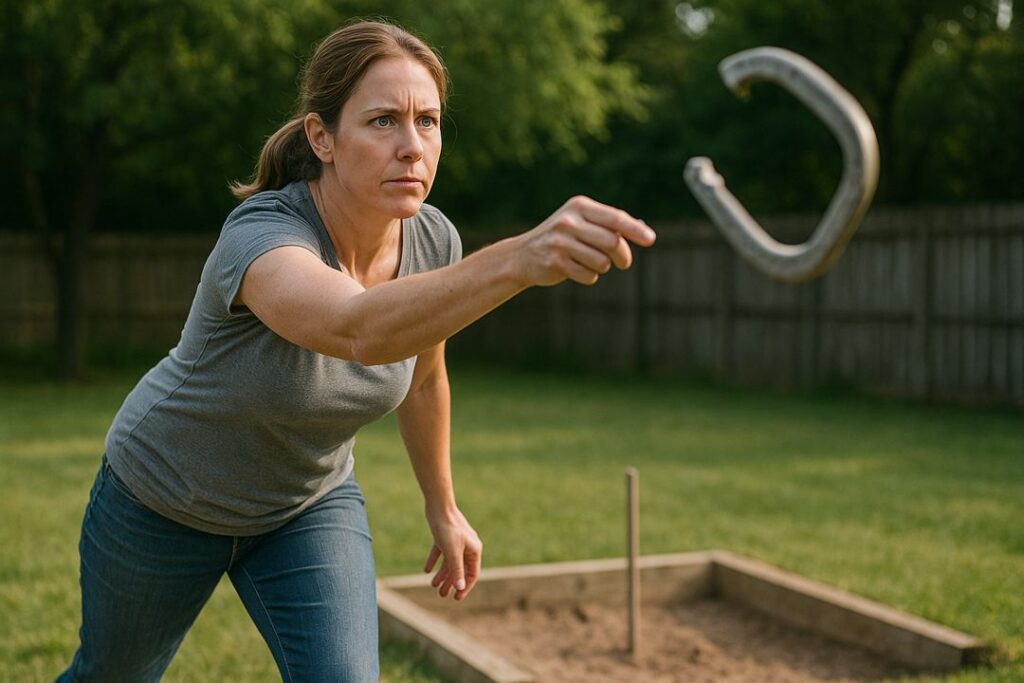
Once you’ve tossed enough shoes to stop feeling like you’re juggling hot metal, you enter the control stage.
Now, instead of random chaos, you’re focusing on:
- A consistent grip
- A predictable stance
- A smoother arm path
- Less wobble in the air
This is when most players discover that horseshoes require more finesse than it looks. You realize you can’t “muscle” a ringer — you have to guide it.
The secret of the fast improvers at this stage?
They pick one grip and one stance and commit to it.
Slower learners change their grip every five minutes, trying to chase whatever feels easy in the moment. That resets progress constantly.
The word for this stage is control, but not full control yet — just enough to feel like you’re not guessing every throw.
Stage 3: The Repeatability Stage — “Now I’m trying to do the same thing twice.”
This is where the game starts to get real.
Repeatability is the heart of horseshoes. Power doesn’t matter. Fancy shoes don’t matter. Age doesn’t matter. The athlete who can repeat the same motion tens of thousands of times wins.
At this stage, players begin working on:
- Matching their stance
- Matching their pace
- Matching their arm swing
- Matching their release point
- Matching their follow-through
The players who grow fast:
- Pick a target point (like the top of the stake or the front of the pit)
- Use a calm, repeatable rhythm
- Don’t rush their setup
- Take notes on what’s working and what’s not
The ones who fall behind:
- Throw too fast
- Constantly tweak things mid-game
- Look up too quickly after the release
- Try to “correct” the throw while throwing
At this stage, a player’s bad habits either cement or get corrected for good.
Stage 4: The Precision Stage — “I know what I want the shoe to do… now I just need to make it happen.”
Once you can repeat your throw, the game shifts into precision. This is where the better players start separating from the recreational ones.
At this point, players are working on:
- Dialing in the exact rotation
- Fine-tuning release angle
- Developing a consistent landing zone
- Throwing shoes that behave the same way in the air
This is when a pitcher moves from “shooting to hit the pit somewhere” to “I’m going to drop the shoe right beside the stake.”
A key difference shows up here:
Fast improvers watch their misses.
Slow improvers hunt for excuses.
Every miss tells you something:
- Too much rotation
- Not enough wrist
- Too low
- Too high
- Released too early or too late
- Wrong alignment
Players who analyze the miss get better fast.
Players who shrug and blame the wind? They stay stuck.
Stage 5: The Ringer Window Stage — “I’m not hoping for ringers anymore… I’m planning on them.”
This is where the magic happens.
You’re not just throwing accurately — you’re throwing strategically.
A player at this stage is no longer amazed when they throw a ringer. They expect it. The best players widen their “ringer window,” meaning the space in front, behind, and around the stake becomes their landing zone.
This stage develops:
- Shot planning (“If I miss left, it needs to bump the stake.”)
- Ringer-friendly angles
- Landing consistency
- Predictable shoe rotation each time
If you’ve ever watched a seasoned pitcher, they don’t throw for “close.”
They throw for capture.
Fast learners at this stage:
- Keep confidence stable
- Don’t get rattled by misses
- Know their shoes’ behavior intimately
- Know when they “feel off” and how to reset
This is when the game becomes dangerous — in the best way. Your percentage climbs. Your mindset tightens. You start smelling victory before it happens.
Stage 6: The Strategy & Adjustment Stage — “Now I’m playing the game, not just throwing.”
Precision alone won’t win every match. At higher levels, strategy is everything.
At this stage, players learn how to:
- Adjust for wind
- Adjust for pit conditions
- Adjust for soft vs. firm sand
- Switch grips if needed
- Vary arc height to counter bounce-outs
- Play percentage shots
- Respond to an opponent’s points
- Protect points already earned
Fast improvers master one key skill:
Real-time correction.
If their first two throws drift right, they make a micro-adjustment — instantly.
Slow improvers wait until next week to think about what went wrong.
The ones who jump to the top bracket understand that strategy + mechanics = unstoppable.
Stage 7: The Mastery Stage — “Now your motion is instinct, and your game is prediction.”
This is where the game becomes second nature.
Mastery doesn’t mean perfection — even elite players miss. It means:
- You don’t overthink the motion
- Muscle memory handles most of the work
- Your eyes read the pit instantly
- You adjust with confidence
- You can teach others clearly
- You develop your own “style”
Players here understand the language of horseshoes:
- The “thunk” sound of a good landing
- The slow fall of a nearly perfect ringer
- The feel of a clean release
- The instinctive read of a windy pitch
- The difference between a soft pit and a firm one
Fast improvers reach this stage sooner because of one thing:
They stay students.
They never assume they’ve “arrived.”
The best players — the ones you’d bet money on — are curious, analytical, and humble enough to keep learning forever.

Why Some Players Race Through These Stages While Others Crawl
Seven stages. Everyone goes through them. But here’s what separates the fast risers from the slow grinders.
They practice with intention, not repetition.
Throwing 200 shoes badly just builds 200 bad throws into your muscle memory.
Throwing 20 shoes deliberately builds skill.
They work on one improvement at a time.
Slow players try to fix everything at once.
Fast players fix:
- grip today
- stance tomorrow
- release angle next week
Small focus = big growth.
They don’t blame misses — they study them.
A ringer tells you almost nothing.
A miss tells you everything.
They find a mentor or a model early.
Watching a good pitcher is the fastest shortcut in the game.
Fast learners copy effective mechanics, not random backyard habits.
They stay relaxed.
Tension destroys accuracy more than anything.
Players who breathe, stay loose, and stay playful learn faster than those who treat every throw like a job interview.
They show up.
This one sounds obvious, but steady players improve dramatically faster.
Consistency beats talent.
Every. Single. Time.
How to Use This Knowledge to Improve Your Game Faster
If you want to accelerate your growth — or help someone else do it — here’s your cheat sheet.
1. Identify your current stage.
Don’t lie to yourself.
If you’re mixing grips every other pitch, you’re not in the precision stage yet.
2. Master the basics before adding speed or power.
Consistency always beats strength.
3. Track your progress.
Even a simple “what worked today” note in your phone keeps you advancing.
4. Film your throw occasionally.
You’ll spot mistakes instantly.
5. Pair up with someone better than you.
The fastest way to learn is to get comfortable losing to someone who pushes you.
6. Make adjustments quickly.
If your first two throws drift left, fix it now, not in two weeks.
7. Stay humble and keep learning.
Mastery is just Stage 6 done consistently.
Recommended Gear to Level Up Your Practice
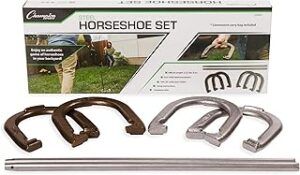
Gordon Professional Pitching Horseshoes
A dependable option for players moving through the precision and ringer-window stages. Good weight, balanced feel, and easy rotation control make them ideal for improving consistency. A solid upgrade from beginner sets without the price of pro-tournament models.
Horseshoe Game Set
FAQ: Skill Growth in Horseshoes
How long does it take to get good at horseshoes?
Beginners usually see meaningful improvement within a few weeks of steady, deliberate practice. Mastery takes longer, but progress comes quickly when fundamentals are consistent.
What’s the fastest way to improve accuracy?
Commit to one grip, one stance, and one release angle. Consistency beats everything else.
Do higher-quality horseshoes help?
Quality shoes make learning easier because they rotate and land more predictably. They don’t replace technique, but they support it.
Why do my shoes keep drifting left or right?
Side drift usually comes from early/late release or shoulder alignment issues. A tiny setup correction often solves it.
How can I tell which stage I’m in?
Look at what you naturally focus on: getting close (Stages 1–2), repeating your motion (Stage 3), fine-tuning rotation (Stage 4), planning ringers (Stage 5), strategy (Stage 6), or instinctual mastery (Stage 7).
Can older players still get better fast?
Absolutely. Horseshoes reward rhythm, not brute force. Many seniors out-improve younger athletes because they pitch with patience and consistency.
Thoughts
Horseshoes isn’t a game you learn in a weekend. It’s a progression — stage by stage, throw by throw. When you understand the seven stages of development, you give yourself a massive advantage. You stop guessing, and you start growing.
The players who improve quickly aren’t luckier. They’re more deliberate. They stay curious. They study their misses. They show up. And they keep moving forward even when progress feels slow.
With the right mindset, the right mechanics, and the right rhythm, anyone can move through these stages — and start stacking ringers like they’ve been playing their whole life.
Next Step:
Ready to sharpen your throwing precision even more? Check out Pitch Like a Pro – A Beginner’s Guide to Horseshoes by Larry McCullough — a complete playbook for grip, stance, and mental mastery that’ll help you pitch like the pros.