
Women in Horseshoes: Growing the Game One Pitch at a Time
If you’ve ever stood over a stake with a horseshoe in your hand, you know the magic: the quiet focus, the easy banter, the satisfying clink when steel finds steel. Horseshoes is the rare sport that blends precision, patience, and people. And here’s what’s changing the game for the better: more women are playing than ever—at parks, in leagues, at state championships, and yes, on backyard pits between cookouts and birthday parties.
This isn’t a token trend. It’s momentum. Women in horseshoes are building communities, mentoring new players, organizing league nights, and bringing a level of consistency and calm under pressure that wins matches. If you’re new and curious, or you’ve been quietly pitching for years, consider this your invitation to step up, aim true, and join the movement—one pitch at a time. 👟
Why Horseshoes Welcomes Women (and Always Has) 🤝
Skill over strength. The heart of horseshoes is repeatable form. The sport rewards smooth mechanics, touch, and accuracy—not brute force. That naturally levels the playing field and makes coed play genuinely competitive.
All ages, all seasons. You can start as a teen, return after raising a family, or find it later in life and still get really good. Many clubs run year-round with outdoor and indoor seasons.
Community first. Most leagues feel like neighborhood cookouts with scoreboards—warm, social, and supportive. New pitchers get tips between frames. Kids chase ringers. Friends hang out after matches. It’s a scene you want to be part of.
Low-impact, high-focus. Horseshoes are easy on joints but tough on attention. You’ll break a sweat walking and raking pits, but the mental reps—breathing, aiming, repeating—are where you’ll grow.
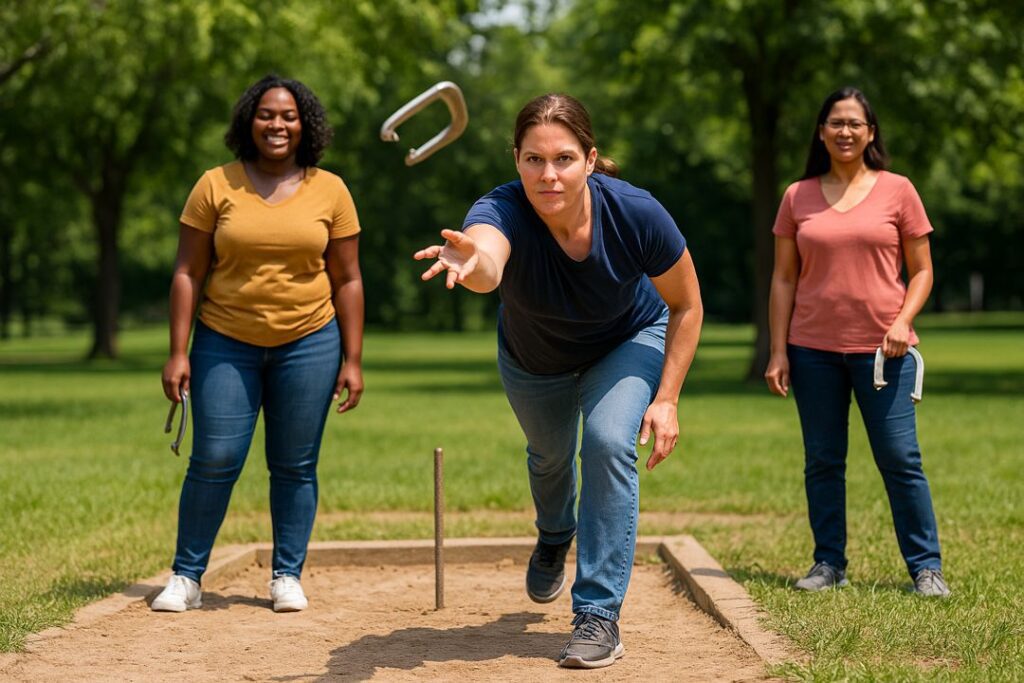
A Short History—And a Long Overdue Spotlight 📜
Women have pitched horseshoes for generations. The early stories aren’t all in the record books, but they live in county fair photo albums and family legends—mixed doubles games at reunions, neighborhood weeklies, church fundraisers on Saturday afternoons. As formal tournament structures matured, women formed divisions, then local and state associations embraced them, and world-level competition created a clear path to championship play.
Today, women compete in coed leagues and women’s divisions, coach juniors, and serve as club officers. The model is simple and powerful: inclusion drives participation, participation develops skill, and skill draws in more players. The sport gets deeper, broader, and more fun.
A Trailblazer like Sue Snyder showed that women could dominate the game just as well as men, inspiring a new generation of pitchers.
The Modern Landscape: Where Women Are Pitching (and Winning) 🏆
Across the U.S., you’ll find:
- Coed leagues at parks and rec centers where women regularly finish in the top spots.
- Women’s divisions at state and national tournaments, giving new pitchers a comfortable on-ramp.
- Mixed doubles nights where partners strategize, read the sand, and feed each other confidence.
- Junior programs where moms, aunts, and grandmothers are the first coaches kids ever have.
The takeaway: women aren’t just joining—they’re leading.
How to Start (If You’re New) — A Friendly, Step-by-Step Plan 👟
Step 1: Find your nearest court.
Search “horseshoe league near me” or “[Your State] Horseshoe Pitchers Association.” Many clubs also post schedules on Facebook.
Step 2: Watch a league night.
Observe stance, pace, etiquette, and how different players set their release. Say hello. Clubs love visitors.
Step 3: Borrow before you buy.
Most leagues have loaner shoes. Try a few weights to see what feels right in your hand.
Step 4: Start short, then scoot back.
If 30 feet is intimidating on day one, start closer. Build a rhythm, not frustration.
Step 5: Build a simple routine.
Pick a stance, a grip, and a release cue (e.g., “elbow up, wrist quiet, eyes on the stake”). Repeat the same sequence every throw.
Step 6: Track one stat.
Don’t obsess over ringers yet. Track “throws landing within one shoe-width of the stake.” Watch that number climb. Small wins, big momentum.
Technique, Made Simple: The 3-Part Pitch 🎯
1) Stance (set your base).
Feet shoulder-width. Shoulders squared to the stake. Relax your grip; tension kills touch.
2) Swing (smooth beats strong).
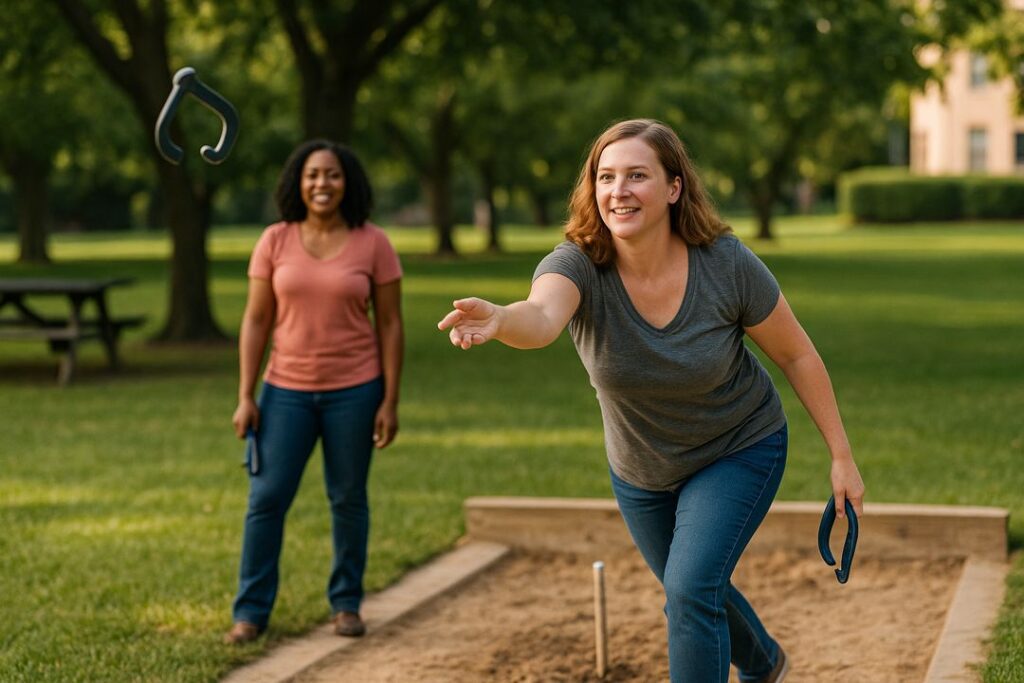
Backswing is slow and controlled. Keep the shoe level. Let the hips and shoulders guide the arm like a pendulum.
3) Release (quiet hands).
Release at about hip height with a soft wrist. The goal is a consistent rotation—many women prefer a gentle ¾ turn because it’s easy to repeat.
👉 Pro tip: Film 10 throws. Look for the same shoulder height, same release point, same follow-through. Consistency multiplies accuracy.
A 6-Week Solo Plan (When You Can’t Find a Partner) 📅
Week 1–2: Feel & Form
- 10-minute warm-up: easy swings, no target, just rhythm
- 3 sets × 20 throws: land shoes within a shoe-width of the stake
- Finish with 10 calm, perfect-form throws
Week 3–4: Aim & Adjust
- “Left-Right” drill: aim just left of the stake for 10, then just right for 10
- “Soft-High” drill: 10 higher arcs, 10 flatter throws—learn your flight window
- End with 15 accuracy throws, counting leaners
Week 5–6: Pressure & Pace
- 30 throws “game pace” (simulate frames—no resets)
- Pressure sets: 10 throws where you must beat your last score
- Finish with 10 visualization throws: breathe, see the ring, throw
Record your best of each week. Improvement is addictive.
League Night 101 (So You Feel Comfortable) 🤗
- Arrive early. Say hello, get assigned, warm up.
- Mind the lanes. Don’t cross into a neighbor’s pit during live throws.
- Score honestly. If you’re unsure, ask for a quick measure—zero drama.
- Encourage freely. Compliments for ringers and close shoes make nights more fun.
- Stay after. The best tips happen once games end.
Common Barriers Women Mention (and Easy Fixes) 💡
“I don’t know anyone yet.”
Perfect. You’ll know five people after your first night. Clubs are famously welcoming.
“I’m worried about throwing heavy shoes.”
Choose a slightly lighter pair to start. Your forearms will strengthen quickly.
“I’m not competitive.”
You don’t have to be. Plenty of players love the social side and the quiet focus of practice.
“It’s all guys.”
Even if it starts that way, one woman showing up can shift the vibe. Clubs love balanced rosters—invite a friend and make it a duo.
For Clubs and Leagues: How to Attract (and Keep) More Women 🌱
- Women’s intro nights. One hour of coaching, one hour of games—fun, pressure-free.
- Feature female players. Post profiles. Celebrate their milestones.
- Mentor program. Pair new women with a friendly veteran for the first month.
- Mixed doubles seasons. Built-in chemistry, more varied matchups, more laughs.
- Family membership options. Make it easy for parents and kids to join together.
- Flexible formats. Shorter match nights help busy schedules.
Mini-Clinic: Five Micro-Drills That Build Confidence Fast 🧠
- Stake-Brushers — Land shoes that gently touch the stake without slamming it. Teaches distance control.
- One-Step Throws — Take just one step into the release. Smooths timing and tempo.
- 10-10-10 10 throws at the left half, 10 at the right, 10 center. Sharpens aim.
- Leaners Only — Target leaners for a set. Forces precise stake contact.
- Last-Throw Lock-in — Always end practice with a throw you’d be proud to repeat. Mental carryover is real.
The Mind Game: Calm Beats Force 🧘♀️
The best pitchers talk about breathing and attention as much as mechanics. Before each throw:
- One deep breath (in through the nose, out through the mouth).
- Pick a single cue (e.g., “level shoe” or “quiet wrist”).
- Don’t chase ringers—chase good throws. Ringers arrive because good throws stack up.
Off-Season & Bad-Weather Options (Yes, You Can Keep Pitching) 🌧️
- Indoor leagues at community centers or club facilities.
- Short-distance lanes in garages or basements using sand tubs for safe landings.
- Strength & mobility: light forearm work, shoulder stability drills, and balance work keep your throw crisp.
(And no—no need for a “portable court kit.” If space is tight, a stake in a sand-filled tub is plenty for release practice.)
Gear Guide: A Solid Starter Set for Women Players 🧰
Recommended: Franklin Sports Classic Horseshoe Set
- Why it’s a fit: Forged steel for true flight, a feel many find slightly easier to control, and a build that holds up to weekly league nights.
- Who it’s for: New and returning pitchers who want a comfortable, confidence-building shoe while they groove consistent mechanics.
(As always, pick what fits your hand and style. The “best” shoe is the one you repeat well.)
Quick Etiquette Tune-Up (So You Look Like a Regular) 👍
- Don’t walk down the lane while someone is set to throw.
- Stand to the side and stay still during releases.
- If you accidentally distract a throw, offer a redo.
- Compliment good pitches—ringers, leaners, clutch close shoes.
- Help rake/level the pit between innings. Shared effort, shared pride.
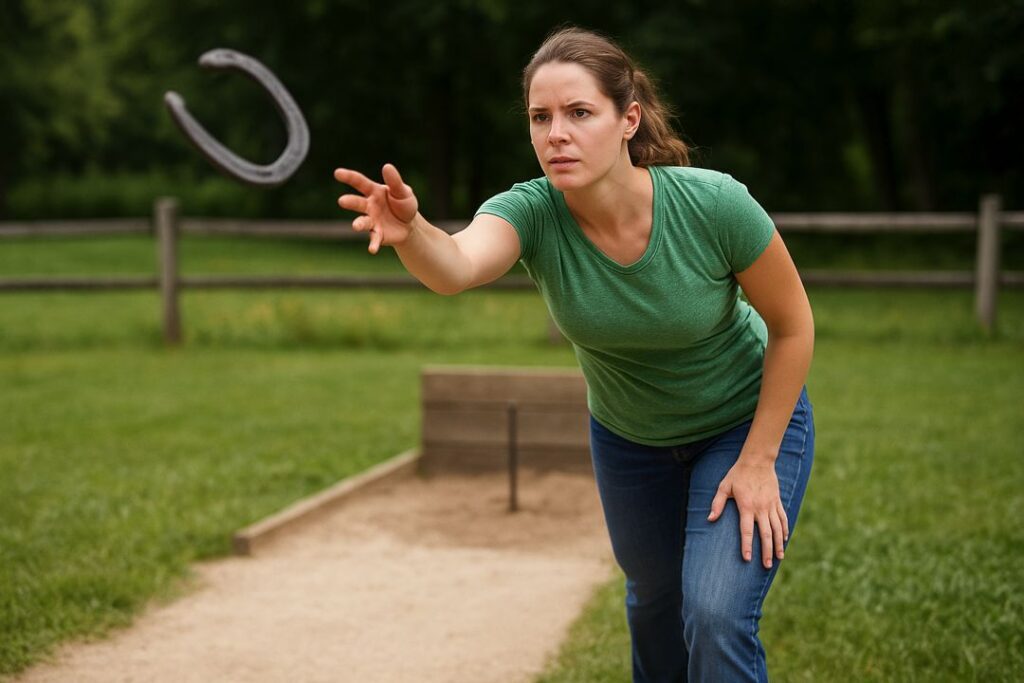
Spotlight Stories: The Momentum Looks Like This ✨
- The First-Timer Turned Teammate. A woman shows up to “watch” at a friend’s request, throws six practice shoes, and signs up on the spot. Two months later, she’s anchoring mixed doubles.
- The Mom-and-Daughter Duo. They start at 20 feet, laughing through wild misses. By July, mom’s landing leaners; by August, daughter hits her first ringer. Now they travel to weekend tournaments together.
- The Quiet Sharpshooter. She practices alone at lunch three days a week. Calm, repeatable form. Her league nickname? “Metronome.”
These aren’t unicorns; they’re everywhere. The more women give the sport a shot, the more stories like these you meet on league night.
Troubleshooting: When the Shoes Won’t Behave 🛠️
- Everything goes long. Move your release slightly earlier; focus on a softer landing spot.
- Everything falls short. Micro-delay the release and lift the arc 6–12 inches higher.
- Wild left/right misses. Keep your eye on the top third of the stake through release. Let your head stay still.
- Inconsistent spin. Loosen your grip pressure. Tension sneaks in as misses stack up—shake it out between throws.
- Nerves on game point. Short breath. One cue. Commit to the throw you’ve practiced—not the one you fear.
Bring a Friend: The Easiest Way to Grow Women’s Participation 💬
Text a friend. Invite a sister. Post a selfie from league night. That’s how the sport grows—one invitation, one friendly nudge, one “you’d love this” at a time. Clubs rise when their members share the joy that got them hooked.
FAQ: Women in Horseshoes
Do women compete directly against men?
Yes. Many leagues are coed, and women regularly place high. Skill and consistency decide matches.
Is pitching distance different?
Most leagues set 30 feet for women (and juniors/seniors), while men pitch at 40 feet. Always check your local rules.
What weight should I choose?
Try a few options. Many women settle into a comfortable weight they can repeat for 40–60 throws without fatigue.
Do I need special shoes or gloves?
Not required. Some pitchers wear light work gloves for grip or to prevent hot spots during long sessions.
Can kids play with adults?
Absolutely. Junior divisions exist, and family leagues are common. It’s one of the best multi-generation sports you’ll find.
Final Thoughts: Your Turn at the Stake 🏁
Women are changing horseshoes for the better—bringing fresh energy, new leaders, and a more welcoming vibe to every pit they step onto. If you’ve been curious, this is your sign to try it. Show up for a league night. Borrow a set. Throw for ten minutes. Then throw for ten more. You don’t have to be loud to be good—you just have to be repeatable.
Here’s to more ringers, more friendships, and more women growing the game—one pitch at a time. 🎯
Call to Action
Have a story about your first league night or a photo from a recent match? Drop it in the comments or send it in—I’d love to feature more women in horseshoes on the site and help others find their community.
Hi there, and thanks for stopping by! My name is Larry, and I’m the voice behind PlayingHorseshoes.com. I love the game and have been playing since I was a kid. I started this blog because I am passionate about the sport, and with all the technology, I hope the sport doesn’t die. I plan to do my part to keep it going for me and my brother’s sake. Thanks for stopping by. Feel free to subscribe and comment. Thank You!


