
AI Tried to Explain Horseshoe Pitching — and Here’s What Happened
Artificial intelligence can write poems, recipe cards, business memos, and breakup texts if you’re spineless enough to let it. But give it something important to explain — like the sacred art of horseshoe pitching — and suddenly the gears start grinding.
This article started as a simple experiment:
I asked an AI to explain how to play horseshoes.
The result?
A mix of comedy, confusion, half-truths, and a few lines that made me question whether the machine had ever seen a horseshoe in its life.
Let’s walk through what happened when AI stepped into the pit… and why the game of horseshoes still belongs solidly to human hands.
The AI Began With Confidence — Which Was Its First Mistake
The first thing the AI spit out was something like:
“Horseshoe pitching is a game where participants throw metal U-shaped objects toward a target peg located some distance away.”
Technically?
Not wrong.
But then it added:
“This is similar to bowling, darts, corn toss, or ancient spear-throwing.”
Ancient spear-throwing?
That one came out of left field.
Right away, I could tell the machine was going to attempt accuracy but occasionally veer off into a Wikipedia wormhole.
Still, it was early. I gave it a chance.
Then It Tried to Explain the Rules… and Things Got Weird
Ask any horseshoe player, and they’ll tell you the same thing:
There’s a straightforward rule set, and then there’s the backyard rule set your uncle invented in 1989 and refuses to modify.
AI, unfortunately, tried to merge the two.
Here’s what it told me:
“In official play, the goal is to land the horseshoe as close to the stake as possible. A ringer is worth three points. This is called ‘a perfect toss,’ or sometimes ‘a dazzle throw.’”
A dazzle throw?
Never once in the history of the sport has anyone walked off the pit bragging,
“I threw three dazzle throws today.”
But the AI wasn’t done.
“If both teams make a ringer, the ringers cancel out. This is called ‘mutual nullification.’”
Mutual nullification sounds like something from a nuclear disarmament treaty — not something yelled across a backyard.
It’s called cancellation scoring, but the AI decided to spice things up like it was writing a textbook for intergalactic diplomats.
The Machine Really Struggled With Grip and Form
Next came the explanation of how to actually throw a horseshoe.
This is where things went completely off the rails.
The AI told me:
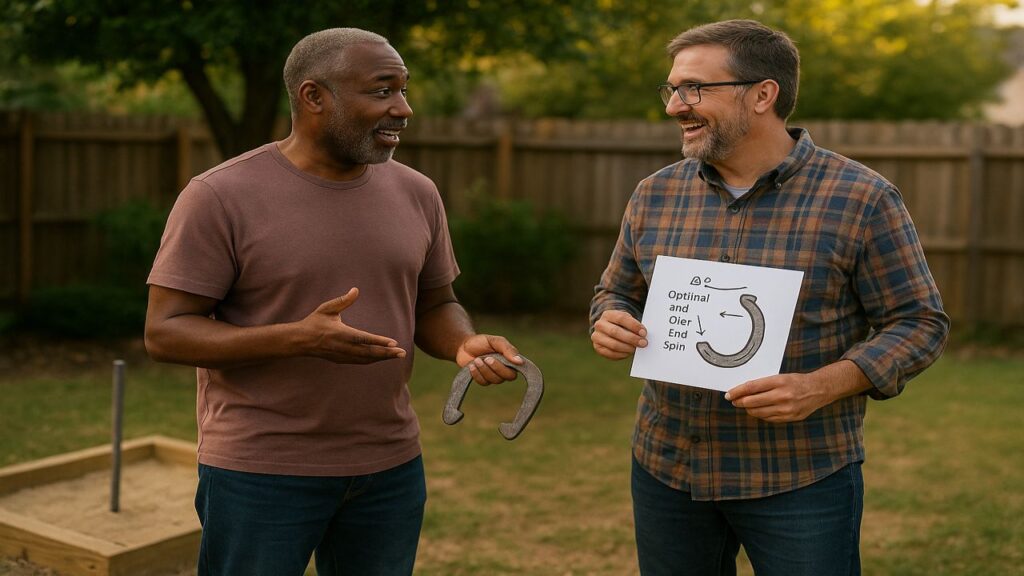
“Grip the horseshoe by pinching one prong between the thumb and forefinger and allow the other prong to rotate freely.”
You could almost hear the old-timers groaning from across the country.
If you pinch the tip, you’re not pitching a horseshoe — you’re preparing to snap a chicken wing.
A proper grip involves the side of the shoe, smooth rotation, and a predictable release. AI tried to explain rotation, too, but again… not great:
“The shoe should rotate end-over-end in the air for maximum precision.”
End-over-end?
That’s how you throw something when you want it to wobble like a wounded duck.
Horseshoes spin flat, not like a falling breadstick.
AI managed to explain an entirely different sport.
It Improvised a History Lesson… Sort Of
Then the AI took a hard turn into a “history of horseshoes” section I didn’t ask for — and clearly didn’t fact-check.
According to my silicon friend:
“Horseshoes began as a Roman military exercise, but became popular among railroad workers in the 1800s who pitched spare metal whenever trains were delayed.”
Were Roman soldiers really in toga uniforms, throwing horseshoes at a stick between battles?
Doubtful.
Did railroad workers pitch scrap when they were bored?
Possibly — but AI explained it like it was a fully documented chapter in the Library of Congress.
For the record, horseshoes have a murky but fascinating history, spanning soldiers, farmers, and families… but the AI acted like it had been there for the invention, leaning on cinematic detail rather than accuracy.
The AI Did Not Understand Distance At All
When I asked it how far apart the stakes should be, the machine replied:
“Regulation distance is anywhere from 25 to 60 feet, depending on difficulty settings.”
Difficulty settings.
Like horseshoes is a video game menu where you select “Easy Mode” and the stakes scoot closer.
Then it added:
“Young players may stand closer, while expert players can challenge themselves by doubling the traditional distance for enhanced training.”
Right — nothing motivates you to practice like pitching from 80 feet and filing an insurance claim afterward.
The regulation distance is 40 feet.
Women, juniors, and elders pitch from 30.
That’s it.
No “difficulty settings.”
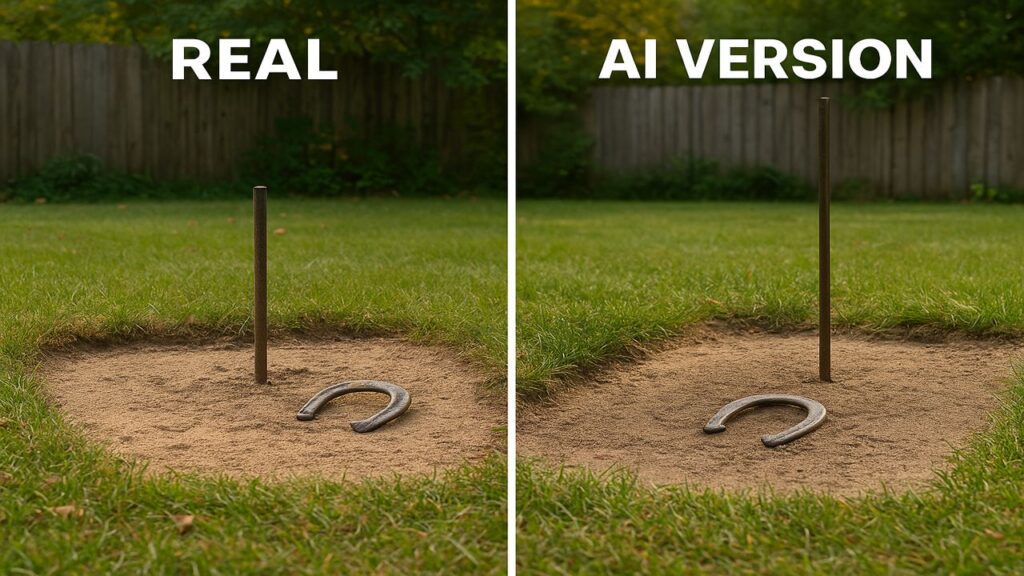
To Be Fair, the AI Got A Few Things Right
Not everything was chaos.
It correctly explained:
- A ringer is worth three points
- Leaners exist
- Closest-shoe scoring is worth one point
- Games typically go to 21
- Horseshoes are social, relaxing, and rooted in tradition
But the accuracy came mixed with enough oddball phrases (“dazzle throw,” “mutual nullification,” “difficulty settings”) that the whole explanation felt like someone describing horseshoes after waking up from a concussion.
Why AI Struggles With Horseshoes (and Why Humans Don’t)
Horseshoes isn’t just a sport — it’s a feel.
It lives in the rhythm of the pitch, the sound of steel against steel, the dust of the pit, the breeze across the field.
It’s a hundred tiny adjustments you make from one pitch to the next.
AI understands language.
But it doesn’t understand “feel.”
It doesn’t know what it’s like to dig your boots into the sand, line up the stake, breathe deep, and try to capture that perfect 1¾ rotation.
It also doesn’t understand:
- Backyard arguments
- Broken-in horseshoes
- Why a ringer sounds different on a cold morning
- The small bragging rights you earn with a leaner
- The joy of beating your cousin three games straight at a family reunion
AI can explain facts.
Horseshoes are built on experience.
And that’s why the machine struggled.
The Human Touch Still Matters
For all its calculations, the AI lacked the part of horseshoes that matters most: the human connection.
You don’t learn horseshoes from a data sheet.
You learn it from someone older than you, someone patient, someone who remembers when you underhanded the shoe so poorly it almost made a right turn.
You learn by:
- Watching the perfect arc
- Feeling the balance
- Listening to the elders argue about scoring
- Losing gracefully
- Winning loudly
- Playing the next game because nobody wants to quit on a good evening
AI can explain the rules.
But it can’t explain the soul of the sport.
Recommended Gear for Beginners (AI-Free)
If you’re trying to learn the real game — not the AI version — start with something proven.
Product Pick:
Franklin Sports Horseshoe Sets
Forged steel, regulation weight, and the kind of balance that lets you feel the throw the way the sport intended.
No dazzle throws required.
Horseshoe Game Set
FAQ
Q: Can AI actually teach someone to pitch horseshoes?
It can give a rough overview, but it tends to misexplain grip, rotation, and distance. Horseshoes need hands-on learning.
Q: What is the correct throwing rotation?
A flat, smooth rotation — typically 1¼ or 1¾ turns — not end-over-end like the AI described.
Q: What’s the regulation distance between stakes?
Forty feet for men, thirty feet for women, juniors, and elders.
Q: Why does AI get horseshoe details wrong?
Because much of the sport is learned through rhythm, timing, muscle memory, and tradition — things a machine can’t feel.
Q: Is horseshoes hard to learn?
Not at all. The basics come quickly. The mastery takes a lifetime.
Q: Is there really a “dazzle throw”?
No. That was the AI having a creative moment it probably shouldn’t have.
Thoughts
Horseshoes is a sport built on feel, community, and repetition.
It’s handed down person to person — not by a machine, not by a manual, and certainly not by an AI trying to invent new terminology along the way.
AI may be smart, but it’s not standing in the pit with you.
It’s never felt the weight of a horseshoe, the grit of sand, or the pride of a perfect ringer.
So if you really want to learn the game, don’t ask a computer.
Ask someone with dust on their boots, steel in their hand, and a lifetime of stories in their back pocket.
Because horseshoes isn’t just a game you explain.
It’s a game you live.


