
What Horseshoe Weight Really Means for Control and Accuracy
Ask ten horseshoe players about shoe weight, and you’ll get ten confident answers — most of them wrong, or at least incomplete.
Some players swear that heavier shoes are more accurate.
Others insist that lighter shoes give better control.
A few think weight doesn’t matter at all.
The truth is simpler and more useful than all of that.
Horseshoe weight absolutely affects control and accuracy — but not in the way most players think.
Weight doesn’t magically create ringers. It either supports your throwing mechanics… or exposes your weaknesses.
This article breaks down what horseshoe weight really does, how it affects different players, and how to choose the right weight for your game — whether you’re practicing in the backyard or playing competitively.
Understanding Regulation Horseshoe Weight (The Basics)
Before getting into feel and performance, let’s set the baseline.
Most regulation horseshoes fall within a fairly tight weight range, typically between 2.3 and 2.6 pounds per pair (roughly 1.15–1.3 pounds per shoe). Within that range, even small differences can feel significant in the hand and during the throw.
What matters most isn’t just the number on the scale — it’s how that weight interacts with:
- Your grip
- Your arm speed
- Your release timing
- Your preferred arc
Two shoes with similar weight can feel completely different depending on balance and shape.

Why Heavier Shoes Feel More Accurate (But Aren’t Always)
Many players gravitate toward heavier shoes because they feel stable.
What Heavier Shoes Do Well
- Resist wind slightly better
- Encourage a smoother, slower arm swing
- Penalize jerky, rushed motion
- Provide solid feedback on release errors
For players who overthrow or rush their throw, a heavier shoe can act like a governor. It forces you to slow down — sometimes enough to clean things up.
Where Heavier Shoes Hurt Accuracy
- Fatigue sets in faster
- Grip tension increases over long sessions
- Late releases become exaggerated
- Arm strength starts compensating for technique
Heavier shoes don’t forgive poor mechanics. They magnify them. When players start “muscling” a heavier shoe, accuracy usually drops fast.
Why Lighter Shoes Feel More Controllable (But Can Be Deceptive)
Lighter shoes often feel easier to control, especially during practice.
Benefits of Lighter Shoes
- Less arm fatigue
- Easier to maintain relaxed grip pressure
- Faster feedback during drills
- More comfortable for longer practice sessions
For training, lighter shoes can help players focus on tempo, arc, and release without fighting fatigue.
The Downside of Lighter Shoes
- More sensitive to wind
- Easier to overthrow accidentally
- Inconsistent arc if tempo isn’t controlled
- Less margin for sloppy release
Lighter shoes demand discipline. Without it, accuracy becomes inconsistent.
Control vs Accuracy: They’re Not the Same Thing
This is where many discussions go off the rails.
- Control is how repeatable your motion is
- Accuracy is where the shoe ends up
Shoe weight influences control first, accuracy second.
If your control is poor, changing the shoe weight won’t fix accuracy.
If your control is solid, the right shoe weight can tighten accuracy noticeably.
Think of weight as an amplifier, not a solution.
How Shoe Weight Affects Arc
Arc is where weight matters most.
Heavier Shoes
- Naturally promote a slightly higher arc
- Drop more predictably near the stake
- Forgive small power variations
Lighter Shoes
- Tend to flatten out if rushed
- Require conscious arc control
- Reward smooth tempo
Players who struggle with low, flat throws often benefit from slightly heavier shoes — not because they’re better, but because they force a better arc.

Grip Pressure Changes with Weight
This is one of the least discussed — and most important — factors.
- Heavier shoes often cause players to grip tighter
- Lighter shoes encourage a looser, more relaxed hand
If your grip tightens as the weight increases, accuracy usually drops after the first few frames. That’s not a weight problem — it’s a grip response problem.
When evaluating shoe weight, always ask:
“Does this weight make me grip harder or stay relaxed?”
That answer matters more than ounces.
Fatigue Is the Silent Accuracy Killer
Shoe weight affects fatigue more than players admit.
As fatigue sets in:
- Release timing changes
- Grip tightens
- Tempo speeds up
- Accuracy suffers
This is why many players throw well early in a session and fall apart later — especially with heavier shoes.
If your accuracy drops sharply after 30–40 minutes, your shoe weight may be working against you.
Practice Weight vs Game Weight (They Don’t Have to Match)
One of the smartest things a player can do is separate practice shoes from game shoes.
During Practice
- Slightly lighter, balanced shoes
- Focus on control, arc, and repetition
- Less fatigue = better mechanics
During Competition
- Shoes that match your preferred game feel
- Familiar weight under pressure
- Confidence through consistency
Training with lighter, control-friendly shoes and competing with your preferred set is a common — and effective — approach.
How Age and Experience Change Weight Preferences
As players age, priorities shift.
- Strength becomes less important
- Efficiency becomes critical
- Consistency matters more than power
Many experienced and senior players quietly move toward lighter or more balanced shoes, not because they can’t throw heavy shoes, but because they don’t need to.
Accuracy improves when effort decreases.
Common Myths About Horseshoe Weight
“Heavier shoes are more accurate”
Only if your mechanics are clean and fatigue-free.
“Pros only use heavy shoes”
Pros use what matches their mechanics — not what looks impressive.
“Changing weight will fix my accuracy”
It won’t. It will expose what’s already there.
How to Choose the Right Weight for You
Ask yourself these questions honestly:
- Do I overthrow when trying to hit ringers?
- Does my grip tighten as I play longer?
- Do I lose accuracy late in sessions?
- Do lighter shoes feel smoother and more relaxed?
If yes, slightly lighter or more balanced shoes may improve control.
If your throws feel rushed or flat, slightly heavier shoes may help slow things down.
There is no universal “best” weight — only the weight that supports your motion.

Product Recommendation: Franklin Sports Horseshoes Set
When evaluating how horseshoe weight affects control and accuracy, it helps to practice with a straightforward, regulation-style set that doesn’t encourage muscling the throw. The Franklin Sports Horseshoes Set is a solid option for this kind of testing and training.
These shoes offer a balanced feel that makes it easier to notice how weight influences:
- Grip pressure
- Arc height
- Release timing
- Fatigue over longer sessions
They’re especially useful during practice drills where consistency matters more than aggressive performance. Many players find that using a neutral set like this helps them understand whether heavier or lighter shoes actually improve their control, or simply mask technique issues.
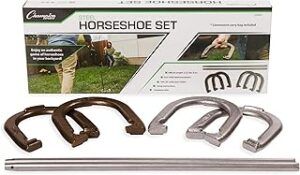
Horseshoe Game Set
Weight Should Support Your Throw, Not Fight It
Horseshoe weight isn’t about throwing harder.
It’s about throwing cleaner.
The right weight:
- Keeps your grip relaxed
- Supports a smooth arc
- Reduces fatigue
- Reinforces repeatable motion
When weight works with you, accuracy becomes predictable.
When it works against you, no amount of practice will save it.
Find the weight that lets you throw easier, not harder — and your ringers will take care of themselves.
Horseshoe Gifts and More!
This shop is my clubhouse for fellow players. You’ll find mugs, shirts, and pit gear to keep games fair, trash talk fun, and ringers flying — whether you’re building your first court or running a league.


