Eyes Closed Practice: Does It Improve Your Horseshoe Accuracy?
At first glance, it sounds like a gimmick.
Throwing horseshoes with your eyes closed doesn’t seem like a serious way to improve. Most players assume accuracy comes from watching the stake, adjusting mid-throw, and correcting mistakes visually.
But that’s only part of the picture.
The truth is, some of the most important elements of a consistent horseshoe pitch—balance, muscle memory, release timing, and rhythm—have nothing to do with what you see. They come from what your body feels.
That’s where eyes-closed practice becomes interesting.
Used the right way, it can sharpen awareness, improve consistency, and expose weaknesses that normal practice hides. Used the wrong way, it can reinforce bad habits and hurt your accuracy.
So the real question isn’t whether it works.
It’s whether you’re using it correctly.
Why Vision Isn’t Everything in Horseshoes
Most players rely heavily on visual feedback. You watch the stake, track your throw, and adjust based on where the shoe lands.
That’s helpful—but it can also become a crutch.
When you depend too much on sight, you stop paying attention to how your throw actually feels. Your body makes constant micro-adjustments, but you don’t fully understand them because you’re focused on the result instead of the motion.
That’s where consistency breaks down.
Because when conditions change—lighting, wind, pressure—you don’t have a reliable internal feel to fall back on.
Eyes-closed practice removes that visual dependency.
And that forces your body to do the real work.
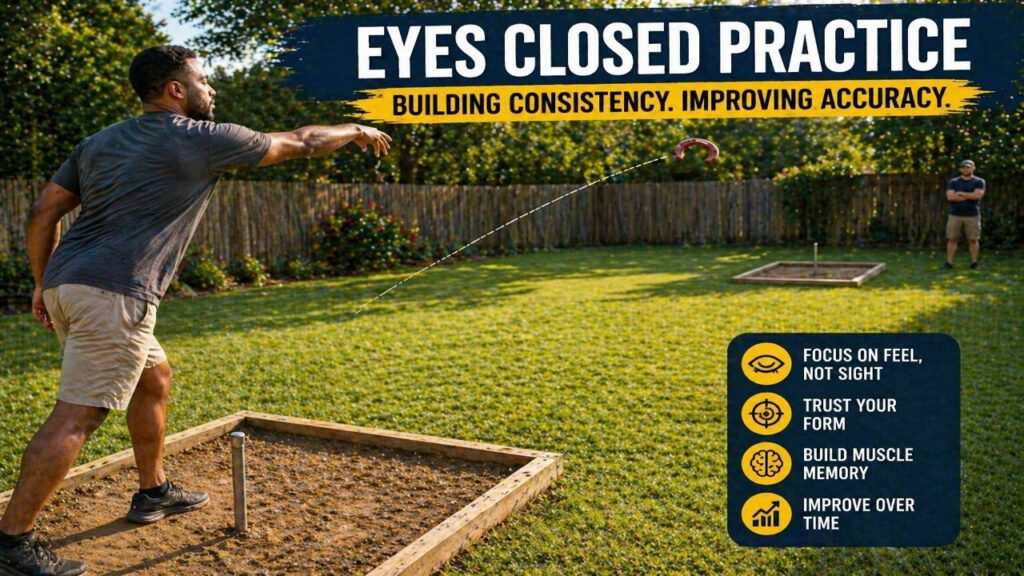
What Eyes Closed Practice Actually Trains
When you remove sight, your brain shifts focus.
Instead of tracking the target, it starts paying attention to balance, alignment, arm path, and release timing. You begin to notice things you normally ignore—like how stable your stance feels or whether your release is smooth or rushed.
That’s where improvement happens.
You’re not trying to hit the stake. You’re trying to repeat a consistent motion.
And once that motion becomes reliable, accuracy follows.
Feel first. Result second.
The Biggest Benefit: Consistency Under Pressure
Anyone can throw well when everything feels right.
The problem is maintaining that level when it doesn’t.
Pressure, fatigue, and distractions all affect performance. When you rely only on visual targeting, those factors can throw off your timing and rhythm.
But when your throw is built on feel, you have something more stable to rely on.
Eyes-closed drills strengthen that internal consistency.
They teach your body what a good throw feels like—so you can reproduce it even when conditions aren’t perfect.
That’s a big advantage.
Where This Practice Can Go Wrong
Here’s the part most people miss.
If your mechanics are off, practicing with your eyes closed can actually make things worse. You’ll end up reinforcing bad habits without realizing it.
That’s why this isn’t something you do blindly (no pun intended).
You need a baseline of proper form first. Your stance, grip, and release should already be reasonably consistent before you start removing visual feedback.
Otherwise, you’re just locking in mistakes.
Good form first. Then experiment.
How to Use Eyes Closed Practice the Right Way
This isn’t something you do for full games.
It’s a controlled drill.
Start by standing at your normal pitching distance. Go through your setup as usual, focus on your alignment, and then close your eyes just before your throw.
Make a smooth, controlled pitch without forcing it.
Do this for a few throws, then go back to normal play.
The goal isn’t to score points. It’s to build awareness.
Short sessions. Focused reps.
A Smarter Approach: Partial Vision Training
If fully closing your eyes feels too extreme, there’s a middle ground.
Try soft focus.
Instead of locking onto the stake, relax your gaze and focus more on your motion. You can also look away just before release instead of throwing completely blind.
This gives you many of the same benefits without completely removing visual input.
It’s often a better starting point for most players.
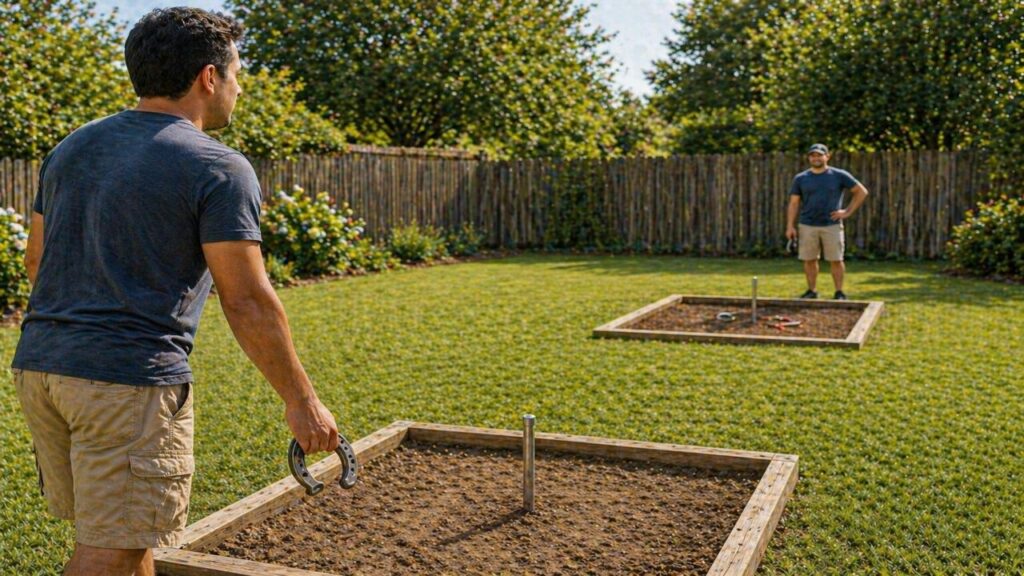
When to Use This Drill (And When Not To)
Eyes-closed practice works best as a supplement—not a replacement.
Use it during practice sessions when you’re focused on improving form. Avoid using it during competitive play or when you’re trying to refine accuracy through targeting.
Think of it as a reset tool.
If your throw feels off, a few eyes-closed reps can help you reconnect with your mechanics.
But it shouldn’t dominate your practice time.
Balance is key.
Equipment That Helps You Train Consistently
When you’re working on feel and repetition, your equipment needs to be consistent. Variations in weight or balance can throw off your timing and make it harder to build muscle memory.
A well-balanced option like the St. Pierre Royal Classic Horseshoe Setgives you a consistent feel from throw to throw, which is exactly what you want for drills like this.
If you prefer something slightly different in grip and balance, the Mustang Professional Pitching Horseshoesoffer a solid alternative that many players like for control-based practice.
And if you’re practicing frequently, having a durable, regulation-style setup like the Baden Champions Horseshoe Setensures your equipment holds up over time without affecting performance.
Consistency in gear leads to consistency in results.
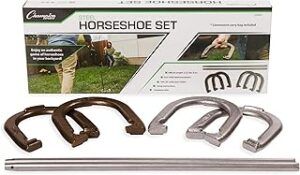
Horseshoe Game Sets
What You Should Expect Over Time
This isn’t a quick fix.
You’re not going to suddenly start throwing ringers with your eyes closed. That’s not the goal.
What you will notice is a smoother, more controlled throw. Your release will feel more natural. Your timing will improve.
And when you go back to normal play, your accuracy will feel more stable.
That’s how you know it’s working.
Common Mistakes to Avoid
One of the biggest mistakes is overusing the drill. Too much eyes-closed practice can disconnect you from real-game conditions.
Another mistake is rushing throws. Without visual feedback, players sometimes speed up their motion, which defeats the purpose.
And finally, ignoring form issues is a problem. If something feels off, fix it before continuing.
This drill is about awareness.
Use it that way.
FAQ: Eyes Closed Horseshoe Practice
1. Does practicing with eyes closed really improve accuracy?
Yes—when used correctly. It improves consistency and muscle memory, which leads to better accuracy over time.
2. How often should you use this drill?
A few minutes per practice session is enough. It should be a supplement, not the main focus.
3. Is this good for beginners?
Only after the basic form is developed. Beginners should focus on fundamentals first.
4. Should you throw full games with eyes closed?
No. This is a drill, not a gameplay method.
5. What’s the biggest benefit?
Improved body awareness and more consistent release timing.
Build a Throw You Can Trust
At the end of the day, accuracy isn’t just about aiming.
It’s about repeating the same motion over and over with confidence. When your throw feels right, the results take care of themselves.
Eyes-closed practice is just one way to get there.
Not flashy. Not complicated.
But when used the right way, it can quietly improve the one thing that matters most—consistency.
Hi there, and thanks for stopping by! My name is Larry, and I’m the voice behind PlayingHorseshoes.com. I love the game and have been playing since I was a kid. I started this blog because I am passionate about the sport, and with all the technology, I hope the sport doesn’t die. I plan to do my part to keep it going for me and my brother’s sake. Thanks for stopping by. Thank You!