From Bad Toss to Ringer: How to Troubleshoot Common Pitching Problems
Every horseshoe player — from backyard hobbyists to competitive league veterans — has had “those days.” You step up to the stake, take your time, release… and the shoe sails wide, lands short, wobbles like a paper airplane, or bounces off the stake like it’s allergic to points.
Here’s the thing: bad tosses aren’t just random. They’re signals. Each miss tells you something about your grip, your stance, your release, or even your mindset. If you can read those signals, you can fix your pitch — and turn frustrating misses into satisfying clangs of ringers.
In this guide, we’ll break down the most common pitching problems, why they happen, and how to fix them with practical drills, mental strategies, and small adjustments.
By the end, you’ll have a troubleshooting playbook that can take you from “spraying shots all over the court” to “confidently dropping ringers on command.”
Why Bad Tosses Happen in the First Place
Horseshoes is a game of repetition and precision — and small errors compound quickly. Most pitching problems boil down to:
- Grip issues – Not holding the shoe in a way that matches your throwing style.
- Poor stance or alignment – Your body isn’t lined up with your target.
- Release timing – Letting go too early or too late.
- Inconsistent mechanics – Switching styles or overthinking mid-throw.
- Mental distractions – Losing focus or letting frustration creep in.
The good news? Every one of these can be fixed without a complete overhaul of your technique.

The First Step: Diagnose Before You Change
Many players make the mistake of “fixing” a problem before they’ve confirmed what the problem really is. That can lead to more inconsistency.
Here’s how to diagnose:
- Watch your misses closely – Do they miss left, right, short, long?
- Note your shoe’s flight path – Is it smooth and flat, or wobbly and uneven?
- Pay attention to your release point – Does it feel rushed or delayed?
- Check your stance – Are your feet and shoulders square to the stake?
Even filming yourself for a few throws can be eye-opening. Sometimes what you think you’re doing isn’t what’s actually happening.
The Big Five Pitching Problems (and How to Fix Them)
1. The Overshoot 🚀
What you see: Shoes consistently land well beyond the stake.
Why it happens:
- Overpowering the throw.
- Late release.
- Trying to compensate for wind or distance by throwing harder.
How to fix it:
- Focus on control, not power — aim to land the shoe a foot before the stake.
- Reduce your backswing slightly.
- Practice 10–15 tosses at 80% power until your muscles memorize the feel of a softer throw.
Drill: Place a towel one foot in front of the stake and aim to land the shoe on it.
2. The Shortfall 🐢
What you see: Shoes consistently land before reaching the stake.
Why it happens:
- Early release.
- Weak follow-through.
- Not engaging your lower body.
How to fix it:
- Step forward as you throw to add momentum.
- Keep your arm moving forward after release.
- Focus on a “follow-through target” that’s past the stake.
Drill: Throw from a slightly closer distance until you can consistently reach the target, then move back.
3. The Sidewinder
What you see: Throws consistently miss to the left or right.
Why it happens:
- Stance alignment is off.
- Twisting your wrist on release.
- Losing focus on the target.
How to fix it:
- Make sure your lead foot points directly at the stake.
- Keep your wrist locked during the release.
- Stare at the stake until the shoe leaves your hand.
Drill: Place two cones in line with the stake and your foot to check alignment before each throw.
4. The Wobble
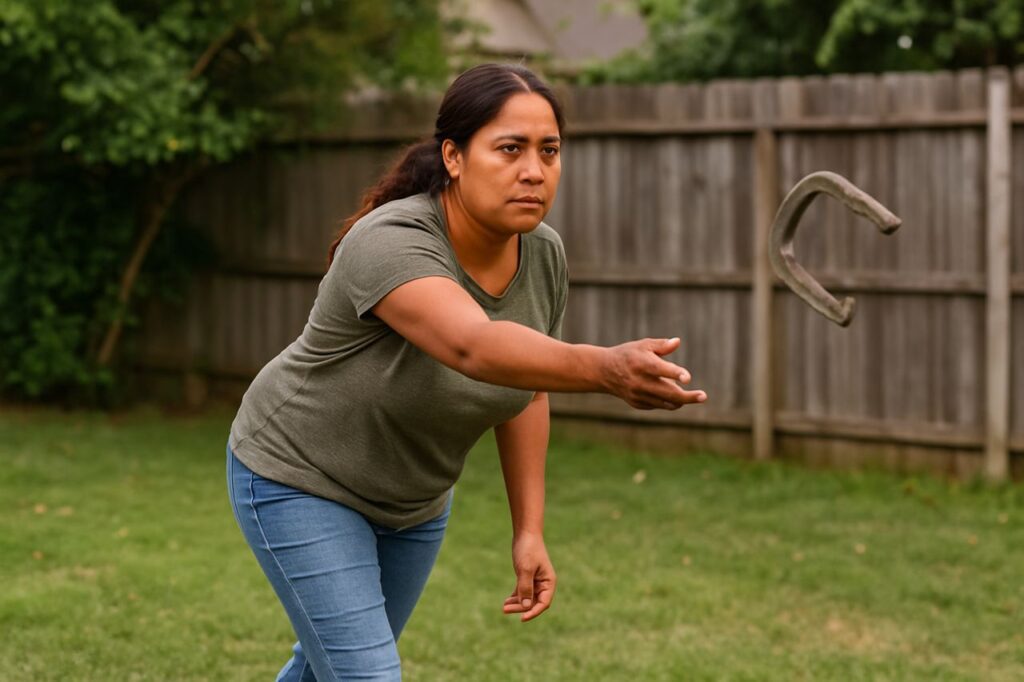
What you see: The shoe spins unevenly, flutters, or tumbles mid-air.
Why it happens:
- Inconsistent grip pressure.
- Off-center release.
- Switching grip styles mid-game.
How to fix it:
- Commit to one grip style (flip, ¾ turn, or 1 ¼ turn).
- Hold firmly without squeezing.
- Practice slow-motion tosses focused only on clean rotation.
Drill: Pitch at half speed focusing on rotation, not distance.
5. The Bounce-Out
What you see: The shoe hits the stake but bounces away instead of hooking.
Why it happens:
- Throwing too flat.
- Too much speed on impact.
- Hitting dead-on instead of hooking.
How to fix it:
- Add a gentle arc to your throw.
- Reduce throwing speed slightly.
- Approach with the open end of the shoe aiming to “wrap” the stake.
Drill: Place a small object just in front of the stake to force an arc over it.
Advanced Troubleshooting: When the Basics Aren’t Enough
Sometimes, you’ve fixed the obvious issues but still aren’t hitting your stride. Here’s where fine-tuning comes in.
- Check your grip depth – Holding too close to the shank or too far on the blade changes rotation.
- Mind the weather – Wind can push your shoe off course; adjust your aim slightly.
- Evaluate fatigue – Tired arms tend to release early; shorten your sessions.
- Simplify your routine – Extra motions in your pre-throw setup add inconsistency.
Five Drills That Build Consistency
- Ringer Isolation Drill – Stand closer than regulation and throw only for ringers. Build the muscle memory of a perfect hook.
- Half-Court Warm-Up – Start every session from half the distance to emphasize control.
- Stake Focus Drill – Keep your eyes locked on the stake through release — no peeking.
- Slow-Mo Throws – Pitch in exaggerated slow motion to feel the release point.
- 10-in-a-Row Challenge – Hit the target area (around the stake) ten throws in a row before ending practice.
The Mental Side of Troubleshooting 🧠
Sometimes your form is fine — but your head isn’t in the game.
- Stay patient – Bad streaks happen; don’t let them derail your focus.
- Reset after misses – Take a deep breath and mentally “wipe the slate clean.”
- Play your own game – Don’t get rattled by an opponent’s pace or style.
Pro Tip: Use a simple “trigger word” like smooth or ringer just before you pitch to center your focus.
When to Ask for Feedback
If you’re stuck, get another set of eyes on your throw. Even experienced players benefit from an outside perspective. A coach, teammate, or even a recorded video can reveal small flaws you can’t feel mid-throw.
Product Spotlight: St. Pierre American Professional Horseshoe Set
When you’re troubleshooting, having a balanced, tournament-quality horseshoe is key — it lets you feel the difference each adjustment makes. The St. Pierre American Professional Horseshoe Set is a favorite for serious practice because:
- Balanced weight – Helps you develop consistent rotation whether you throw flip or turn style.
- Drop-forged steel – Built to last through years of competitive play.
- NHPA-approved – Meets official specs so you can train like you compete.
- Comfortable edges – Reduces fatigue during long sessions.
Investing in the right set now can help you lock in muscle memory faster and avoid relearning later.
Call to Action
Your bad tosses aren’t failures — they’re opportunities to learn exactly what’s off in your throw. Start diagnosing your misses, apply one or two targeted fixes at a time, and stick with them until they’re second nature. You’ll be surprised how quickly the “clang” of a perfect ringer becomes your new normal. 🙌
FAQs
Q: How long should I spend on each fix?
A: Dedicate at least 15–20 throws to one adjustment before switching focus.
Q: Should I change my grip style?
A: Only if your current grip consistently causes problems. Most issues can be fixed without a full change.
Q: How much does weather affect performance?
A: Quite a bit — wind, humidity, and temperature can all change shoe flight. Adjust your aim and grip as needed.
Q: Can practicing with shorter distances help?
A: Absolutely — it builds confidence and consistency before moving back to regulation.
Final Thoughts
Going from bad tosses to ringers isn’t about reinventing your throw — it’s about recognizing patterns, making small, targeted adjustments, and practicing with purpose. Once you start treating each miss as feedback, you’ll not only improve faster but also enjoy the process a whole lot more. Horseshoes is a game of patience, precision, and persistence — and with the right troubleshooting, you’ll master all three. 🎯
Hi there, and thanks for stopping by! My name is Larry, and I’m the voice behind PlayingHorseshoes.com. I love the game and have been playing since I was a kid. I started this blog because I am passionate about the sport, and with all the technology, I hope the sport doesn’t die. I plan to do my part to keep it going for me and my brother’s sake. Thanks for stopping by, feel free to subscribe and comment. Thank You!