The Importance of Stance and Grip in Horseshoe Pitching
When it comes to horseshoe pitching, most people obsess over distance and power — but ask any serious player, and they’ll tell you the real secret lies in two underrated fundamentals: stance and grip. These two elements can make or break your pitch. They’re the foundation of your form, balance, and accuracy. Without a stable stance or a consistent grip, even the best aim will fall short — literally.
Let’s dive deep into how your stance and grip work together, how to find your personal “sweet spot,” and the drills that can take your throw from average to ringer-ready.
Why Stance Matters More Than You Think
Your stance is your launching pad — the solid base that anchors your entire motion. If it’s off, everything else follows suit. Think of it like building a house: if the foundation isn’t level, the walls will never line up.
When you step into position at the pit, your stance determines your balance, alignment, and follow-through. The right stance allows you to stay stable through your swing and deliver the shoe smoothly toward the stake.

Open vs. Closed Stance: What’s Right for You?
There’s no universal rule here — it depends on your body mechanics and comfort. Still, here’s how the two most common options stack up:
1. Open Stance
- Feet shoulder-width apart.
- Front foot angled slightly toward the stake.
- Great visibility of your target.
- Easier to maintain balance for beginners.
This is often where new players start. It promotes flexibility and makes it easier to see your target. You’ll feel more “open” to the stake, which helps when you’re still developing coordination.
2. Closed Stance
- Feet more parallel to each other, almost pointing straight ahead.
- Less body rotation, more control.
- Demands precision and consistency.
Closed stances are favored by more advanced pitchers who want to fine-tune accuracy. It reduces excessive movement and forces a cleaner, more repeatable swing path.
Common Stance Mistakes (and How to Fix Them)
Even experienced pitchers slip up on the basics sometimes. Here are a few stance issues to watch for — and how to correct them before they mess with your rhythm.
- Leaning too far forward:
This shifts your balance and kills your control. Keep your weight evenly distributed — about 60% on your lead foot, 40% on your back. - Feet too close together:
Narrow stance = shaky throws. Widen your base slightly until you feel grounded and stable. - Over-rotation of hips:
Your shoulders should line up with the stake, not spin past it. Over-rotation causes sideways tosses and inconsistent arcs. - Standing too upright:
A slight knee bend helps absorb motion and adds power. Too stiff, and your body will fight your throw instead of supporting it.
Remember: small tweaks go a long way. Record yourself pitching and watch how your feet move before and after release — you’ll catch bad habits you didn’t even know were there.
The Power of a Perfect Grip
If stance is your foundation, grip is your steering wheel. It’s the one connection you have with the horseshoe — and the way you hold it directly affects your spin, release, and accuracy.
A poor grip makes for unpredictable throws. Too tight, and your release jerks off course. Too loose, and the shoe slips out early. You want that “firm but relaxed” hold that lets the horseshoe flow with your natural arm motion.
Finding the Sweet Spot
The key is balance — your hand should feel secure but not tense. You’re not choking the shoe; you’re guiding it. Many pitchers describe the right grip as feeling like a confident handshake — controlled, natural, and sure.
Try this quick test:
- Hold your horseshoe as you normally would.
- Relax your hand slightly and give your wrist a small flick.
- If the shoe feels heavy or sluggish, you’re gripping too tight.
- If it shifts or wobbles, tighten just a touch.
A comfortable grip gives your wrist the freedom to add that smooth half-turn that leads to ringers.

Popular Grip Styles (and When to Use Them)
There are a few tried-and-true grips in horseshoe pitching — and each has its own purpose.
1. The 1-1/4 Turn Grip
Probably the most common competitive style. You hold the shoe with the open end facing up and your thumb along one shank. The shoe rotates about one and a quarter turns in flight and lands square around the stake.
- Best for: Experienced players seeking accuracy and spin control.
2. The ¾ Turn Grip
A slightly smaller rotation, great for consistency and lower arcs.
- Best for: Players who prefer shorter, flatter throws and want a more predictable release.
3. The Flip Grip
The horseshoe flips end-over-end instead of spinning sideways.
- Best for: Beginners or casual backyard games where the emphasis is on fun, not formal competition.
Experimenting with these grips during practice sessions helps you learn how each affects trajectory and landing behavior. You’ll eventually find the one that “feels right” in your hand — and that’s the one you should stick with.
Perfecting Your Personal Technique
Every horseshoe pitcher is different. Height, arm length, foot placement, even hand size — all of it influences what works best. That’s why developing your personal stance and grip combo is key.
Start by asking yourself:
- Do I value consistency or precision more right now?
- Am I stronger on one side of my body?
- Does my stance allow for a smooth, repeatable motion?
Once you’ve answered that, tailor your stance to those needs.
Customizing Your Stance
If you struggle with balance, spread your feet slightly wider or shorten your stride.
If accuracy is your weak spot, practice aligning your lead foot directly toward the stake.
The more consistent your body position, the easier it becomes to duplicate winning throws.
Dialing In Your Grip
Before every pitch, give your grip a micro-check:
- Is it comfortable?
- Is your thumb properly placed?
- Are your fingers relaxed?
Think of it like a pre-flight checklist — one quick scan that keeps your toss smooth and repeatable.

Practice & Precision: Drills to Build Muscle Memory
Great horseshoe pitchers aren’t born with perfect mechanics — they build them through focused repetition. Here are a few simple, effective drills to help you reinforce solid stance and grip habits.
1. The Foot Marker Drill
Place tape or chalk marks on the ground where your feet should be for each throw. Step into position, check alignment, and pitch. After a few sessions, your body will naturally find those marks without thinking about it.
2. Grip Consistency Drill
Use a single horseshoe and practice gripping and releasing it 20–30 times without throwing. Focus purely on feel — same pressure, same thumb placement every time. Then start tossing gently to integrate that muscle memory.
3. Target Adjustment Drill
Set up smaller targets (cones or stakes) at varying distances. Focus on maintaining your stance and grip while adjusting only your arm motion. This trains you to adapt without losing form.
4. Wrist Strength Exercises
Use a light dumbbell, resistance band, or stress ball to strengthen your wrist and forearm. A steady wrist equals a steady release.
5. Simulated Game Sessions
Pitch under different conditions — wind, wet surfaces, fatigue. Real-world practice helps you stay adaptable and sharp when it matters.
Tracking Your Progress
Don’t just practice — measure your improvement. Keep a pitching log or use a daily performance tracker. Note:
- Number of ringers per 20 throws
- Closest shoes within 6 inches
- Grip comfort rating (1–10)
- Foot placement consistency
These small data points reveal patterns. Maybe your accuracy dips on windy days, or your grip feels tighter during longer sessions. Spotting those trends helps you fine-tune your setup over time.
Advanced Stance and Grip Strategies
Once you’ve nailed the basics, it’s time to level up. Advanced players refine micro-movements and mental focus that separate casual throwers from true competitors.
1. Analyze the Pros
Watch footage of top pitchers. Observe how their feet move, how long they hold the shoe before release, and how relaxed their motion looks. Even subtle timing cues can upgrade your own technique.
2. Use Video Feedback
Set up your phone or a small tripod near your pit. Record a dozen throws, then review in slow motion. You’ll catch things you never notice in real-time — like slight wrist twists, off-center releases, or leaning too early.
3. Visualization Techniques
Before each pitch, close your eyes and visualize a perfect ringer — smooth swing, even spin, soft clang. Visualization activates the same neural pathways as physical practice. The more vividly you see success, the more naturally it happens.
4. Pressure Simulation
To prep for tournament play, create pressure in practice. Keep score, time yourself, or have someone watch. The goal is to stay consistent even when adrenaline kicks in.
Adapting to Changing Conditions
Even the best stance and grip need flexibility. Weather, court surface, and fatigue all affect your body mechanics.
- Windy Days:
Use a slightly firmer grip and lower arc to fight gusts. - Soft Ground:
Widen your stance to maintain balance. - Tight Muscles or Fatigue:
Lighten your grip slightly and shorten your stride to stay fluid.
The best pitchers adapt without overhauling their fundamentals. They understand how to make micro-adjustments instead of wholesale changes.
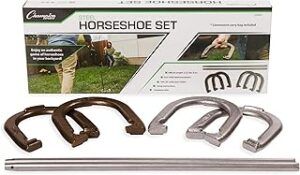
Horseshoe Game Set
Recommended Gear to Support Better Technique
Just like a golfer chooses the right clubs, a horseshoe player benefits from well-balanced, durable equipment. For those refining stance and grip, try:
- Champion Sports Tournament Horseshoes – designed for consistent balance and weight distribution.
- Franklin Sports Official Horseshoe Set – ideal for backyard training and accuracy practice.
- Grip-strength trainer or hand exerciser – builds endurance and consistency.
High-quality gear won’t fix bad form, but it can eliminate variables and help you focus purely on mechanics.
Mindset: The Hidden Ingredient
Physical mechanics matter — but mental focus completes the equation. Every great pitcher develops a routine that quiets the noise. Whether it’s a deep breath before throwing or a short mantra like “steady and smooth,” find what keeps your head calm and body steady.
Confidence breeds consistency. When your stance and grip feel automatic, your brain can focus entirely on the target. That’s where ringers are born.
FAQs About Stance and Grip in Horseshoe Pitching
Q: Should I always use the same stance?
Mostly, yes. Consistency builds muscle memory. But you can make slight adjustments for different distances or conditions.
Q: How hard should I grip the horseshoe?
Firm enough that it won’t slip, but relaxed enough for a smooth release. Think of it like holding a hammer — steady, not squeezed.
Q: My throws curve sideways. What’s wrong?
Likely an uneven grip or early wrist rotation. Check your finger alignment and release timing.
Q: Is one grip better than another?
Not really. It depends on comfort and control. Try a few styles to see which delivers the most consistent landings.
Q: How can I improve faster?
Record your throws, practice short focused sessions, and track your stats. The more feedback you collect, the quicker you’ll progress.
Final Thoughts
At the end of the day, great horseshoe pitching isn’t about brute strength or fancy throws — it’s about balance, feel, and repetition. Your stance gives you stability; your grip gives you control. Together, they form the backbone of every accurate, satisfying pitch you’ll ever throw.
So slow things down. Focus on your feet. Adjust your hand. Get to know your equipment. Because when your stance feels right and your grip feels natural, the rest falls into place — and that clang of a ringer becomes music to your ears.