Horseshoe Pitching Rules Explained: Official vs. Backyard Versions
Let’s face it — every backyard horseshoe player thinks they’re following the “real” rules. But ask three different people how many points a ringer’s worth, and you’ll probably get three different answers.
That’s part of what makes horseshoe pitching such a classic: it’s flexible, fun, and adaptable to any crowd. Still, if you’ve ever wondered how your backyard rules stack up against official regulations, this guide will clear the air once and for all.
Whether you’re just out to enjoy a few tosses with friends or gearing up for organized competition, understanding the differences between backyard and official horseshoe rules can take your game (and bragging rights) to the next level.
🎯 Why Rules Matter — Even in the Backyard
You might be thinking, “It’s just a game, Larry — why worry about rules?”
Because rules do more than keep things fair — they create flow, clarify scoring, and prevent arguments (especially after a few cold drinks).
Whether you’re tossing shoes at a family reunion or at an NHPA-sanctioned tournament, having everyone on the same page keeps the fun rolling.
🏆 The Official Horseshoe Rules (NHPA Standard)
Let’s start with the real deal — the National Horseshoe Pitchers Association (NHPA) rules. These are the gold standard for organized play across the U.S. and Canada.
If you ever plan to join a league, compete in tournaments, or just want to pitch like the pros, this is your playbook.
1. Court Setup
- Court Length: 40 feet from stake to stake.
- Stakes: 1-inch diameter, standing 14–15 inches above the pit surface, tilted forward at a 12° angle.
- Pit Size: Each pit measures 43 inches long and 31 inches wide, filled with sand or clay.
- Pitching Boxes: Players stand behind a 3-foot foul line located 37 feet (for men) or 27 feet (for women and juniors) from the opposite stake.
Pro Tip: Consistency is everything. The NHPA uses exact measurements to keep play fair across all courts — meaning no “too close” or “too far” excuses.
2. Game Format
- Number of Shoes: Each player pitches two horseshoes per turn.
- Winning Score: Official games go to 40 points or 50 shoes pitched, whichever comes first.
- Scoring System:
- Ringer: 3 points (a shoe encircling the stake so that both ends could touch it if bent).
- Close Shoe: 1 point for the shoe closest to the stake if no ringers are scored.
- Two Close Shoes: 2 points if both of your shoes are closer than your opponent’s.
Ties don’t count for either player — it’s a wash.
3. Foul Line Rules
Your foot cannot cross the foul line when the shoe leaves your hand. Doing so cancels that throw.
This ensures fairness and safety, especially during competitive play.
4. Turn Order and Rotation
- Players alternate turns, pitching both shoes in a row.
- The player who scored last goes first in the next inning.
- Tournaments typically use 30 to 50 shoes per player to determine the winner.
5. Ringers, Leaners, and Close Calls
Here’s how the NHPA defines key terms:
- Ringer: Both ends of the horseshoe encircle the stake within 1/4 inch.
- Leaner: Shoe leaning against the stake but not fully encircling it (1 point if closest).
- Dead Ringer: Both players throw ringers — the points cancel out.
NHPA Fun Fact: The world record for ringers in a 50-shoe game? Over 90% — that’s pro-level consistency.
🌳 The Backyard Horseshoe Rules (The Fun Version)
Now let’s talk about how the rest of us play — the backyard version.
This one’s been shaped by barbecue smoke, friendly rivalries, and pure improvisation.
There’s no governing body here — just good old-fashioned house rules.
1. Court Setup
Backyard setups vary wildly. Some folks use sand, some use dirt, and some dig a pit that barely fits a stake.
Common backyard specs:
- Stake Distance: Usually between 30 and 40 feet, adjusted for space (or skill level).
- Stake Height: Often 12 to 15 inches; no one gets out the protractor for tilt.
- Pit Size: Whatever you can fit in your yard — some just mark the spot with chalk.
Backyard Reality: If the dog’s not running through it and your neighbor’s not complaining, it’s regulation enough.
2. Scoring Systems
Backyard scoring is where creativity (and chaos) thrive.
Here are the most common versions:
- Simple Ringer System:
- Ringer = 3 points
- Leaner = 2 points
- Closest shoe = 1 point
- Cancellation Scoring (semi-official hybrid):
Ringing and closest points cancel each other out between players. - “First to 21” Format:
Shorter games where the first to hit 21 points wins — faster-paced, perfect for backyard tournaments or cookouts.
3. The “Unofficial” House Rules
Every yard has its traditions. Here are a few you’ve probably seen (or argued over):
- Leaners count double if they knock off a ringer.
- Bounce-ins don’t count.
- “Lucky Ring”: If your horseshoe somehow lands upright and balanced — automatic win (the crowd decides).
- Do-overs: Allowed once per game for wild throws, but only if everyone agrees.
Pro Backyard Tip: Always agree on rules before the first pitch — saves friendships and cookouts.
⚖️ Official vs. Backyard Rules — Side-by-Side Comparison
| Category | NHPA Official Rules | Backyard Version |
|---|---|---|
| Court Length | 40 feet | 25–40 feet (whatever fits) |
| Stake Height | 14–15 inches | 10–15 inches |
| Stake Angle | 12° forward tilt | Usually straight up or eyeballed |
| Surface Material | Sand or clay | Sand, dirt, grass, or whatever’s handy |
| Game Length | 40 points or 50 shoes | Often 21 points or until dinner’s ready |
| Scoring | 3 for ringer, 1 for close, cancel scoring | Mix of 3/2/1 or “closest wins” |
| Foul Line | Strict enforcement | Rarely enforced unless someone’s too cocky |
| Tournaments | NHPA-sanctioned | Backyard bragging rights only |
| Beer Rule | Not allowed | Highly encouraged 🍻 |
💬 Common Arguments (and How to Settle Them)
Horseshoe disputes are as old as the game itself. Here’s how to end the most common ones before they turn ugly:
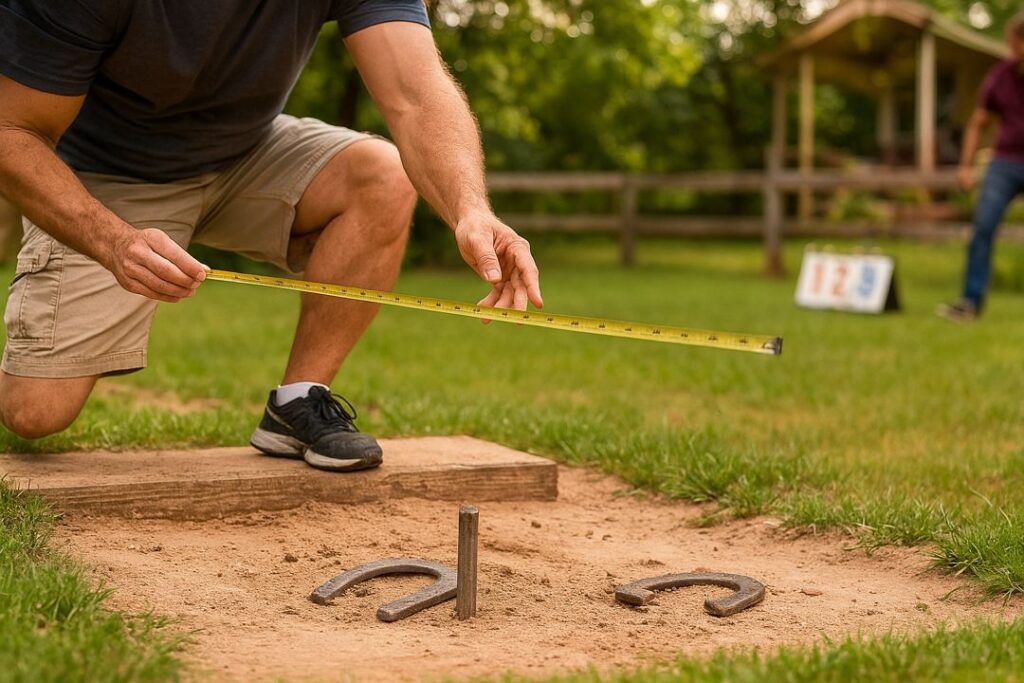
- “That’s a ringer!” — Measure it. If both ends of the shoe could touch the stake, it counts.
- “I was closer!” — Use a measuring string or stick. Closer wins unless ringers cancel.
- “You crossed the line!” — In backyard play, if no one saw it, it didn’t happen.
- “Game’s over!” — Agree on the winning score before you start. 21 or 40 are both fair.
Pro Backyard Rule: When in doubt, flip a horseshoe to settle it. Winner takes the call.
🧠 Mixing the Two Worlds — Competitive Backyard Play
You don’t have to choose between fun and formality. Many players use hybrid rules:
- Official distances but backyard scoring.
- Friendly tournaments with simple scoring.
- Official shoes and pits, but relaxed foul lines.
This balance keeps games competitive without sucking out the joy — and it helps you practice official skills in your own yard.
🏗️ How to Upgrade Your Backyard Court (the Right Way)
If reading this makes you want to get more serious, here’s how to level up your setup.
1. Standardize Your Pit
Use treated lumber or landscape timbers to frame your pit. Fill it with sand or clay.
Leave 3–4 feet behind each stake for pitching room.
2. Install Regulation Stakes
Use 1-inch steel rods tilted forward 12°. Keep the tops 14–15 inches above ground.
3. Add a Foul Line
Mark 37 feet and 27 feet lines using paint or rope. You’ll thank yourself later when practicing consistency.
4. Keep It Fun
Add lighting for night games, scoreboards, and maybe even a speaker setup for music.
Make your pit the spot for summer gatherings.
🏅 Pro Gear Picks for Fair and Fun Games
Whether you’re playing backyard or official, good gear makes the difference.
Here are a few standout picks that hold up to heavy play:
- St. Pierre American Professional Horseshoe Set – NHPA-approved steel set with excellent balance and durability.
- Triumph Forged and Steel Horseshoe Set – Affordable, reliable, perfect for backyard tournaments.
- Champion Sports Rubber Horseshoe Set – Safe and fun for all ages; ideal for indoor or kid-friendly games.
Quality gear means fewer warped shoes and more satisfying ringers — no one wants a bent throw halfway through the match.
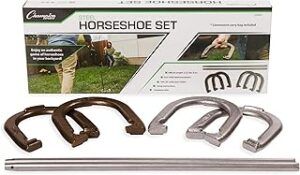
Horseshoe Game Set
💭 Final Thoughts: Play How You Like — Just Keep Pitching
At the end of the day, horseshoe pitching is about connection — not perfection.
Whether you’re playing by official NHPA rules or the looser backyard version your uncle swears by, what matters most is the fun, laughter, and maybe a little friendly competition.
If you’re playing for trophies, follow the official book.
If you’re playing for bragging rights and burgers, make your own rules.
The best games are the ones that keep everyone pitching, laughing, and listening for that perfect clang.