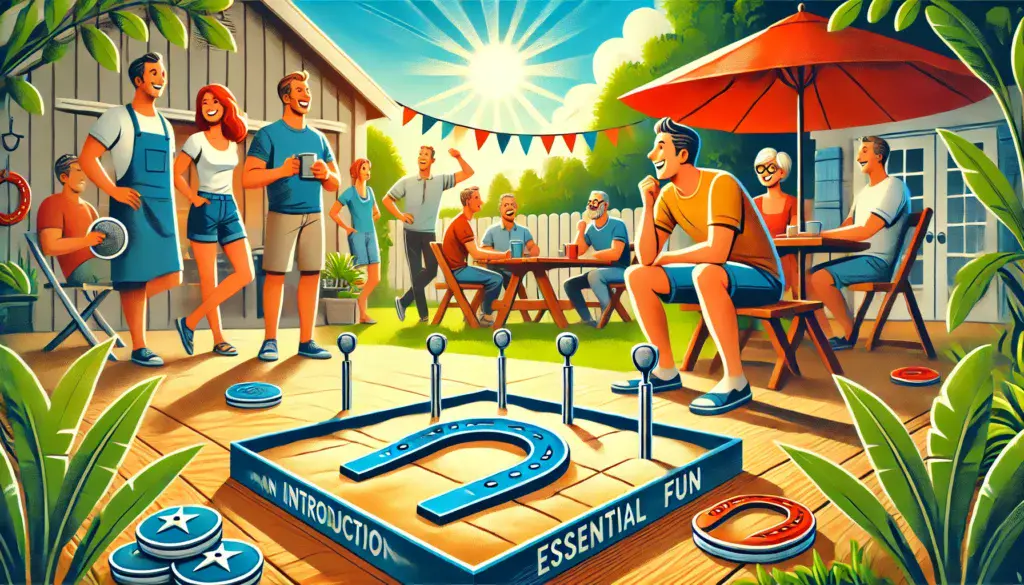
🌀 Horseshoe Throwing Techniques Explained: Flip, Turn, and Grip Styles
Discover the key horseshoe throwing techniques—flip, turn, and grip styles. Learn how to choose the best method for your game and improve your accuracy with expert tips.
If you’ve ever stepped onto a horseshoe court and wondered how the pros make it look so easy, the answer usually comes down to technique. And not just one—but a combination of throwing style, grip, and release. Whether you’re brand-new to the sport or looking to refine your competitive edge, understanding the differences between flip and turn throws—and the grips that support them—can change the way you play.
Let’s break down each technique, when to use them, how to practice, and which tools can help take your game to the next level.
🔄 1. The Flip Throw: Straightforward and Reliable
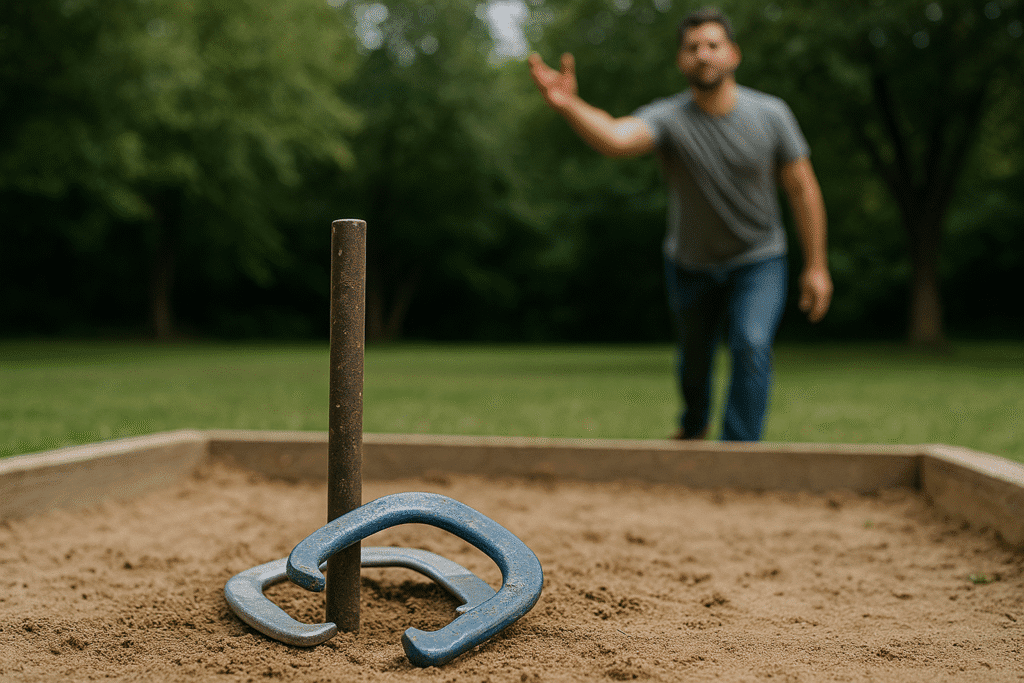
The flip throw is often considered the more beginner-friendly option. It’s all about sending the horseshoe flying end-over-end, flipping like a coin in the air, and landing square on the stake.
💡 Key Characteristics:
- Horseshoe flips vertically in midair
- Easier to learn and repeat
- Best for short to mid-range players
- Works well on soft or sandy courts
✅ Advantages:
- More natural feel for many beginners
- Minimal wrist action required
- Easy to adjust your aim and throw trajectory
⚠️ Challenges:
- Can be less stable in windy outdoor conditions
- Requires precise distance control for accurate landings
- Ring potential is slightly lower than with the turn throw
💪 How to Perform the Flip Throw
- Grip the horseshoe around the inside edge with 2 or 3 fingers. Index and middle finger should be along the inner curve.
- Stance: Stand with your throwing-side foot slightly forward, knees relaxed.
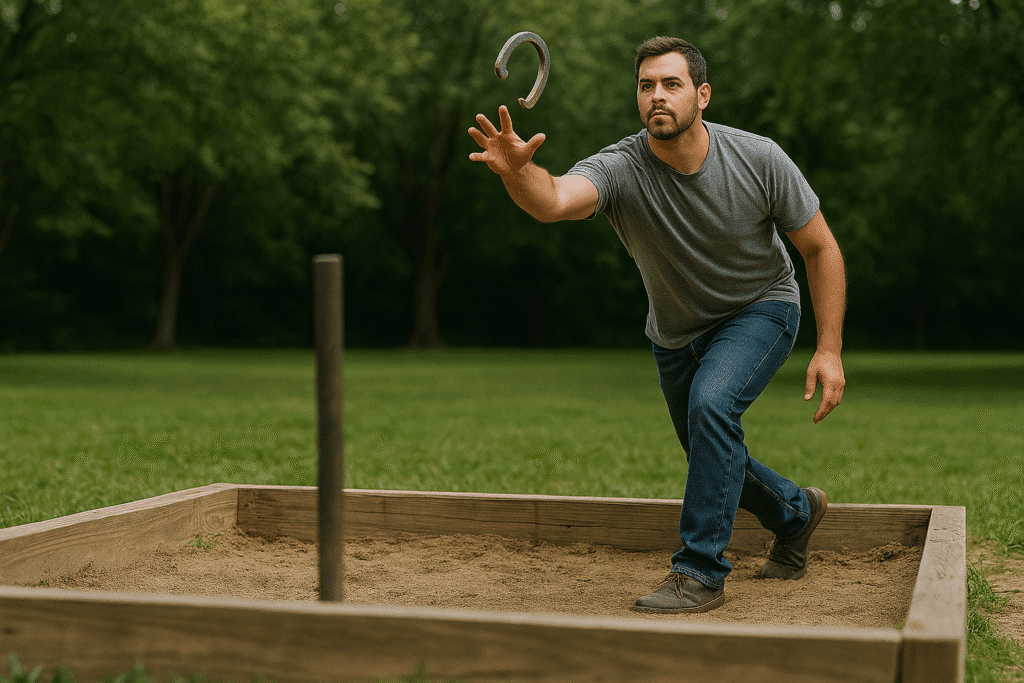
- Motion: Bring your arm back like a pendulum and throw with a slight upward motion.
- Release: Let go smoothly with your palm facing up to create the flipping motion.
- Follow-through: Finish your motion pointing toward the stake.
🧠 Pro Tip: Practice with marked stakes at different distances to master flip timing and arc control.
🔃 2. The Turn Throw: Advanced Precision and Spin
The turn throw adds a rotational twist. Instead of flipping, the horseshoe spins horizontally like a frisbee, offering more stability and a greater chance of hooking onto the stake with the open end.
💡 Key Characteristics:
- Horseshoe spins flat along a horizontal axis
- Preferred in competitive and professional play
- Offers better stake-grabbing potential
- Demands more wrist control and consistency
✅ Advantages:
- Increased accuracy over distance
- Higher ringer percentages with practice
- Performs better in wind and hard courts
⚠️ Challenges:
- Requires more practice to master
- Less intuitive for new players
- Poor rotation results in unstable flight
💪 How to Perform the Turn Throw
- Grip: Hold the shoe with 1-2 fingers along the inside curve and thumb lightly on top.
- Stance: Keep a steady, shoulder-width posture with smooth weight transfer.
- Motion: Swing your arm forward in a level motion.
- Release: Let go with a subtle wrist flick to create rotation (not a snap).
- Follow-through: Keep your hand extended, palm down, to guide the spin direction.
🎯 Pro Tip: Record your throws in slow motion to analyze the spin rate and adjust your wrist mechanics.
✋ 3. Mastering the Grip: Control Starts in Your Fingers
A solid throw starts with a strong, comfortable grip. The grip you choose not only affects accuracy—it influences how consistent your throws feel game after game.
🔹 Common Grip Styles:
✋ Standard Two-Finger Grip
- Index and middle finger on the inside edge
- Thumb on top, ring/pinky used for balance
- Good for both flip and turn throws
✋ Full Hand Grip
- Entire hand wraps around the center bar
- Offers stability but less finesse
- Better for players with larger hands
✋ Knuckle Grip
- Fingers tucked slightly for added spin control
- Preferred by experienced turn-style players
- Demands more wrist precision
👌 Choosing the Right Grip
Your ideal grip depends on:
- Hand size and finger length
- Throwing style (flip or turn)
- Desired spin and control
🏗️ Don’t be afraid to experiment. You may start with one grip and transition to another as you gain confidence.
🧪 4. Practice Drills to Sharpen Technique
Now that you know the basics, it’s time to put them into action. The best way to master horseshoe throwing techniques is through targeted, consistent practice.
🏋️♂️ Drill Ideas:
- Stake Snap Drill: Practice landing the horseshoe to “snap” against the stake—great for developing accuracy.
- Spin Control Drill: Try 10 throws in a row, focusing only on the shoe’s rotation midair.
- Distance Adjustment Drill: Practice at varying distances (30, 40, 50 feet) to refine your arc and power.
- Alternating Styles: Switch between flip and turn to improve overall mechanics and versatility.
📈 Track your progress weekly—how many ringers, how many near misses, how many misfires—and adjust accordingly.
🎯 5. Technique Comparison at a Glance
Let’s simplify the differences:
Throw StyleRotationSkill LevelAccuracy PotentialIdeal Court TypeFlipVerticalBeginnerMediumSoft/OutdoorTurnHorizontalIntermediate/ProHighAny/All-Weather
🧠 Tip: Many pros start with flip, then graduate to turn for tournament play.
🧰 6. Gear That Enhances Your Throw
Choosing the right horseshoes can complement your technique. If you’re focusing on a flip or turn throw, your gear should support that style with balanced weight, grip texture, and proper shape.
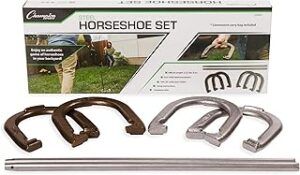
Horseshoe Game Set
🏆 Recommended Gear:
✅ Challenger Pitching Horseshoe Set
💬 Great for flip throwers, offering a durable, symmetrical design for easy rotation and consistent performance.
✅ EZ Flip Horseshoe Set
💬 Specifically designed for flip-style throwers with a slightly wider blade for softer landings and easier control.
✅ American Professional Horseshoes (St. Pierre Series)
💬 Balanced for both flip and turn throwers. Offers grip-friendly edges and tournament-level durability.
🎒 Bonus: Add a non-slip grip glove and a quality carrying case to round out your competitive setup.
🧠 7. Common Mistakes to Avoid
Even experienced players can fall into technique traps. Here are the most frequent errors:
- ❌ Over-rotating or under-rotating on a turn throw
- ❌ Rushing the release during flip throw
- ❌ Inconsistent grip or switching styles mid-game
- ❌ Not adjusting based on wind, stake height, or terrain
👁️ Pay attention to your consistency. If you’re throwing differently every time, it’s time to return to basics and tighten up form.
🧠 8. Mindset Makes the Difference
Beyond technique, your mental approach defines how quickly you improve. Adopt a growth mindset—be curious, not critical.
- 🧘 Take time between throws to reset
- 📓 Keep a throwing journal for insights
- 🤝 Ask experienced players for feedback
🧠 Visualization before each throw—imagine the horseshoe’s arc, the sound of it ringing—can prime your brain for success.
❓ Frequently Asked Questions
🔹 Should I learn both flip and turn techniques?
It helps, but focus on mastering one first. Once you’re confident, adding the second can increase your adaptability.
🔹 What technique do most pros use?
Most professionals use a turn throw due to its consistent rotation and high ringer potential—but it takes time to master.
🔹 How do I know if my grip is correct?
Your throws should feel smooth, not forced. If you’re constantly adjusting mid-throw or feeling discomfort, try repositioning fingers or changing styles.
🏁 Final Thoughts: Your Winning Throw Starts with Technique
Mastering horseshoe throwing techniques—whether flip, turn, or grip—isn’t about copying someone else’s form. It’s about understanding your body, your preferences, and what feels right.
✅ Start by choosing a throw that feels natural
✅ Lock in a reliable grip
✅ Practice with intent and track your progress
✅ Pair your skills with the right gear
🎯 Whether you’re playing for fun or aiming for trophies, the right throw can change everything.
👉 Which style are you working on right now—flip or turn? Leave a comment and share your experience!

Larry Mac
Hi there, and thanks for stopping by! My name is Larry, and I’m the voice behind PlayingHorseshoes.com I love the game and have been playing since I was a kid. I started this blog because I am passionate about the sport, and with all the technology, I hope the sport don’t die. I plan to do my part to keep it going for me and my brother’s sake. Thanks for stopping by, feel free to subscribe and comment. Thank You!