Mastering the Game: Advanced Horseshoe Throwing Techniques, Game Strategies & Scoring Secrets
If you’ve been pitching horseshoes for a while, you’ve probably hit a few ringers, scored some leaners, and maybe even crushed your cousin in a backyard tournament or two. But when you’re ready to level up—from casual play to confident competitor—it’s all about refining your technique, learning strategic play, and fully understanding how to score like a pro.
In this article, we’ll dive into advanced horseshoe throwing techniques, explore real-world game strategies, and break down scoring mastery that’ll help you play smarter, not just harder.
🎯 Advanced Throwing Techniques: More Than Just a Toss
There’s an art to a perfect horseshoe throw. The more you practice, the more you realize that every little movement—from your stance to your release—impacts where that shoe lands.
Let’s break down what separates casual pitchers from seasoned throwers.
🔄 1. Mastering Your Throwing Style
There are two main throwing styles used in horseshoe pitching:
➤ The Flip
This throw rotates the horseshoe end-over-end, often with a single flip in the air. It’s easier for beginners but lacks consistency at longer distances.
Best for: Backyard games, short-distance play, players who prefer simplicity over spin.
➤ The Turn (1¼ or 1¾)
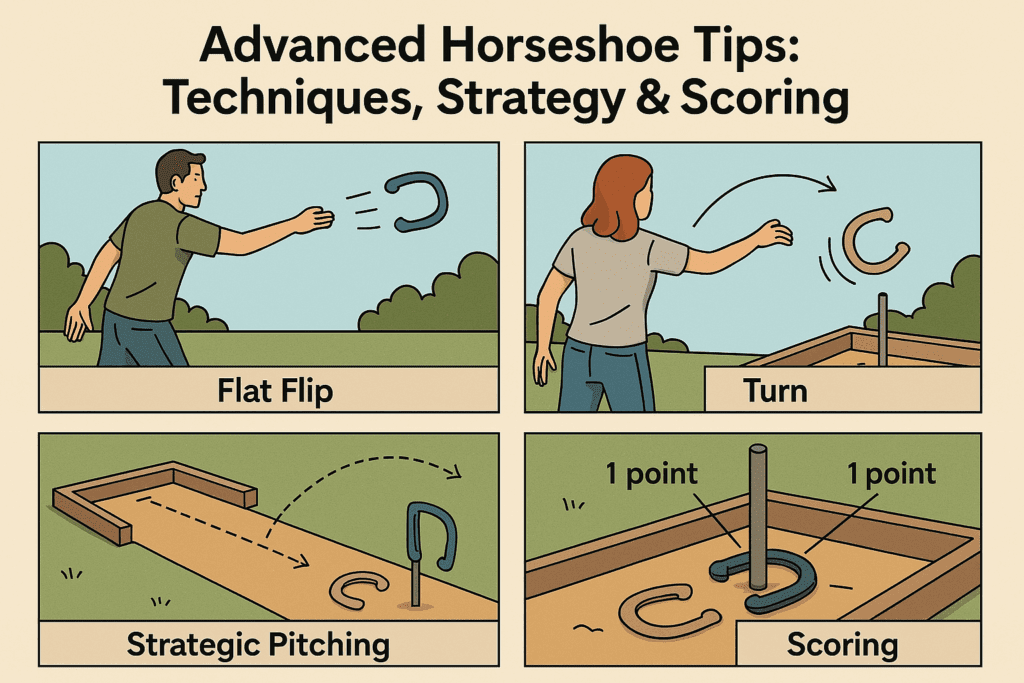
In this advanced style, the horseshoe spins as it travels toward the stake, rotating horizontally in the air. The 1¼ turn is the most popular in competitive play.
Best for: Accuracy and consistent ringers. Reduces bounce and allows better stake contact.
Pro Tip: Stick to one throwing style and master it. Constantly switching techniques will slow your progress and make muscle memory harder to build.
🧍 2. Perfecting Your Stance & Grip
A good throw starts from the ground up.
Your stance should be:
- Feet shoulder-width apart
- Lead foot slightly forward (same side as your throwing arm)
- Balanced with slight knee flex
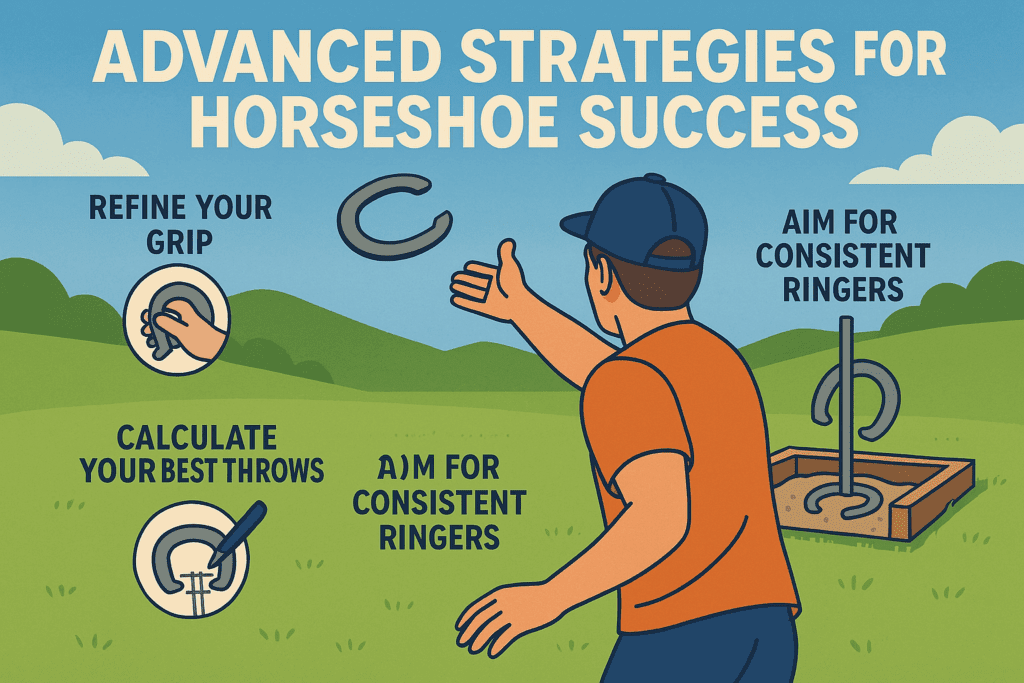
Your grip should be:
- Firm but relaxed
- Thumb over the top, fingers under the open end
- Centered for balance
The release is where magic happens. Let the horseshoe glide off your fingers as your wrist flicks gently, adding the spin or flip based on your chosen style.
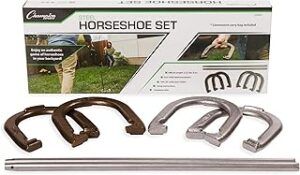
Horseshoe Game Set
🧠 3. Control Your Arc and Trajectory
Every great throw has a consistent arc. Too flat, and you’ll bounce past the stake. Too high, and you’ll lose precision.
Aim for a medium-high arc that allows the horseshoe to descend gently and “stick” into the pit without rolling.
Advanced players adjust their arc depending on wind, surface softness, and even fatigue late in a match.
🧪 Game Strategy: Thinking Like a Horseshoe Champ
Pitching well is half the battle. To truly dominate, you’ve got to think like a strategist.
🎲 1. Offense vs Defense
Horseshoe isn’t just about landing your own points—it’s about denying your opponent’s, too.
Offensive strategy:
- Aim for ringers consistently
- Take calculated risks to dominate the scoreboard
Defensive strategy:
- Land shoes close enough to block the stake
- Knock your opponent’s horseshoes off the stake
- Focus on scoring 1 or 2 points consistently, rather than always swinging for 3
🔄 2. Understand Inning Momentum
Each inning in horseshoes is a chance to control the game. The second thrower always has a slight advantage because they can respond to the first player’s shots.
Use this to your benefit by:
- Watching how their horseshoes land
- Adjusting your spin or arc if the pit surface changes
- Going for the ringer if they land close—or blocking if they don’t
🧩 3. Adapt Your Throws Mid-Game
Don’t be afraid to adjust based on conditions. Clay getting sticky after a rain? Use a flatter arc. Stake leaning after multiple hits? Compensate with slight directional changes.
The most consistent players aren’t always the most powerful—they’re the most adaptive.
🧮 Scoring Mastery: Know the Rules, Own the Game
Many games are lost not because of bad throws, but because players don’t fully understand how scoring works—especially when it comes to ringers, canceling out points, and strategic advantage.
✔️ Scoring Basics Recap
- Ringer (3 points) – Fully circles the stake. If both players get one, they cancel out.
- Closest shoe (1 point) – Only counts if no ringers are thrown that inning.
- Two closest (2 points) – If both your shoes are closer than any of your opponent’s.
- Max score per inning – 6 points (two ringers, no opposing ringers).
🧠 Advanced Scoring Tactics
1. Play to Cancel
If your opponent lands a ringer, landing one yourself neutralizes their 3 points. Focus on consistent ringers to control the scoreboard.
2. Smart Scoring Buildup
A mix of 1- and 2-point ends can win just as surely as high-scoring innings. Consistency beats volatility in tight games.
3. Avoiding the “Lean” Trap
A horseshoe leaning against the stake does not count as a ringer—it’s still just 1 point if it’s the closest.
Fun fact: A “leaner” looks cool but won’t boost your score. Many casual players confuse this—don’t make the same mistake.
🧰 The Competitive Edge: Practice With Purpose
It’s not just about playing more—it’s about practicing smarter.
➤ Use Markers
Set up zones around your stake to aim for—1-foot rings, different angles, left and right side targets. Practice landing shoes in these areas to sharpen control.
➤ Track Your Performance
Keep a notebook of your average scores, number of ringers per match, or how many times you hit both stakes. Over time, you’ll spot patterns and areas to improve.
➤ Play With Better Players
The fastest way to improve is to compete with people more skilled than you. Watch their stance, throw, and strategy—then try to replicate and refine it.
🏆 Final Thoughts: From Backyard Player to Pitching Pro
Mastering horseshoes isn’t just about brute strength or luck. It’s about precision, control, and strategy. The more you play, the more you’ll understand your throwing style, how to read the pit, and how to play smarter than your opponent.
So whether you’re pitching at a weekend barbecue or prepping for your first local tournament, remember this: every ringer started with a repeatable throw, a smart game plan, and a mindset to improve.
Put these techniques to work, and you’ll go from casual thrower to clutch player before you know it.
🎯 What’s Next?
In our next post, we’ll explore Horseshoe Game Variations & Fun Formats to keep your pit exciting—whether it’s kids, adults, or everyone in between.
💬 Got your own scoring tip or advanced throw trick? Drop it in the comments and help the community level up.
Hi there, and thanks for stopping by! My name is Larry, and I’m the voice behind PlayingHorseshoes.com. I love the game and have been playing since I was a kid. I started this blog because I am passionate about the sport, and with all the technology, I hope the sport doesn’t die. I plan to do my part to keep it going for me and my brother’s sake. Thanks for stopping by. Feel free to subscribe and comment. Thank You!