Horseshoes Grip & Throw: Biomechanics Explained
How to Improve Accuracy, Consistency, and Power by Understanding Your Body’s Natural Mechanics
Want to hit more ringers? Discover how proper grip, body positioning, and biomechanical technique can dramatically improve your horseshoe throwing game—plus tips, training drills, and gear picks to refine your skills.
Introduction: Why Your Throwing Form Matters 🎯
If you’re serious about horseshoes—whether you’re pitching casually with friends or training for league competition—mastering your throw starts with one thing: understanding your body.
This isn’t just a game of luck. The secret to consistent ringers lies in your biomechanics: how you grip the shoe, how your body moves during the throw, and how that movement affects spin, speed, and accuracy. Think of it like a golf swing or a baseball pitch—it’s all about fluid motion.
In this guide, we’re breaking down everything you need to know about grip styles, throwing mechanics, posture, body alignment, and how to avoid the common form mistakes that wreck your accuracy.
The Foundation: Mastering the Horseshoe Grip
Let’s start with where every great throw begins—your grip. How you hold the horseshoe determines how it spins, how balanced it is in flight, and how precisely it lands near the stake.
🔄 Common Grip Styles (And When to Use Them)
- Flip Grip (End-Over-End):
- Ideal for beginners.
- Easy to control with a straight-line release.
- The horseshoe rotates vertically and lands open.
- 1¼ Turn Grip:
- A more advanced grip where the shoe spins one full rotation plus a quarter.
- Offers a flatter landing and improved ringer potential.
- Requires stronger wrist control.
- 1¾ Turn Grip:
- Adds more rotation and is common among elite players.
- Requires exceptional timing and feel.
- Less forgiving for beginners but deadly when mastered.
- Hybrid or Custom Grip:
- Adapted to individual hand size or comfort.
- Many players evolve toward a custom grip over time.
🤲 How to Hold the Horseshoe
- Place the horseshoe in your throwing hand with the open end pointing forward.
- Fingers should rest comfortably along the inside curve.
- Don’t squeeze too hard—this tightens muscles and causes jerky releases.
- The thumb should anchor on top for stability.
💡 Pro Tip: Choose a grip and stick with it for at least a few weeks. Constantly switching makes it harder to build muscle memory.
Full-Body Mechanics: The Throwing Breakdown
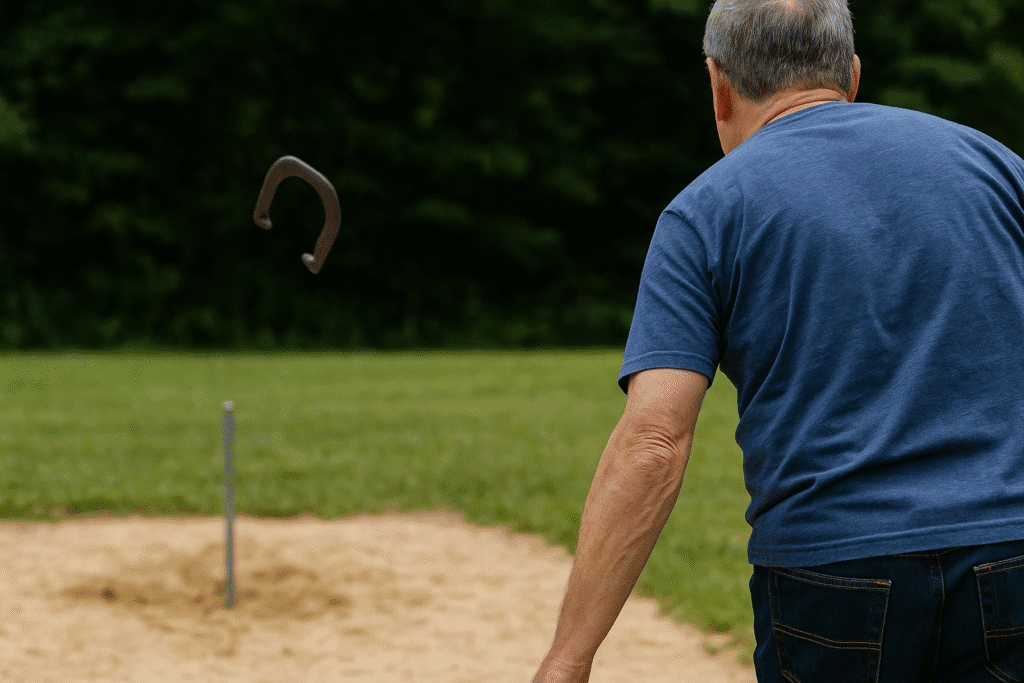
Contrary to popular belief, horseshoes isn’t all wrist. Your whole body contributes to a smooth, accurate throw. Here’s how to activate your body the right way:
👣 1. Set Your Stance
- Stand squarely with feet shoulder-width apart.
- Your non-dominant foot should be slightly forward.
- Keep your knees relaxed, shoulders square, and eyes fixed on the stake.
🌀 2. The Windup
- Bring the horseshoe back in a smooth, pendulum-like motion.
- Your throwing arm stays straight—not stiff—through the backswing.
- Use your shoulder joint, not your elbow, to power the motion.
🎯 3. The Release
- Let the horseshoe roll naturally off your fingers at the peak of your forward motion.
- Do not flick your wrist—this leads to uncontrolled spin.
- Maintain a soft follow-through in the direction of your target.
🧍 4. The Follow-Through
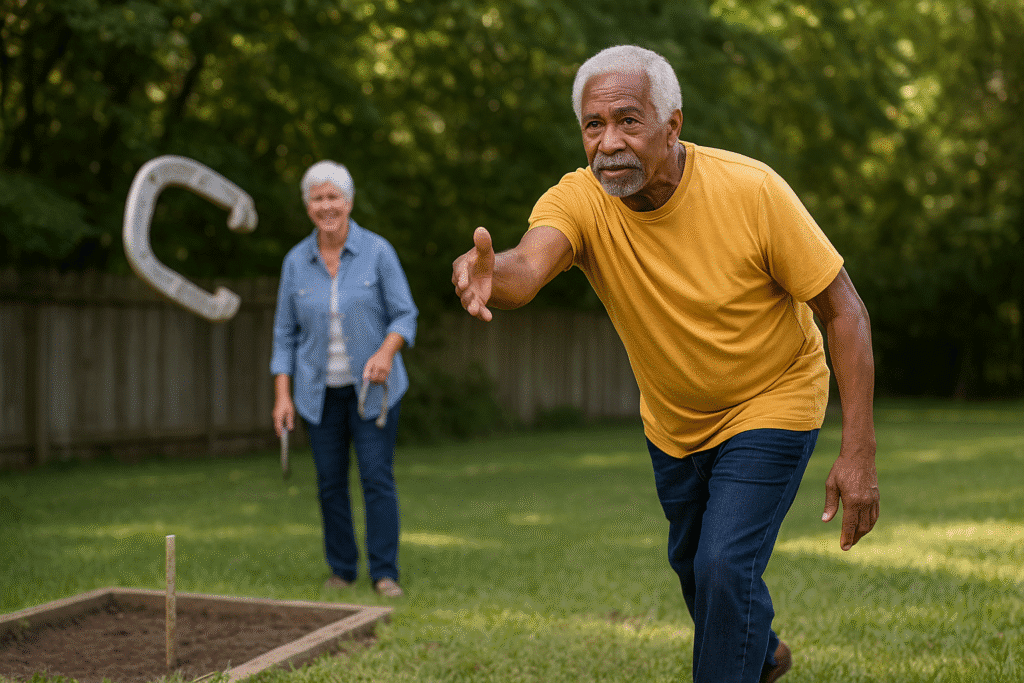
- Your arm should finish high and slightly forward, like you’re shaking hands with the stake.
- Your back foot may lift slightly as weight transfers forward.
🧠 Body Awareness Matters
This is where biomechanics really shines—the better you understand your posture, balance, and movement, the more consistent your throws will become. It’s not about muscle—it’s about muscle memory.
Common Mistakes That Sabotage Your Throw
Even experienced players can slip into bad habits. Watch for these:
- Death grip: Over-gripping the shoe leads to awkward releases and poor spin.
- Off-center releases: Causes the shoe to wobble in the air.
- Jerky arm motions: Breaks momentum and disrupts aim.
- Inconsistent foot placement: Throws off body balance and alignment.
- Not practicing follow-through: Leads to weak throws and poor accuracy.
🛠️ Quick Fix Drill:
Stand 10 feet from a stake and focus only on grip and release, without worrying about scoring. Use slow-motion movements to feel each part of the throw.
Biomechanics in Action: What the Pros Do Differently
Skilled players don’t just throw harder—they throw smarter. Their techniques share a few core principles:
- Relaxed power: Energy comes from fluid motion, not force.
- Repetition: They practice the same form over and over, even when warming up.
- Body alignment: Their hips, shoulders, and feet are all aimed at the stake.
- Controlled spin: Their shoes land open, facing the stake, with perfect rotation.
🎥 Want to learn from top players? Watch slow-motion videos of professional ringers and compare your form. Seeing is believing—and learning.
Conditioning for Better Throws (and Fewer Injuries)
You don’t need to hit the gym to get better at horseshoes—but a little conditioning goes a long way.
🏋️ Best Exercises for Horseshoe Players
- Wrist curls: Strengthens grip without strain.
- Shoulder rolls & rotator cuff stretches: Prevents soreness and injury.
- Core stability (planks, bridges): Supports balance and follow-through.
- Hamstring and quad stretches: Helps maintain a grounded, balanced stance.
🚫 Injury Watchlist
- Elbow pain: Usually due to overuse or poor form.
- Shoulder tightness: Often a sign of pushing too hard without warming up.
- Back strain: Result of poor balance or leaning.
Recommended Gear to Support Biomechanical Improvement
Choosing the right horseshoe set can reinforce proper grip, weight distribution, and form.
🎯 Top Pick: Franklin Sports Professional Horseshoe Set
This regulation-weight steel horseshoe set includes:
- 4 forged-steel horseshoes
- 2 official-size stakes
- Perfect balance for practicing consistent rotation
- Durable design that mimics tournament conditions
👉 Looking to master your throw? Upgrade your training with the Franklin Sports set—it’s a favorite among backyard players and league hopefuls alike.
Training Tools and Drills to Build Better Mechanics
- 🎯 Target Pitch Drill: Place smaller rings around the stake to aim for precision.
- ⏱️ Timed Release Drill: Count down and throw with rhythm to develop consistency.
- 📹 Video Feedback: Record and review your throws frame-by-frame.
💡 Use chalk or tape to mark your stance and track foot position after each throw.
FAQ: Biomechanics for Horseshoe Pitching
Q: Which grip is best for beginners?
A: The flip grip is easiest to learn and great for developing rhythm and confidence.
Q: Should I twist my wrist for more spin?
A: No. Let the shoe roll naturally off your fingers. Forced wrist action leads to wobble.
Q: How do I improve my follow-through?
A: Focus on your hand finishing in line with the stake. Practice shadow throws without the horseshoe to perfect motion.
Q: Do I need different shoes for different grip types?
A: Not necessarily—but weight, balance, and feel matter. Try a well-balanced set like Franklin’s to find your rhythm.
Q: Can strength training help my throw?
A: Absolutely—especially wrist, shoulder, and core strength. Just don’t overdo it. Flexibility is equally important.
Final Thoughts: Small Adjustments, Big Results
You don’t need superhuman strength or perfect aim to become a great horseshoe player. You just need repeatable, biomechanically sound technique.
Start with your grip. Align your stance. Release with confidence. The more you fine-tune your movements, the more those ringers will start to stack up.
💪 So whether you’re playing under the lights or in your backyard, remember: every great throw starts with understanding your body.
Ready to Take Your Game to the Next Level?
👉 Try the Franklin Sports Professional Horseshoe Set today and start training with the balance and precision the pros rely on.
For more tutorials, equipment tips, and backyard game strategies—stick with us at PlayingHorseshoes.com.
Hi there, and thanks for stopping by! My name is Larry, and I’m the voice behind PlayingHorseshoes.com. I love the game and have been playing since I was a kid. I started this blog because I am passionate about the sport, and with all the technology, I hope the sport doesn’t die. I plan to do my part to keep it going for me and my brother’s sake. Thanks for stopping by, feel free to subscribe and comment. Thank You!