Precision, rhythm, patience — and the world watching.
There’s something timeless about the sound of a horseshoe hitting steel. That crisp clang carries the same weight whether you’re in a backyard, campground, county fairgrounds, or a sanctioned NHPA pit tucked behind a municipal rec center.
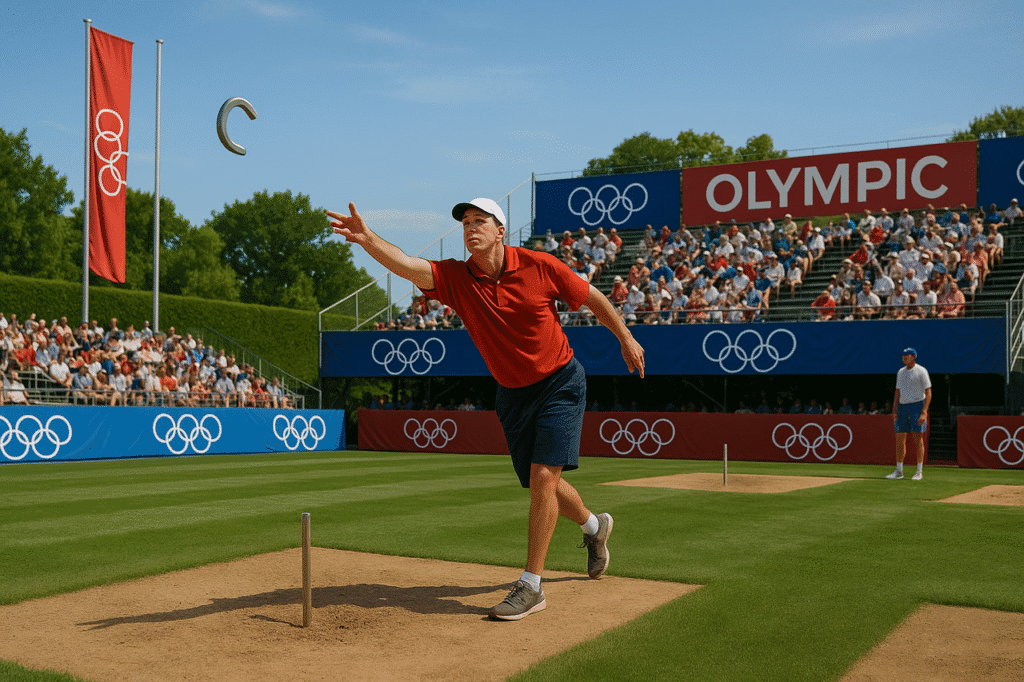
But imagine — just imagine — that instead of casual summer tournaments and league play, the entire world tuned in to watch the best pitchers alive compete for gold.
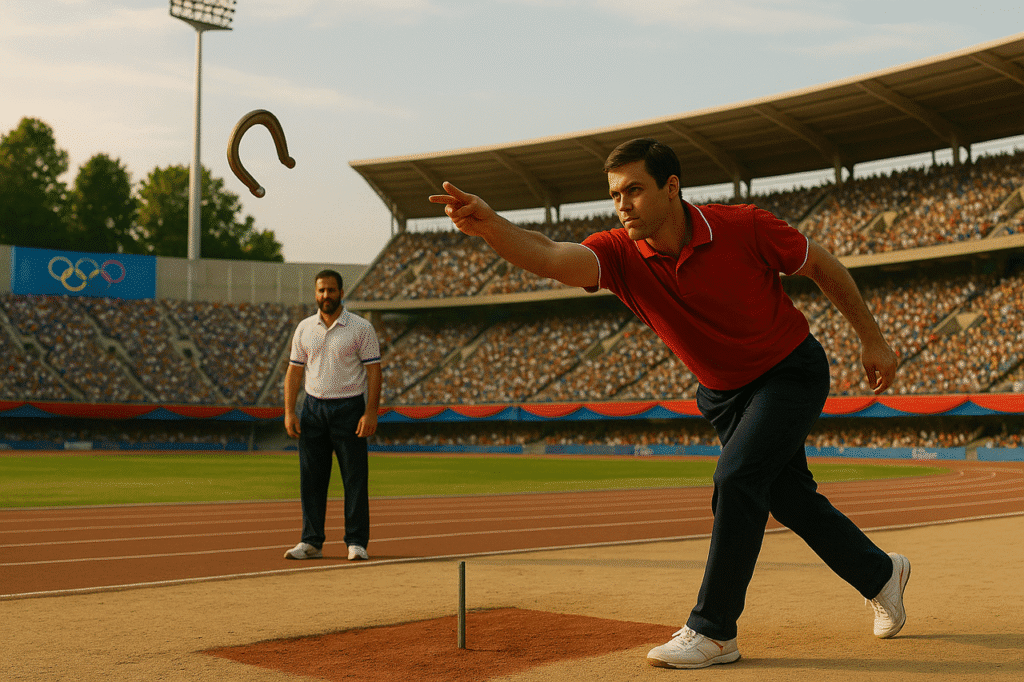
What if horseshoes were an Olympic sport?
Getting a sport into the Olympics isn’t a walk in the park. It’s more like navigating a labyrinth with a map that keeps changing. But hey, nothing worth it comes easy, right? So, what’s the game plan for horseshoes to snag that coveted spot alongside the heavy hitters in the sporting world?
Let’s take the idea seriously — but not too seriously — the way the best horseshoe games always are.
The Opening Ceremony Moment
Picture this:
The stadium lights dim. Flags wave. The crowd goes quiet.
Then — clang.
A horseshoe ringer rings out over the speakers like a national anthem of its own.
Out steps the U.S. National Horseshoe Team, uniforms clean but practical — nothing flashy, because real pitchers aren’t out here for attention. They’re out here for consistency.
The crowd? Not cheering wildly — but leaning forward.
Because horseshoes is a game of focus — the kind that pulls people in instead of blowing them back.
The whole world is about to learn what you and I already know:
A perfect ringer is a thing of beauty.
How the Olympic Horseshoe Facilities Would Look
Let’s be honest — the Olympics love over-designing everything.
But horseshoes don’t need lasers or LED runways.
A proper Olympic horseshoe venue would actually look… simple.
Court Specs:
Regulation 40-foot foul line distance
Two indoor-rated clay pits (because nobody wants to see a ringer bounce)
Perfectly conditioned clay — damp enough to hold the shoe, but not muddy
Stakes at the correct 40-degree lean, not “somewhere in the ballpark of leaning-ish”
No boards. No gimmicks. Just clean pits, bright lighting, and that beautiful neutral hush before a throw.
The Olympics might try to make a spectacle of it — but the sport would push back.
Horseshoes are grounded. Rooted. Steady.
Which is why it would shine.
The Athletes: Built Different
Horseshoe pitchers don’t look like sprinters, gymnasts, or powerlifters.
They don’t need to.
This is a sport of micro-mechanics and mental discipline.
Olympic Horseshoe Player Traits:
Skill
Why It Matters
Wrist Relaxation
Prevents wobble & over-spin
Foot Foundation
Body quiet = shoe flies true
Repeatable Rhythm
Every throw should be identical
Emotional Calm
No frustration tilt throws
Long-match stamina
Concentration over time
These aren’t athletes who “go all out.”
They’re athletes who stay steady.
The most elite players? Move like they’re breathing — rhythmic, unhurried, unbothered.
The camera would zoom in on the hand release, and commentators would say:
“Look at that — that’s poetry right there.”
And they’d be right.
Uniforms & Gear: Practical, Not Flashy
No sequins. No compression suits. No crazy country-colored face paint.
Olympic Horseshoe Uniform:
Breathable button-down or polo shirt
Flexible work-fit or athletic-fit pants
Solid-soles — no heavy boots, no squishy running shoes
Shoes (the steel ones): Each pitcher brings their own balanced set
Because in this sport:
Your horseshoe is your brush, and you’re painting a perfect arc.
Imagine the broadcast team calling a championship match:
Announcer 1: “She’s been working that 1 ¼ flip all season — absolutely dialed in. Her release is so consistent it’s basically muscle memory.”
Announcer 2: “The last round she adjusted her stance just an inch to compensate for clay packing. That’s elite awareness right there.”
The crowd gasps for a leaner.
People in living rooms everywhere are googling:
“What is a leaner and why is everyone so excited?”
The sport finally gets the respect it deserves.
The Drama
This is where it gets good.
Horseshoes is quiet — but that means every miss matters. Every wobble. Every over-rotation. Every fingertip adjustment.
You can’t hide in horseshoes. You can’t blame the equipment. You can’t point fingers.
You either:
Relax and flow
Or tighten up and fall apart
Olympic pressure would test even the most seasoned pitchers.
And that’s exactly what makes it exciting.
The Training — Yes, This Would Get Serious
Olympic horseshoe athletes would train like precision shooters or archers:
Daily Drills:
Controlled repetition from the foul line
Release angle slow-motion practice
Targeting tosses to hit the same sand indentation
Mental breathing exercises
Clay management/raking/conditioning awareness
Wind compensation for outdoor matches
This isn’t just “go toss in the backyard.”
This is:
Every throw is a data point. Every throw teaches you something.
The Stars & Legends Would Finally Emerge
Just like curling gained worldwide fandom once people got it, horseshoes would become:
A quiet cult favorite
A strategy sport
A “once you understand it, you’re hooked” kind of thing
Kids would start practicing in driveways. Backyards would get new pits. Local parks would add horseshoe courts again, like they used to.
The game would grow.
What Makes Horseshoes Olympian in Spirit?
The Olympics celebrate:
Precision
Body control
Rhythm
Calm
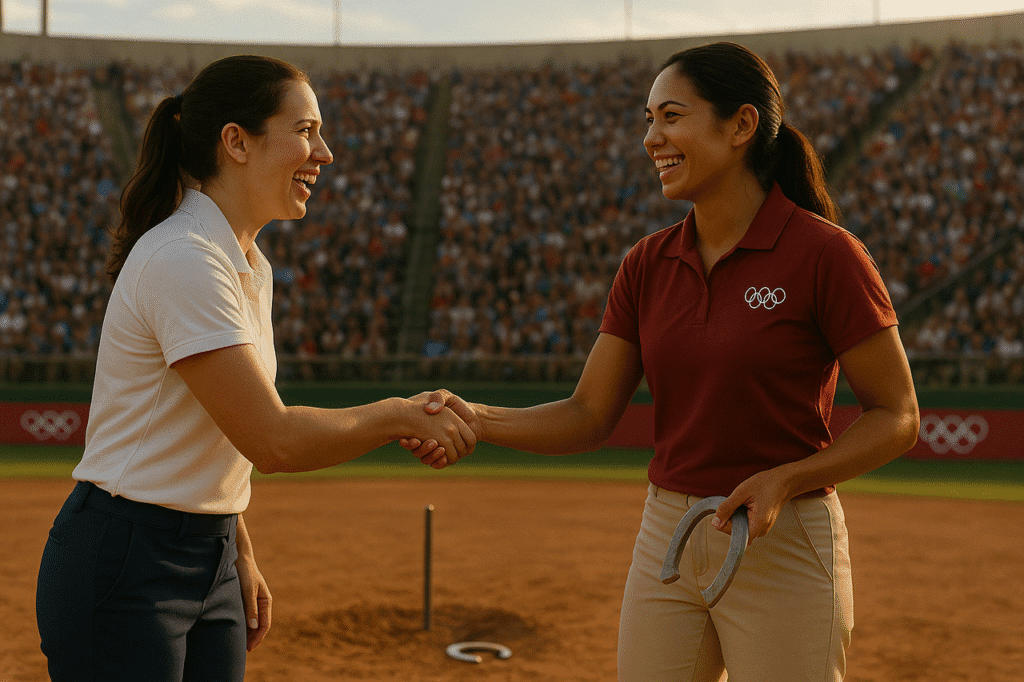
Respect
Ritual
Horseshoes are all of that.
It’s also:
Humble
Accessible
Community-driven
You don’t need money to play. You don’t need a gym membership. You don’t need a coach.
You just need:
A stake
A flat walkway
A pair of shoes
And some time
Which means:
Horseshoes is one of the most truly universal sports on Earth.
That alone makes it perfect for the Olympics.
FAQ: Horseshoes as an Olympic Sport
Q: Would horseshoes actually fit into the Olympic Games? Yes — horseshoes checks every box the Olympics is built on: precision, technique, repeatable form, and mental discipline. It’s a sport where experience matters as much as physical ability, which gives it universal accessibility. That’s exactly the kind of sport that gains international respect once people understand its depth.
Q: How would scoring work if horseshoes were played at the Olympic level? Scoring would follow standard competitive rules:
Ringer = 3 points
Closest shoe = 1 point
Leaners count = 1 point (if used in that division)
Most matches would likely go to 21 or be structured as best-of-three sets to keep timing consistent for broadcast audiences.
The goal wouldn’t change — accuracy, consistency, and calm under pressure.
Q: Would players need special equipment to compete? No — and that’s part of the charm. Competitive horseshoe sets are balanced forged steel shoes, typically between 2½–2¾ pounds. The important part is balance and feel — not flashy materials. Uniforms would be lightweight and functional, designed for range of motion and breathability rather than marketing flair.
Q: What kind of training separates elite pitchers from casual backyard players? Elite horseshoe pitchers train for:
Repeatable throwing rhythm
Consistent release angle
Controlled rotation (often the 1¼ flip)
Quiet footwork and grounded stance
Mental reset between throws
Situational play — knowing when to aim for a blocker vs. a clean ringer
The difference isn’t in strength — it’s in consistency.
Q: Would matches be fast or slow to watch on TV? Horseshoes is intentionally unhurried — but that’s where the tension and excitement build. TV broadcasts would highlight slow-motion release angles, fingertip spin, pit impact, and air arc tracking. Similar to curling, archery, and golf, the interest comes from anticipation, not velocity.
Q: Could this help grow the game globally? Absolutely. Right now, most people discover horseshoes through:
Family backyards
Campgrounds
Local rec fields
County and state fairs
Veterans halls and senior communities
An Olympic spotlight would bring:
More organized youth play
More public court installations
More respect for technique
A new generation of players learning the sport the right way
The game grows when people see why it matters.
Q: Why do horseshoes resonate with so many different types of players? Because the game rewards patience over strength, rhythm over power, and composure over intensity. It’s a sport that teaches lessons far beyond the pit:
Slow down. Focus. Breathe. Try again. Respect the moment.
That’s timeless — and universal.
Thoughts
If horseshoes ever made it to the Olympics, it wouldn’t suddenly become a loud, high-hype, energy drink commercial kind of sport.
It would bring the Olympics back to something older.
Something slower.
Something human.
A quiet game. A steady hand. Two shoes. One stake. And the whole world listening for the ringer.
Contains information related to marketing campaigns of the user. These are shared with Google AdWords / Google Ads when the Google Ads and Google Analytics accounts are linked together.
90 days
__utma
ID used to identify users and sessions
2 years after last activity
__utmt
Used to monitor number of Google Analytics server requests
10 minutes
__utmb
Used to distinguish new sessions and visits. This cookie is set when the GA.js javascript library is loaded and there is no existing __utmb cookie. The cookie is updated every time data is sent to the Google Analytics server.
30 minutes after last activity
__utmc
Used only with old Urchin versions of Google Analytics and not with GA.js. Was used to distinguish between new sessions and visits at the end of a session.
End of session (browser)
__utmz
Contains information about the traffic source or campaign that directed user to the website. The cookie is set when the GA.js javascript is loaded and updated when data is sent to the Google Anaytics server
6 months after last activity
__utmv
Contains custom information set by the web developer via the _setCustomVar method in Google Analytics. This cookie is updated every time new data is sent to the Google Analytics server.
2 years after last activity
__utmx
Used to determine whether a user is included in an A / B or Multivariate test.
18 months
_ga
ID used to identify users
2 years
_gali
Used by Google Analytics to determine which links on a page are being clicked
30 seconds
_ga_
ID used to identify users
2 years
_gid
ID used to identify users for 24 hours after last activity
24 hours
_gat
Used to monitor number of Google Analytics server requests when using Google Tag Manager
1 minute
You can find more information in our Cookie Policy and .