What If Sasquatch Started a Horseshoe League in the Pacific Northwest?
Forest echoes, campfire laughter, and the legend of the perfect ringer.
Some stories feel almost too good to check.
Stories that move like mist through cedar trees.
Stories told just after the fire burns down to an ember and someone says:
“Alright… but don’t laugh — I swear this happened.”
And if you grew up anywhere near the Pacific Northwest — Oregon backroads, Washington foothills, Idaho timber country — you’ve heard some version of the tale:
Sasquatch doesn’t just roam. Sasquatch plays horseshoes.
And not just casually.
Not like tourists throwing shoes in a campground clearing.
We’re talking form.
We’re talking focus.
We’re talking ringer accuracy so clean it’s unsettling.
But that’s just the beginning.
Because, as the stories go…
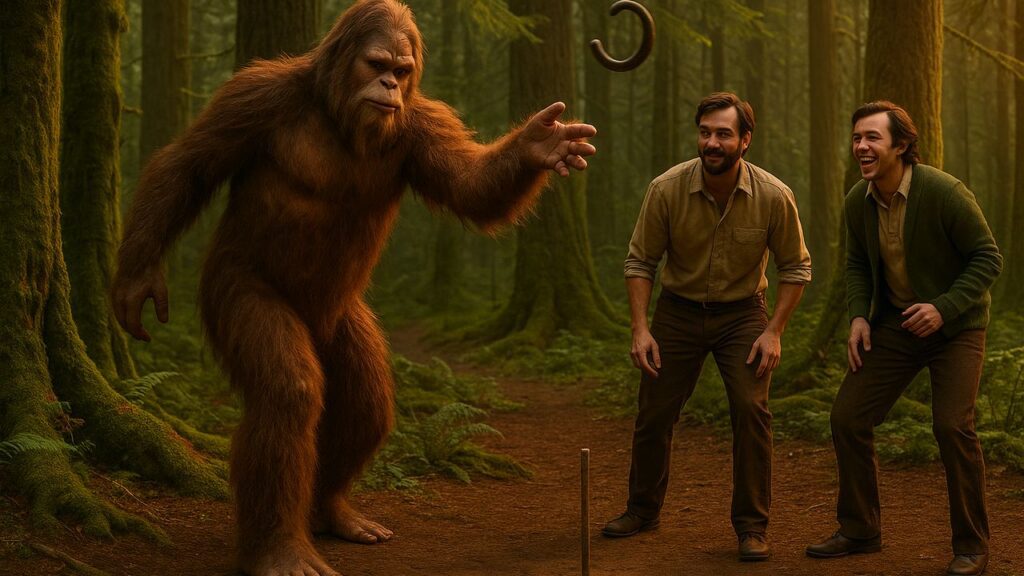
Sasquatch didn’t just play. Sasquatch started a league.
Why Horseshoes Make Perfect Sense in Sasquatch Territory
Think about it for a second:
- A game that requires no electricity
- Easy to travel with
- Works in a forest clearing
- Encourages patience, observation, stillness, presence
- Quiet enough to keep the forest calm
Horseshoes are basically forest meditation disguised as friendly competition.
And Sasquatch — in legend — is a patient creature.
Observant.
Still.
Calm.
Methodical.
It tracks.
It really tracks.
Plus, have you ever tried to win a ringer against someone with hands the size of dinner plates?
Yeah. Exactly.
How the League Got Started (The Campfire Version)
No one knows the exact origin story, but this is the one most commonly repeated:
Scene:
Two campers are near the base of Mount Rainier.
Late afternoon light.
Cool shadows between trees.
They set up a portable horseshoe pit near their truck.
A couple of ringers, a couple of laughs, nothing special.
And then they notice:
A perfectly thrown horseshoe lands in the pit from behind the tree line.
Smooth rotation.
Perfect arc.
Dead-on ringer.
No wind-up.
No grunt.
No showmanship.
Just precision.
One camper says:
“…Did you throw that?”
The other shakes his head slowly.
And from the edge of the clearing, something massive shifts its weight.
Not threatening.
Just… watching.
And then?
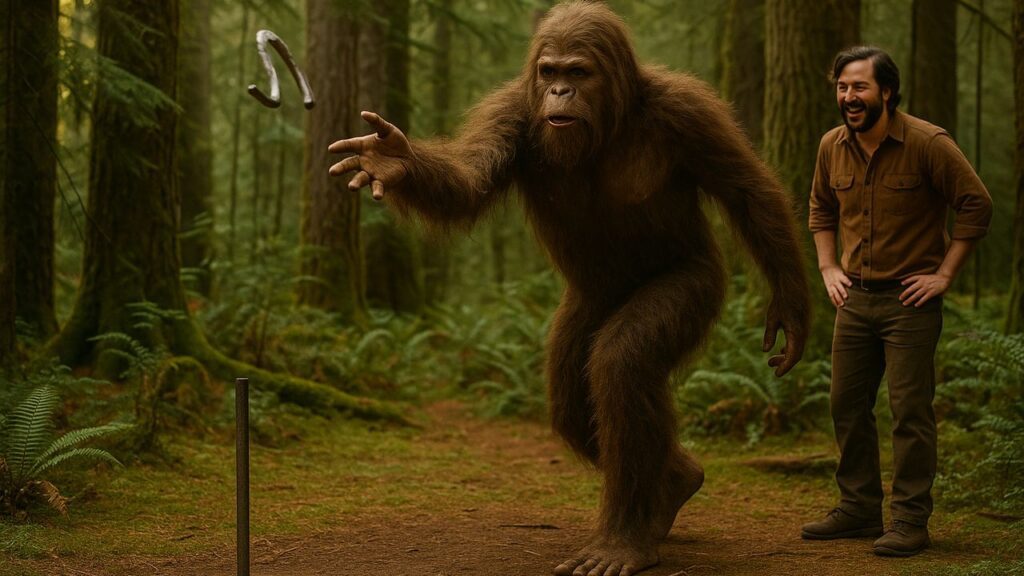
Another horseshoe arc.
Another perfect ringer.
They don’t run.
They just look at each other like:
“Well. I guess we’re playing.”
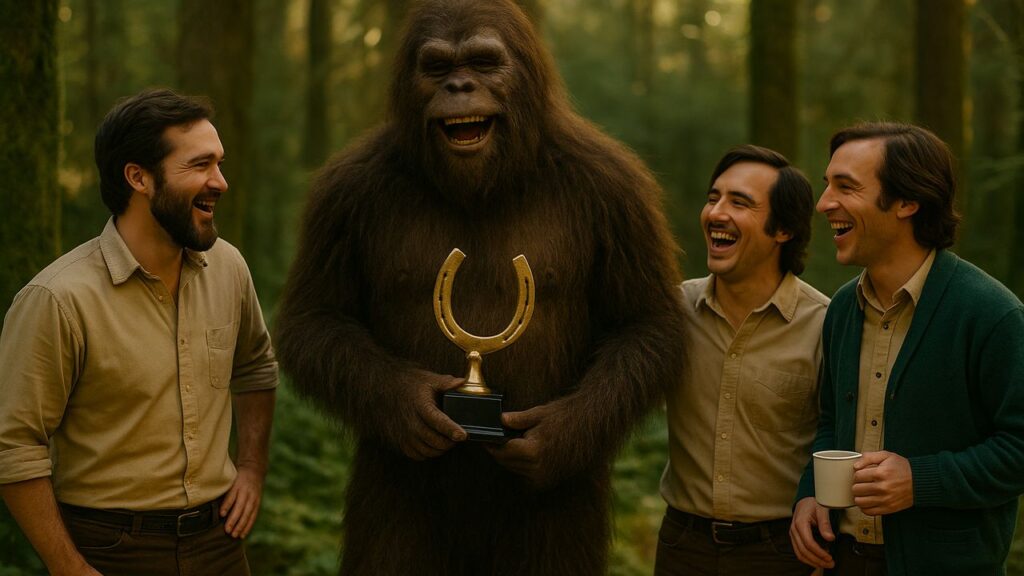
And the legend of the Sasquatch Horseshoe League begins.
The Rules of the Forest League
(As told by the people who claim to have seen it)
1. No Scoreboards
You remember who won.
If you forget, it wasn’t important.
2. Always Play Near Water
Streams, rivers, lakes — quiet places.
Sound carries differently in the forest.
3. No Crowding the Thrower
Give the pitcher space.
Respect the concentration.
4. No Pictures
Even if you could get a clear shot, it’s not about proof.
It’s about the moment.
5. Everyone Packs Out Their Gear
Leave the forest exactly as you found it.
Better, if possible.
6. Laugh When You Miss
Because if you can’t laugh at a bad throw, you’re not here for the right reasons.
Honestly?
These rules are better than half the summer backyard tournaments I’ve seen.
The Playing Style
Sasquatch pitchers reportedly use a high, slow arc:
- Smooth release
- Wrist loose
- Body quiet
- Full follow-through
No “snap toss.”
No tight over-spin.
No slinging it sideways like someone trying to impress their cousins at a reunion.
It’s closer to:
Placing the shoe where it needs to be.
Which, honestly, might be the single best horseshoe advice I’ve ever heard.
A Northwest Court Setup (The Real Takeaway)
Let’s talk about actual horseshoe play, because the forest has some unique challenges.
Ground Conditions:
Forest soil is loose, soft, and sometimes mossy.
A good forest pit uses:
- Canvas sandbags or a shallow wooden frame
- Medium-grit sand for consistent shoe stop
- Stake anchored with crossed rebar spikes or a tripod brace
Why Sandbags Work:
You can carry them
Fill them on-site
Pack them out when done
Leave no trace
Stake Recommendation:
40° lean toward the pitcher
for predictable bounce and controlled ring potential.
(Yes — even Sasquatch respects stake tilt. Legends are still subject to physics.)
How to Throw a “Forest Ringer”
Because this is where the real crossover happens.
1. Keep Your Shoulders Loose
Tension kills accuracy.
2. Slow Your Backswing
This is not cornhole.
This is not darts.
This is rhythm.
3. Let the Shoe Rotate Naturally
Don’t force the spin.
4. Follow Through Toward the Stake
Your hand should finish pointed exactly where you want that shoe to land.
5. Breathe
Yes, really.
Breathing is half the game.
These are the same fundamentals we teach any backyard player, improving from a “lucky hit” to an intentional thrower.
The forest just makes it feel bigger.
Older.
More grounded.
Why This Story Feels Right
Even if you don’t believe a 700-pound woodland legend hosts quiet evening horseshoe tournaments under fir trees…
You do know this feeling:
- The game that happens after dinner.
- The moment when conversation slows.
- The air stills.
- Nobody’s performing anymore.
Just good people.
Good throws.
The sound of metal on steel.
That is what this story is about.
Horseshoes are not loud.
It is not flashy.
It is not ego-driven.
It is a game for:
- Listeners
- Observers
- Quiet competitors
- Thinkers
- Old souls
And maybe — just maybe — for Sasquatch too.
FAQ: Sasquatch & Horseshoes in the Pacific Northwest
Q: Is the Sasquatch Horseshoe League real, or is it just a fun story?
It’s a campfire legend — a playful Northwest tale shared around late-night fires. Whether or not Sasquatch is actually pitching ringers isn’t the point. The story captures the heart of horseshoes: good company, quiet evenings, and a simple game played slowly and with intention.
Q: Can you really play horseshoes in the forest?
Yes — and a lot of campers do.
The key is to keep the setup portable and leave-no-trace:
- Use sandbags instead of digging pits
- Stabilize stakes with clamps or a tripod brace
- Pack out everything you brought in
This protects the forest floor and keeps the space natural for the next group.
Q: What throwing style works best on uneven ground or soft forest sand?
The flip grip with a high, relaxed arc tends to work best.
Uneven surfaces reward control, not power.
Focus on:
- Relaxed shoulder
- Smooth motion
- Natural rotation
- Gentle follow-through
Trying to force the shoe usually leads to wild misses.
Q: Do players keep score in these “forest-style” games?
You can — standard scoring works just fine:
- Ringer = 3 points
- Closest shoe = 1 point
- Game to 21 or whatever you all agree on
But in the Sasquatch-style league, score doesn’t matter much.
It’s about connection, not competition.
Q: Is horseshoes beginner-friendly?
Very.
Most new players can make consistent throws after just a few turns.
Horseshoes is a confidence-building game where improvement comes from rhythm, not strength. It’s a great campfire activity because everyone can play — kids, grandparents, seasoned throwers, and first-timers.
Q: What kind of horseshoes are best for camping or travel?
Choose balanced steel pitching horseshoes that feel comfortable in the hand.
Avoid cheap, overly heavy, or hollow novelty sets — they make learning harder and feel clunky. A well-balanced shoe encourages smooth rotation and better control.
Q: Why do people say horseshoes is a relaxing game?
Because it naturally slows your mind down.
There’s a tempo to it:
Step.
Swing.
Release.
Rotate.
Listen.
It’s almost meditative — especially in a quiet forest clearing.
Q: What’s the real message behind the Sasquatch horseshoe story?
That the best horseshoe games aren’t about winning.
They’re about:
- Evening light fading through the trees
- Friends laughing when someone wildly overthrows
- Slow throws that feel good in the body
- A moment nobody is in a hurry to end
Whether Sasquatch is real or not — the feeling is.
Thoughts
Whether you believe the story or not isn’t the point.
The point is:
Horseshoes belong anywhere people gather to enjoy each other’s company — forest, backyard, campground, or home-built pit behind the garage.
If Sasquatch does exist, I guarantee you this:
He doesn’t care who wins.
He just wants a clean throw,
a good laugh,
and one more game before dark.
Just like the rest of us.