When a Horseshoe Goes Rogue (And Lands Where It Shouldn’t)
A Backyard Disaster No One Saw Coming
Backyard horseshoes have a way of humbling people. The game looks simple — a pit, two stakes, and a couple of pieces of shaped steel. But the moment someone steps up to the line and tries to make a shoe do what they’ve seen in videos, the truth shows up. Horseshoes is equal parts skill, finesse, physics, and patience.
And now and then, it turns into slapstick comedy.
Anyone who has played horseshoes long enough has seen at least one pitch that went way past embarrassing. Maybe it didn’t just miss wide. Maybe it cut hard like it was dodging the stake on purpose. Maybe it veered off at an angle that looked physically impossible. Maybe it flew with such enthusiasm it seemed self-propelled.
Some of those wild throws land safely in the dirt. Others don’t.
The story you’re about to relive is a tribute to that second category — the kind of pitch that’s remembered for years, retold at cookouts, joked about during holidays, and whispered whenever a certain player walks up to the pit.
It’s a story about one throw, one misguided horseshoe, and one ceramic lawn ornament that never saw it coming.
The Scene: A Perfect Backyard Day Ruined by Momentum and Gravity
It was a Saturday that felt designed for outdoor games. Sunshine in the mid-70s. A slight breeze. Lawn chairs already arranged in a half-circle. Someone had fired up a grill even though nobody asked them to. A couple of coolers were sweating in the shade. A small crowd — siblings, neighbors, friends — hovered around the pits, sizing up competition and pretending they weren’t secretly keeping score.
And then there was Carl.
If every backyard has a “character,” Carl was that character. A twice-a-year player who warmed up like an Olympic athlete. A man who believed every competitive activity in life — beanbags, darts, cornhole, even Jenga — should be played with intensity.
He moved to the throwing line like someone about to deliver a speech.
He held the horseshoe as if it were evidence in a courtroom.
He stared down the stake with the expression of a man trying to read its mind.
No one said anything. No one needed to. Everyone knew something dramatic was coming, even if no one knew what direction it was headed.
Carl inhaled deeply, squared his shoulders, raised the shoe back behind him, and launched it forward in a motion that had all the elegance of a heavy suitcase being thrown onto an airport conveyor belt.
The release was too tight, the angle was wrong, and the momentum didn’t follow a forward path. What left his hand was not a pitch — it was a steel projectile with an attitude problem.
It didn’t roll, arc, or rotate toward the stake.
It sliced diagonally.
It banked left like a crop duster making a hard turn.
And then the crowd saw its final target.
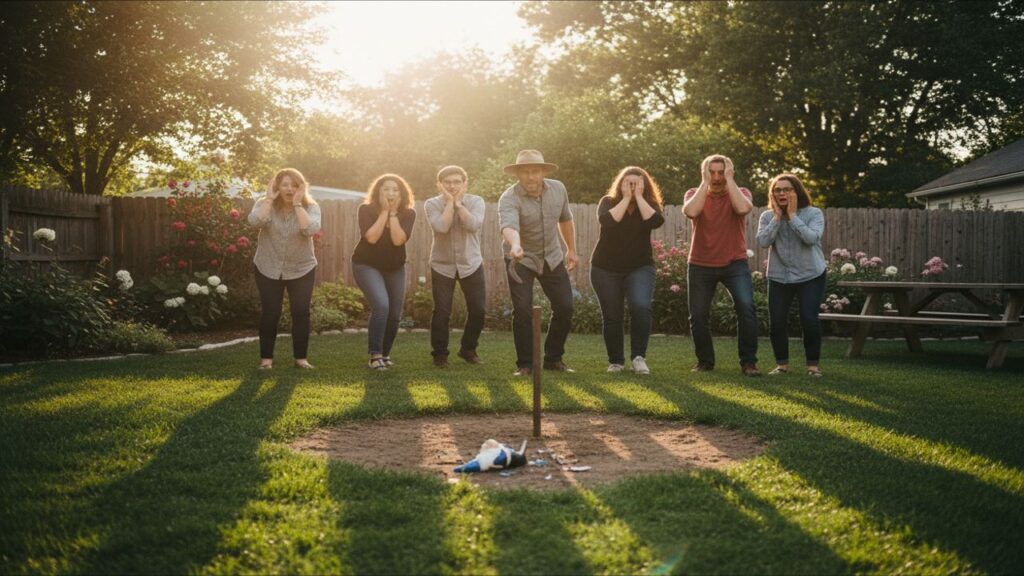
The Victim: A Hand-Painted Ceramic Treasure
There are lawn ornaments, and then there are lawn icons. Aunt Linda’s garden gnome fell firmly into the second category. He wasn’t just a decoration; he was a household mascot. A ceramic masterpiece wearing patched-up overalls, holding a fishing pole, positioned triumphantly next to a small birdbath as if guarding the kingdom of ornamental landscaping.
He’d been there for years. Rain didn’t bother him, snow didn’t weaken him, and careless dogs barely tipped him. He was stoic. Loyal. Respected.
Until Carl’s horseshoe found him.
The pitch connected with the gnome with a force nobody expected from a backyard game. It didn’t bounce off harmlessly. It didn’t just chip a little paint. It shattered that poor fishing friend into an explosion of ceramic shrapnel. His hat flew in one direction. His beard split into multiple chunks. His little fishing pole snapped in two like a twig under a truck tire.
Silence followed. The kind of silence that only happens when something beloved has just been destroyed by someone who absolutely shouldn’t have been in charge of anything heavy.
Aunt Linda’s gasp wasn’t loud. It was worse — it was slow, long, and filled with disappointment. She didn’t yell. She didn’t swear. She just stared at Carl the way people stare at someone who backed into a mailbox and then blamed the mailbox for being too solid.
Carl, naturally, blamed the wind.
How Good Throws Go Bad: The Anatomy of a Rogue Pitch
It’s easy to laugh at a disaster after it happens, but there’s real physics behind a wild throw. Horseshoe players don’t throw rogue tosses because they’re unlucky. They throw them because their mechanics are off. Three mistakes cause almost every unpredictable miss.
1. The Grip of Doom
A tense grip twists the shoe. People squeeze like they’re trying to crush the steel. The tighter the grip, the more uneven the release.
The fix: Relax the hand. Grip with fingers, not a fist.
2. Wrist Roulette
When players flip or turn their wrist to “help” the shoe, they sabotage its rotation. The shoe doesn’t need steering. It needs consistency.
The fix: Keep the wrist quiet. Let the arm do the work.
3. The Early Release Catapult
If the shoe leaves the hand too soon, it hooks left. If it leaves late, it dives right. Most wild throws come from bad timing — not bad luck.
The fix: Release as the arm passes your thigh on the forward swing.
Perfect throws aren’t built on power. They’re built on smoothness. A horseshoe is honest. It goes exactly where your technique sends it. In Carl’s case, that happened to be the gnome.
Backyard Safety Nobody Wants to Talk About (But Should)
People assume horseshoes is “as safe as cornhole.” That’s because they’ve never seen an airborne shoe nearly take out a toddler, or dent a cooler, or graze someone’s shin. Horseshoes are heavy. They’re steel. They’re sharp enough to cut open bags of soil.
A safe backyard setup respects three rules:
- Nobody stands behind or directly ahead of the pitcher.
- Spectators should sit off to the side, never at the ends.
- Children and pets do not retrieve horseshoes during the game.
The gnome was collateral damage, but it could just as easily have been a foot, a knee, or someone’s unsuspecting drink-holding hand.
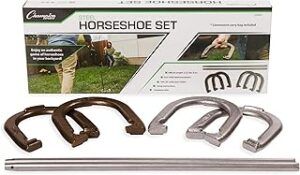
Horseshoe Game Set
How Better Gear Helps Prevent Disaster
Improved skill matters most. But gear can help players learn consistency faster. A good set offers even weight, proper balance, and predictable rotation, making it easier to refine your timing and grip.
One dependable, user-friendly option for backyard use is the Champion Sports Elite Horseshoe Set. It’s regulation weight, solid enough to withstand years of casual use, and designed with a smoother rotation in mind — which means fewer out-of-control spirals heading toward lawn decorations.
Good shoes don’t make someone a pro, but they do make practice honest.
The Dissection of Carl’s Form: A Teaching Moment Nobody Wanted
For educational purposes — and possibly to help Carl redeem himself — let’s break down exactly how his throw went so wrong.
- His stance was closed, meaning his feet pointed left of the target. That encouraged the shoe to travel left.
- He gripped too hard, knuckles white, wrist tense, guaranteeing an uneven release.
- He swung too fast, as if speed could make up for lack of control.
- He released early, which sent the shoe into a diagonal path instead of a forward one.
If you ever want to replicate Carl’s throw, do those four things. If you don’t, do the exact opposite.
Professional-level players don’t throw harder. They throw cleaner. They throw with intention. They make gravity an ally, not a weapon.
Turning Rogue Throw Shame Into Progress
Everyone at that backyard game remembers the shattered gnome. That’s the bad news. The good news? Every player there — Carl included — will never forget how that throw happened. And knowledge sticks longer when it comes with a story you can’t forget.
Rogue throws teach the best lessons:
- Better timing beats more muscle.
- A calm grip beats a clenched one.
- Good pitching lanes prevent accidents.
- Angle, stance, and release aren’t details — they’re the game.
Carl could either be embarrassed forever, or he could become the player who came back next summer, throwing ringers. At least he has motivation.
Aunt Linda has motivation, too. She’s now shopping for metal outdoor decor.
Building a Better Pit (And Preventing Another Lawn Casualty)
A safer game doesn’t require fancy upgrades. It just needs a smart layout. A proper backyard pit includes:
- Correct stake distance: 40 feet for adults.
- Stake lean: about 12 degrees toward the pitcher.
- Deep impact surface: sand or clay, at least 4 inches.
- Ends kept clear: no chairs, tables, grills, or breakable decor nearby.
If the pit is tight against a fence, patio, or garden ornament display, it’s not a court. It’s a lawsuit waiting to happen.
Backyard horseshoes should feel relaxed, but the setup should be taken seriously.
FAQ: For People Who Still Think It Was the Wind
Why do some shoes curve so badly?
Because the rotation wasn’t balanced at release. Bad timing equals bad flight.
Do lighter horseshoes curve less?
Not necessarily. Lighter ones may wobble more if the throw isn’t controlled.
Can someone stand behind the pitcher?
They can, but it’s a bad idea. Miss-throws travel backward more often than people think.
Does playing barefoot change anything?
Only your willingness to jump out of the way fast when Carl is pitching.
Can rogue throws be completely prevented?
No, but they can be drastically reduced by learning proper technique and clearing the throwing lanes.
Thoughts: Respect the Steel, Respect the Lawn
There’s a lesson in all this unpredictable horseshoe action. It’s about leaning into the laughter and the camaraderie these mishaps offer. Embrace the chaos, my friends, because it often turns out to be more fun than the perfect pitch. Who knew a minor backyard fail could mean enduring friendships and cherished memories?
Safety and setup don’t have to stifle the fun, though. A little planning—like checking the playing field—is wise. Maybe remind Carl to watch where he flings that thing. The balance of safe and silly makes even rogue moments a win.
So go ahead, toss that shoe (safely). And when it lands somewhere hilariously unplanned? Well, there’s probably a new family legend ready to be born. That’s the magic of horseshoes: unpredictability, laughter, and memories you’ll spin into tales for years to come.
Horseshoes will always have unpredictable moments. The game is ancient, simple, and stubborn. But it rewards players who treat it with respect. A clean, controlled throw doesn’t just earn points — it protects coolers, grills, pets, and cherished ceramic lawn personalities.
Carl didn’t mean to destroy Aunt Linda’s beloved fishing gnome. But intent doesn’t change impact. The pit remembers. The crowd remembers. The gnome would remember if it still had a head.
The next time someone steps up to throw, let them warm up. Let them take a breath. Let them focus. And maybe — just maybe — make sure you’re not anywhere near the flight path.
And if your yard is decorated with breakable statues, do them a favor: give them a clear view of the game… from a safe distance.