Lightweight vs. Heavy Horseshoes: Finding the Right Weight for Your Throwing Style
Introduction: Why Weight Makes or Breaks Your Throw
If you’ve ever stepped up to a horseshoe pit, grabbed a shoe, and thought, “Whoa—this feels heavier than I expected,” you’re not alone. Horseshoe pitching looks easy until you’re actually standing there with steel in your hand. The truth is, weight changes everything—from how far you can play before your arm wears out, to whether that shoe lands flat or bounces off the stake.
For backyard beginners, the wrong weight can be discouraging. Too heavy, and your arm feels like rubber halfway through the game. Too light, and your throws sail wild or don’t have enough momentum to stick. The right weight gives you confidence, consistency, and—let’s be honest—the thrill of hitting your first ringer.
This guide digs deep into lightweight vs. heavy horseshoes, showing you the pros, cons, and everything in between. We’ll cover:
- What “light” and “heavy” actually mean in pounds.
- How weight affects your throwing mechanics.
- Real pros and cons of each style.
- Which sets to buy from trusted brands like Franklin, Champion, St. Pierre, and Gordon.
- Step-by-step practice drills designed for each weight class.
- FAQs that clear up the most common beginner confusion.
By the end, you’ll know exactly which weight matches your style—and you’ll be itching to set up those stakes and start pitching.
Standard Horseshoe Weights Explained
Horseshoe sets don’t all weigh the same. Here’s how the breakdown usually looks:
- Lightweight horseshoes: 2.25 to 2.5 pounds
- Heavyweight horseshoes: 2.75 to 2.9 pounds
- NHPA official maximum: 2 pounds 10 ounces (≈2.94 lbs)
Backyard “toy” sets might fall below 2 lbs (rubber or plastic versions), but once you step into real steel horseshoes, you’re choosing between the two main camps: light vs heavy.
The Case for Lightweight Horseshoes
Light horseshoes are often the first choice for beginners, kids, and casual backyard players.
Pros of Light Horseshoes
- Easier to handle: Great for players still learning grip and release.
- Less fatigue: You can throw more rounds without your shoulder turning to jelly.
- Faster learning curve: A lighter shoe forgives mistakes—you’ll find your rhythm sooner.
- Family friendly: Kids and seniors can join the game without struggling.
Cons of Light Horseshoes
- Less momentum: They don’t “bite” the stake as firmly.
- More bounce: A light shoe that glances off-center may ricochet instead of grabbing.
- Wind sensitivity: A gust can push a light shoe off its path.
Best Fit For
- Beginners testing the waters.
- Families with mixed ages.
- Casual play at cookouts or camping trips.
Product Spotlight
👉 Champion Sports Horseshoe Set — A well-balanced, slightly lighter option that’s perfect for casual and family play.
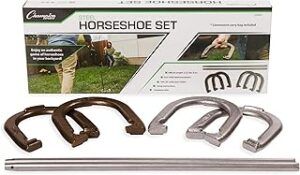
Horseshoe Game Set
The Case for Heavy Horseshoes
Heavier shoes are the choice of serious players and league pitchers.
Pros of Heavy Horseshoes
- More momentum: Heavier shoes wrap the stake with authority.
- Consistency: A stable rotation in the air gives you better accuracy once you master it.
- Tournament feel: Most NHPA-style sets are heavier, so you’ll be practicing like the pros.
Cons of Heavy Horseshoes
- More demanding: They’ll wear you out quicker, especially as a beginner.
- Steeper learning curve: Extra weight exaggerates bad form if your release is off.
- Not family friendly: Harder for kids or older adults to throw comfortably.
Best Fit For
- Players serious about improving.
- Adults who can handle the extra weight.
- Anyone who might join a local league down the road.
Product Spotlight
👉 St. Pierre American Professional Series — Drop-forged steel, official-weight, and one of the most trusted sets for players ready to level up.
The Middle Ground: Balanced Horseshoe Options
Not ready to commit fully to light or heavy? Some sets sit in the sweet spot.
Product Spotlight
👉 Gordon Professional Horseshoes — Known for premium quality, with a weight that’s slightly heavier than backyard sets but not as demanding as high-end pro shoes.
👉 Franklin Advanced Horseshoe Set — A sturdier upgrade from their starter version, giving you that “serious” feel without going all-in on heavyweights.
How Weight Changes Your Throw
The difference between light and heavy horseshoes isn’t just about how your arm feels—it changes the physics of your pitch.
- Light Horseshoes: Travel faster, require more control in the release, and tend to have a shorter arc.
- Heavy Horseshoes: Travel slower but with more stability, rotate with smoother momentum, and are more likely to “stick” when they hit.
Imagine tossing a baseball vs. a softball. Both can hit the target, but the mechanics and feel are different. Same with horseshoes.
Practice Drills Based on Weight
Drills for Lightweight Horseshoes
- Short-Range Accuracy: Start at 15–20 feet. Focus on consistent underhand arcs.
- Grip Consistency Drill: Throw 10 shoes in a row with the same grip—don’t change anything.
- Wind Challenge: Practice on breezy days to learn how to adjust release angles.
Drills for Heavy Horseshoes
- Endurance Rounds: Play to 30 points to build arm stamina.
- Smooth Release Drill: Focus on a slow, controlled release to avoid wobble.
- Stake Wrap Challenge: Stand closer and aim to wrap the stake, not just hit it. This builds confidence in heavier shoes’ momentum.
Real Player Profiles: Who Should Use What?
- Kids (under 12): Rubber or lightweight steel sets. Safety first.
- Seniors: Lightweight sets for less joint strain.
- Casual Backyard Player: Champion Sports or Franklin Starter (lightweight to medium).
- Aspiring League Pitcher: St. Pierre American Professional or Gordon Pro (heavier sets).
- Mixed-Age Families: Keep both a lightweight and a heavier set—you’ll make everyone happy.
Common Mistakes When Choosing Weight
- Buying too light thinking it’s “easier.” You’ll outgrow it fast.
- Jumping straight into heavy sets. Beginners risk fatigue and bad habits.
- Switching weights too often. Stick with one until your form is solid.
- Ignoring stake setup. Even the perfect shoe weight won’t matter if your stakes are wobbly.
Extended FAQ
Q: What’s the official weight of a horseshoe?
A: Up to 2 lbs 10 oz (≈2.94 lbs) under NHPA rules.
Q: Can I train with lightweight and compete with heavy?
A: Not recommended. Build consistency with one weight.
Q: Do heavier shoes make you more accurate?
A: Only if your mechanics are good. Otherwise, they magnify mistakes.
Q: Can I mix sets in a game?
A: No—always stick with the same weight within a match.
Q: What about women’s play?
A: Many women prefer lighter shoes, but plenty of competitive female players use heavyweights.
Q: How do I know if a shoe is too heavy?
A: If your arm aches after 10–15 tosses, you’re probably not ready for that weight.
Q: What’s the difference between cast and drop-forged steel?
A: Cast is cheaper but more brittle. Drop-forged (like St. Pierre) lasts longer and has better balance.
Q: Can rubber sets help beginners learn weight transfer?
A: Yes, they’re great for kids and indoors, but transition to real steel as soon as possible.
Q: How do I build stamina for heavier shoes?
A: Short practice sessions, gradually adding throws. Treat it like lifting weights.
Q: Which brands are the most trusted for beginners?
A: Franklin for affordability, Champion for family sets, St. Pierre for tournament feel, Gordon for premium quality.
Final Thoughts: Choose the Weight That Fits You
Here’s the bottom line:
- Go lightweight if you’re just starting, playing casually, or introducing kids and seniors.
- Go heavy if you’re serious, want that pro feel, and don’t mind a steeper learning curve.
- Go middle-ground if you want one set that grows with you.
👉 My personal advice? Start with a Champion Sports or Franklin Starter Set. Once you’re hooked—and you will get hooked—step up to the St. Pierre American Professional Series or Gordon Pro Series. That way, you’ll experience both sides of the game and find the weight that truly fits your style.
Don’t overthink it—grab a set, set up those stakes, and start tossing. The best horseshoe weight is the one that keeps you playing.
Hi there, and thanks for stopping by! My name is Larry, and I’m the voice behind PlayingHorseshoes.com. I love the game and have been playing since I was a kid. I started this blog because I am passionate about the sport, and with all the technology, I hope the sport doesn’t die. I plan to do my part to keep it going for my brother and my sake. Thank you for stopping by. Feel free to subscribe and comment. Thank You!