Why “Thinking Less” Wins More Games in Horseshoes
Overthinking kills consistency in horseshoes. Learn why relaxed focus, rhythm, and trusting muscle memory lead to better accuracy and more wins on the court.
The best horseshoe games usually feel effortless.
The arm stays loose.
The timing feels natural.
Ringers happen without forcing them.
Then the mind gets involved.
Suddenly, every throw gets analyzed. Grip pressure changes mid-game. Misses replay in your head. Confidence fades, accuracy slips, and frustration appears quickly.
In horseshoes, thinking too much is one of the quickest ways to lose control.
Winning more games isn’t about shutting your brain off completely. It’s about knowing when thinking helps — and when it quietly sabotages your throw.

1. Horseshoes Is a Feel Game First
Once basic mechanics are learned, horseshoes becomes a game of rhythm and repetition.
Accuracy comes from:
- Muscle memory built through repetition
- A steady tempo that doesn’t change under pressure
- Relaxed grip pressure
- Familiar motion repeated the same way
These skills live in the body, not the conscious mind. When the brain tries to micromanage them during the throw, timing breaks down.
Horseshoes reward feel, not calculation. Players who rely on feel tend to throw smoother, stay calmer, and recover faster from mistakes.
2. Why Overthinking Feels Helpful (But Isn’t)
Overthinking doesn’t feel like panic. It feels like an effort.
It feels like:
- Trying to correct mistakes
- Wanting to be precise
- Wanting to “figure it out”
The problem is that analysis happens too late.
Once the throw begins, the brain can’t process fast enough to help. Instead, it interferes — tightening muscles, altering timing, and breaking rhythm.
Thinking feels productive. In horseshoes, it often does the opposite.
3. What Overthinking Looks Like on the Court
Overthinking shows up in subtle ways.
Common signs include:
- Changing grip pressure every frame
- Adjusting arc based on the last miss
- Thinking about mechanics during the swing
- Second-guessing stance or foot placement
- Rushing the next throw to “fix” the last one
These behaviors don’t improve accuracy. They create tension — and tension shows up immediately in the release.
4. Why Your Best Throws Happen on Autopilot
Every experienced player has had games where everything feels automatic.
The mind quiets down.
The body takes over.
The throw feels smooth and familiar.
That’s not luck. That’s trained motion running without interference.
Autopilot doesn’t mean careless. It means trusting what’s already been practiced.
Players often say, “I don’t even remember throwing that one.” That’s the point. The less the brain interferes, the more consistent the motion becomes.
5. Thinking Before the Pitch vs Thinking During the Pitch
There’s a critical difference between useful thinking and harmful thinking.
Thinking Before the Pitch
Helpful thinking happens before stepping into the throw:
- Reading the court
- Noticing footing, slope, or wind
- Choosing an arc intention
- Resetting focus
This is preparation.
Thinking During the Pitch
Harmful thinking happens once motion starts:
- Correcting mid-swing
- Replaying the last miss
- Forcing release timing
- Tightening grip consciously
Once the arm starts forward, thinking should stop. The throw should happen.
6. How Mental Tension Becomes Physical Errors
The brain and body are tightly connected.
When the mind over-engages:
- Grip pressure increases
- Arm speed changes
- Release timing drifts
- Arc flattens
Many players blame mechanics when the real issue is mental noise turning into physical tension.
Relaxed minds throw relaxed shoes. Tight minds throw erratic ones.
7. Simplicity Beats Perfection
Horseshoes don’t reward perfect mechanics. It rewards repeatable mechanics.
A simple, repeatable throw beats a technically perfect throw that changes every frame.
That’s why players with unconventional form often outperform players who constantly tweak. They trust what works instead of chasing perfection.
Simplicity builds confidence.
Confidence builds consistency.

8. One Thought Is Better Than Five
If a mental cue is needed, keep it simple.
Effective cues include:
- “Smooth”
- “Easy swing”
- “High arc”
- “Relaxed hand”
Pick one and stick with it. Multiple thoughts compete with each other and disrupt rhythm.
The goal isn’t zero thought — it’s minimal thought.
9. Trust Is a Skill That Gets Trained
Trust doesn’t appear overnight. It’s built through repetition and restraint.
Trust grows when:
- The same motion is repeated without constant changes
- Misses are allowed without panic
- Adjustments aren’t made after every throw
Each time you resist the urge to overhaul your throw, confidence strengthens.
10. Why Overthinking Gets Worse in Close Games
Pressure amplifies mental noise.
In close games, players often:
- Try harder
- Aim more carefully
- Think more
Performance usually drops.
Winning players don’t increase effort — they reduce interference. They rely on what already works.
11. Practicing the Skill of Thinking Less
This mindset can be trained intentionally.
Helpful practice habits include:
- Sessions focused only on rhythm
- Letting several throws happen before adjusting anything
- Ignoring short-term results
- Resetting with a breath before each pitch
Preparation happens in practice. Trust shows up in games.
12. Handling a Bad Throw Without Spiraling
Bad throws happen to everyone.
What matters is the response.
Instead of:
- Replaying it mentally
- Changing mechanics immediately
- Forcing the next pitch
Do this:
- Acknowledge it
- Reset stance
- Return to one simple cue
Short memory wins games.

13. Why Thinking Less Improves Accuracy Over Time
When the mind quiets down:
- Grip stays relaxed
- Arc stabilizes
- Tempo smooths out
- Confidence builds
Accuracy improves not from trying harder — but from getting out of the way.
14. Product Recommendation: St. Pierre American Professional Horseshoes
A low-thinking, trust-based approach works best with a balanced, predictable horseshoe set that responds the same way throw after throw.
The St. Pierre American Professional Horseshoes are known for their steady feel and reliable balance, making them a strong choice for players focused on rhythm, tempo, and consistency rather than constant mechanical adjustment. Their predictable response reinforces smooth, repeatable motion — exactly what’s needed when letting muscle memory take over.
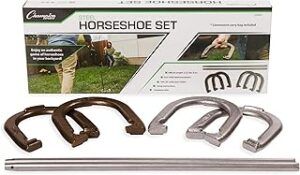
Horseshoe Game Set
Frequently Asked Questions
Is thinking less the same as not caring?
No. Preparation still matters. Thinking less means trusting preparation instead of micromanaging the throw.
Should beginners think less, too?
Beginners need some conscious focus early, but simple cues work better than overanalyzing.
What if misses increase when thinking less?
That usually means repetition isn’t solid yet. Trust grows with practice.
How many thoughts should be in a throw?
Ideally, one or none.
Why does casual play feel easier than competitive play?
Less pressure reduces mental noise. Carrying that mindset into competition is the real skill.
When the Mind Gets Quiet, the Game Gets Better
Horseshoes don’t reward constant correction. It rewards calm repetition.
The more you trust your throw, the less tension shows up in your grip, your timing, and your release. Accuracy improves not because you’re trying harder, but because you’ve stopped interfering with what already works.
Preparation still matters. Practice still matters.
But once the shoe is in your hand and the motion starts, thinking less usually means pitching better.
Step up. Stay loose. Trust the motion.
Then let the shoe do what it already knows how to do.