The Science of a Perfect Ringer: Physics, Arc, and Rotation Explained Simply
There’s Real Science Behind That “Clang”
That satisfying “clang” of a horseshoe ringing the stake isn’t luck. It’s physics — pure and simple.
The best pitchers know it’s not about muscle; it’s about motion. The perfect ringer combines arc, rotation, release, and angle in one smooth, natural throw.
But don’t worry — we’re not breaking out the chalkboard here. You don’t need a physics degree to understand what makes a ringer happen. You just need a clear picture of what your horseshoe is doing in the air and how tiny adjustments — in your grip, release, and aim — can make all the difference.
Let’s break it down, simply and clearly, so you can pitch smarter, not harder.

1. The Forces at Work — What Happens When You Let Go
When you release a horseshoe, several key forces go to work immediately:
- Gravity: Pulls the shoe down toward the ground (obvious, but critical).
- Air resistance: Slows the shoe slightly and affects its spin stability.
- Momentum: Keeps the shoe traveling in a straight path toward the stake.
- Torque and spin: Give the shoe that slow, balanced rotation we all look for.
The goal is to balance all these so the shoe travels in a controlled arc and lands open — the tips leading just enough to grab that stake.
If you’ve ever had a shoe veer off to the side, wobble mid-air, or land flat, that’s the physics telling you something’s off — maybe your release angle, grip pressure, or spin speed.
2. The Arc — Height Matters More Than You Think
Most players underestimate how much the height of the throw matters.
A low, line-drive pitch feels powerful, but it tends to skid or bounce past the stake. Too high, and you lose distance control. The sweet spot? A smooth, medium arc — high enough to drop down softly but still carry momentum.
- Ideal arc height: For most players, the shoe should peak around 8–10 feet high at its midpoint.
- Angle of release: Typically 25–35 degrees upward from the ground.
- Why it matters: A proper arc lets gravity do the work, guiding the shoe downward in a controlled fall rather than a dive.
Picture it like tossing a key ring onto a hook — you’re letting it fall into position, not drive it in like a nail.
3. The Rotation — How Fast Should the Shoe Spin?
Here’s where a lot of beginners overdo it. Too much spin, and the shoe flies unstable like a boomerang. Too little, and it flutters flat.
The best pitchers throw a slow, steady rotation — usually one full spin (360°) before it reaches the stake.
That single rotation gives the shoe:
- Balance — keeps both arms of the shoe even mid-flight.
- Predictability — you can see how the shoe opens and closes consistently.
- Control — you know exactly how it will land.
A smooth underhand toss with gentle wrist motion gives the best rotational balance. Don’t flick the wrist hard — let the shoe roll naturally out of your grip.
4. The Release — Timing Is Everything
The moment you let go determines everything that follows. Too early, and the shoe rises too high; too late, and it dives short.
The correct release point is when your arm passes just in front of your lead leg, allowing the shoe to follow your arm’s natural arc upward and outward.
Try this:
- Watch your shoe’s angle at release — it should be open slightly (tips up about 10°).
- Keep your follow-through relaxed and straight toward the stake.
- Don’t “force” the throw — rhythm beats power every time.
Good pitchers often describe the perfect throw as “effortless.” That’s not an exaggeration. Once you nail the release, the shoe seems to fly itself.

5. Grip and Balance — Small Adjustments, Big Results
Different grips produce different flight patterns. The two most common:
- Flip Grip: The shoe flips once or twice on its way to the stake. Great for short-range backyard play.
- Turn Grip: The shoe rotates a full circle (or close to it). Preferred in regulation play for its stability and ringer potential.
When you grip the shoe:
- Keep it balanced across your fingers — not too deep in the palm.
- Make sure the shoe’s open end faces your target.
- Hold firm but not tight — tension kills rotation.
Remember: every hand is different. What works for one player might feel off to another. Experiment with grip pressure and finger placement until you find your personal balance point — the one that feels “locked in.”
6. The Landing — Let Physics Finish the Job
A perfect throw doesn’t just hit the stake — it lands around it.
Your horseshoe should drop with its open end facing the stake, slightly tilted forward. Gravity and the shoe’s slow spin pull it downward, letting one arm make first contact, slide, and wrap around.
If it hits flat, the arc was too low or the shoe released early.
If it bounces past, your angle was too sharp or your rotation too fast.
Here’s what a “textbook” landing looks like:
- Shoe touches down about 6–12 inches before the stake.
- The heel digs slightly, allowing the front to wrap.
- The spin completes its turn just as the stake slides into place between the arms.
That’s when you hear that satisfying clink — the unmistakable sound of physics done right.
7. The Role of Spin Axis — Why Tilt Can Make or Break a Ringer
Here’s a subtle point most players never think about: the tilt axis of your spin.
When the shoe leaves your hand, it shouldn’t spin perfectly flat like a Frisbee — it needs a slight tilt (5–10 degrees) so one arm leads into the stake. This tilt helps the shoe “bite” the sand and wrap naturally.
If your shoe wobbles side to side in flight, your spin axis is off-center. Try adjusting your grip slightly or release smoother to stabilize it.
A stable tilt = predictable landings = more ringers.
8. How Air and Environment Affect the Throw
You might not think of wind or humidity as major factors — but they can shift your shoe just enough to miss.
- Wind: A light crosswind can push the shoe’s open end sideways, especially on higher arcs. Adjust your aim slightly into the wind.
- Humidity: Heavier air slows the shoe slightly, meaning you may need a touch more arc.
- Temperature: Cold steel grips differently — warm your shoes with your hands between rounds for a consistent feel.
The best pitchers adapt instinctively. They can feel when the shoe “floats” differently and adjust without overthinking it.

9. Practice Drills to Feel the Physics
You don’t need a lab — just a pit, your shoes, and some intention. Try these drills:
- Arc Control Drill: Place a target halfway between you and the stake. Aim to clear it by the same height every throw.
- Spin Drill: Focus on getting exactly one rotation per toss. Watch the arms — if they blur, you’re spinning too fast.
- Release Drill: Pitch at half power and freeze your arm after release. This helps you feel where your timing naturally lands.
- Landing Drill: Toss from shorter range and observe how your shoe hits. Adjust until the front arm consistently hits first.
These drills don’t just improve accuracy — they build muscle memory. When physics becomes instinct, ringers start stacking up.
10. The Mind-Body Connection — Where Science Meets Feel
You can study angles, torque, and velocity all day, but great pitchers know there’s something deeper — rhythm.
Your body must move as one fluid system: step, swing, release, follow-through. When you rush or overanalyze, your timing breaks down. The key is learning to trust the physics by feeling it.
Some players use breathing patterns. Others count silently. Some simply focus on the sound of the shoe hitting the sand.
Whatever helps you stay in rhythm — that’s your scientific edge disguised as superstition.
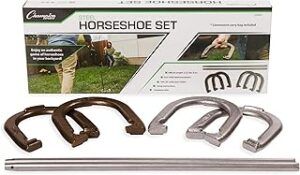
Horseshoe Game Set
Recommended Product
St. Pierre American Professional Horseshoe Set – precision-balanced, forged steel construction that delivers consistent weight and feel. Designed for both casual and competitive players, it’s a set that makes every toss feel smooth and predictable — ideal for mastering your arc, spin, and landing.
Frequently Asked Questions
Q: What’s the ideal rotation speed for a perfect ringer?
About one full rotation from your hand to the stake. That keeps the shoe stable without wobble.
Q: Should I focus on power or technique?
Technique every time. Power without control just means faster misses.
Q: Why do my shoes land flat?
You’re probably releasing too early or throwing too low an arc. Try raising your release angle slightly.
Q: Can I actually measure my arc or spin?
Yes — slow-motion video on your phone works great. You’ll see exactly how your shoe rotates and where it flattens out.
When you strip it down, the perfect ringer isn’t magic — it’s math, muscle memory, and motion working together.
You’re creating a repeatable system: consistent grip, smooth release, steady rotation, reliable arc. Once your throw becomes predictable, the game transforms. Every toss feels balanced. Every ringer feels earned.
When you learn the science, you master the art.
Tips and tricks from fellow players can be helpful, but at the end of the day, it’s about what works for you. Keep a mental note of your throws—what clicked, and what didn’t. That way, you’re not just tossing metal; you’re refining a craft.
The Connection Between Science and Experience
Throwing a horseshoe can feel like dancing with science. The more you embrace the physics behind each move, the more natural the game becomes. It’s this sweet spot where logic meets instinct that turns the ordinary into extraordinary.
Seasoned players know that understanding theory is crucial, but you can’t substitute it for hands-on practice. Every game adds to your experience, helping you sharpen your skills with every pitch. And that’s where the beauty really shines—in blending learned knowledge with personal flair.
Real life has countless stories of players who found their rhythm by harmonizing the science of the throw with their unique style. It’s about figuring out what works best for you and allowing the characteristics of physics to merge effortlessly with your natural abilities.
You don’t need to be a physicist to enjoy the perfect ringer, but understanding the journey from science to execution gives you an edge. Over time, harnessing both expertise and intuition won’t just improve your game; it’ll turn every throw into a personal achievement.