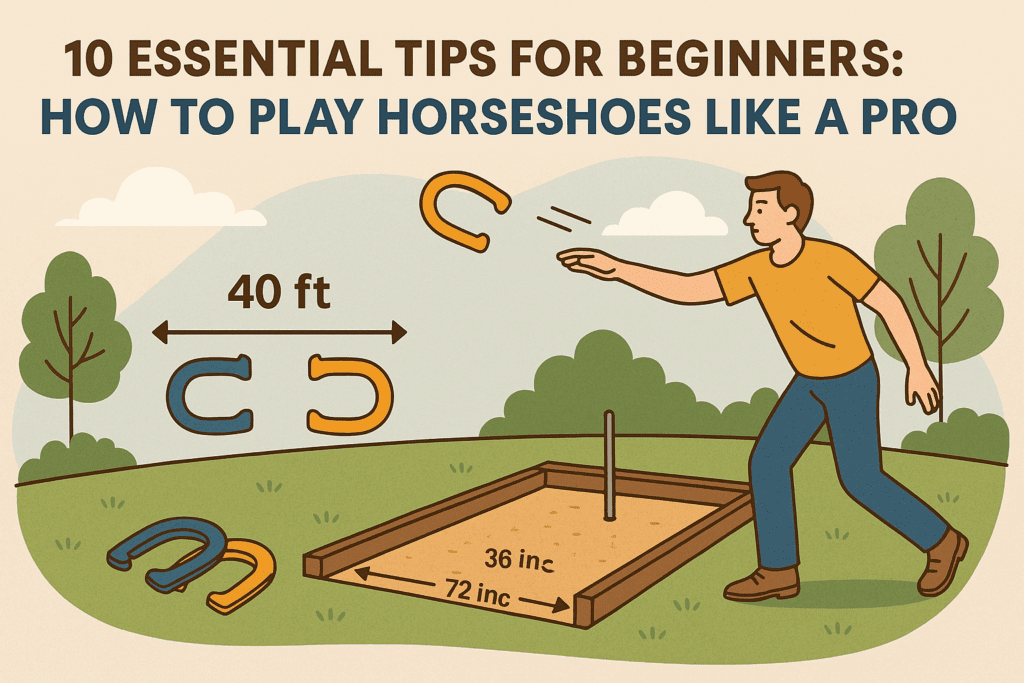
Zen and the Art of the Perfect Pitch
How slowing down might be the secret to throwing better horseshoes — and living better, too.
The Quiet Science of a Horseshoe Pitch
Ask anyone who truly loves horseshoes, and they’ll tell you the same thing: the game gets quieter the longer you play it. There’s noise around you — laughter, ribs on the grill, kids running in the yard — but the moment your hand grips that horseshoe, something shifts. Your breathing deepens. Your stance settles. And, for just a second, the backyard becomes a meditation hall.
People think horseshoes are about strength or aim. But players know the truth. Horseshoes is a mind game, a rhythm game — and, without realizing it, most players naturally drift into something close to Zen.
It’s repetition, breath, sand, steel, and silence.
It’s a game where the mind can work against you just as easily as it can guide you.
And it’s one of the few pastimes where—if you let it—your body takes over, your thoughts fade, and the perfect pitch suddenly feels effortless.
This article explores that space: the unspoken calm, the ritual, the focus, and the inner stillness behind a beautiful throw.

The Zen Mindset: Letting Go to Throw Better
Here’s the truth most players don’t talk about: gripping harder, thinking harder, or trying harder rarely helps. In fact, the more you force it, the worse you pitch.
That’s where Zen thinking comes in.
Relaxation is the real accuracy booster.
When your shoulders soften, your grip settles naturally, and you stop fighting the arc, the shoe moves the way it was meant to move. Horseshoe pitching becomes a flow rather than a task.
The Zen mindset comes down to three principles:
1. Stop forcing the pitch
Tension kills accuracy. A tight arm, hunched shoulders, or clenched fist causes jerky motion and unpredictable rotation. Loosening your grip and allowing the shoe to swing naturally brings more consistency.
2. Quiet the chatter
Overthinking creates hesitation. “Don’t overthrow this.” “Remember to rotate.” “Last one went left.”
Your brain becomes a heckler instead of a coach.
When the mind settles, the body finally does its job.
3. Presence beats perfection
A pitch happens in a few seconds. A wandering mind can sabotage that moment.
Being present — fully present — changes everything.
The best players don’t chase perfection. They drop into the moment and let the pitch happen.
The Rituals of Great Pitchers
Every great pitcher has a ritual. And whether they admit it or not, those small routines are a form of meditation.
Think about it:
- The way you place your lead foot
- The small breath before the swing
- The exact finger pressure on the sides of the shoe
- The natural sway of the arm before release
- The micro-pause before walking to the other stake
These aren’t superstitions — they’re mental anchors.
Repetition brings rhythm.
Rhythm brings calm.
Calm brings accuracy.
A chaotic throw is usually the result of a chaotic mind.
A smooth ritual builds a smooth pitch.
Finding Your Focus Point
Most new players stare hard at the stake, squinting like they’re trying to burn a hole through it. That’s not focus — that’s tension.
Zen pitching uses a softer visual approach:
Soft eyes, not tight eyes
Instead of staring at the stake like an enemy, relax your gaze.
You’re not trying to control the stake — you’re trying to connect with your motion.
Choose a target beyond the target
Some pitchers focus on:
- A shadow
- A spot on the sand
- A point slightly above the stake
These reference points allow your arm to move more naturally. You’re giving yourself something to feel, not something to fight.
Each pitch is brand new
A very Zen rule.
The previous throw is gone — good or bad.
Carrying it into the next pitch only adds weight to your shoulders.
The pit rewards presence, not memory.
Rhythm, Arc, and Energy Flow
Ask a smooth pitcher to explain their throw and they’ll say something surprisingly simple: “It just feels right.”
That “feel” is where Zen overlaps with skill.
The arc is a reflection of balance
A horseshoe’s arc should be:
- Controlled
- Even
- Relaxed
- Predictable
If your arc is chaotic, you’re forcing the motion rather than flowing with it.
Rotation happens naturally
Over-rotating the shoe is usually the result of gripping too hard or flicking your wrist.
Zen pitching allows rotation to happen as a byproduct of the swing, not from muscular effort.
Energy should flow through the arm, not get trapped
Relaxed shoulders + loose grip + smooth follow-through = clean energy transfer.
Tension interrupts the flow.
Relaxation amplifies it.
Silence, Sound, and the Ringer Moment
There’s something sacred about the quiet that hangs right before a pitch.
Your hand lifts the shoe.
Your body stills.
The air seems to hold its breath with you.
This silence is part of the ritual.
Then there’s the opposite side of Zen — the sound.
The clean, unmistakable ring of steel hitting steel.
It’s short.
Sharp.
Perfect.
Players joke that a ringer is the closest thing horseshoes has to enlightenment.
But there’s something true in that.
When everything aligns — mind, body, motion, sand, arc — the payoff is a sound that feels like the game itself, confirming you’re on the right path.
Some people meditate with bells.
Horseshoe players meditate with ringers.

How to Practice Zen Pitching at Home
You don’t need incense or a meditation cushion.
Just a pit, a horseshoe, and a willingness to slow down.
Drill 1: The Breathing Pitch
- Inhale as the shoe rises.
- Exhale as you release.
Linking breath to movement improves consistency.
Drill 2: The Silent Five
Throw five pitches without speaking, reacting, or correcting too fast.
Let your body learn on its own terms.
Drill 3: Arc Awareness
Forget accuracy for a minute.
Just throw for smoothness.
When the arc becomes stable, accuracy follows naturally.
Drill 4: Visualization
Before your first pitch of the day, picture:
- The swing
- The release
- The rotation
- The ringer
Players underestimate how much visualization improves muscle memory.
Building a Zen Pit
If you want a dedicated “Zen zone,” try:
- Soft backlighting or natural golden-hour conditions
- Clean, raked sand
- No clutter around the pit
- A quiet, predictable environment
The fewer distractions, the smoother your mind becomes.
Mindset for Competitive Calm
Competition introduces pressure — which is exactly where Zen becomes most valuable.
Stay centered between throws
Don’t let one bad pitch snowball.
Reset your body language.
Reset your breath.
Reset your intention.
Read conditions without anger
Wind?
Tree shadows?
Uneven sand?
Treat them like part of the landscape, not an enemy.
Don’t attach to the outcome
The tighter you cling to “I must hit this,” the more you sabotage yourself.
Detach from results and trust the process.
Play one throw at a time
A match may take 40–60 pitches.
But each pitch is a universe of its own.
Stay inside the one you’re holding.
Horseshoe Game Set
Lessons From the Pit That Apply to Life
Zen and horseshoes overlap in some surprising ways.
Patience
You can’t rush improvement.
You can’t rush calm.
You can’t rush a perfect pitch.
Focus
When you train your mind to stay present at the stake, presence becomes easier everywhere else.
Consistency
Little habits create big results.
A great throw is built from 100 small, repeatable movements.
Letting Go
A bad pitch is gone.
The next one hasn’t happened.
The only thing you control is the moment in front of you.
Accepting What You Can’t Control
Wind gusts happen.
Sand shifts.
Shoes bounce strangely.
Life does the same.
Zen pitching teaches you to focus on what is in your hands — not what isn’t.
FAQ
Is horseshoe pitching really meditative?
Absolutely. The repetitive motion, focus, breathing, and quiet moments all mirror traditional mindfulness practices.
Do relaxation techniques actually improve accuracy?
Yes. Tension disrupts rotation and arc. Relaxed muscles create smoother, more predictable throws.
How do I develop a smoother throwing motion?
Focus on rhythm over power. Practice slow, consistent swings until the arc stabilizes.
What’s the best way to reset after a bad pitch?
Pause. Breathe. Drop the last throw from your mind. Step into the next pitch fresh.
How do I get into a flow state while playing horseshoes?
Build a consistent pre-pitch ritual. The predictability helps your brain slide into a calm, repeatable rhythm.
Thoughts
Horseshoe pitching has always been more than a backyard pastime. It’s a lesson in patience, rhythm, breath, and calm. A perfect pitch isn’t just about mechanics — it’s about quieting the noise long enough for your body to find the motion it already knows.
When you learn to approach the game with presence and intention, horseshoes becomes something deeper. Not just a throw toward a stake, but a grounding act that brings focus, balance, and clarity into the rest of your life.
A little Zen can make your pitch better.
But the truth is, your pitch can make you better, too.